Effectiveness of GRAPPA-Assisted Head Immobilization in Enhancing Diagnostic Confidence and Interobserver Agreement in Routine Adult Brain MRI: A Prospective Paired Study
Keywords:
Brain MRI, Diagnostic confidence, GRAPPAAbstract
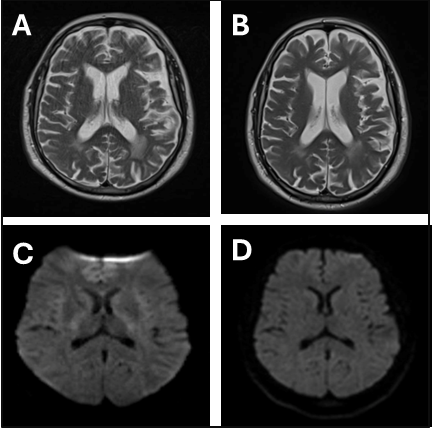
Background: Motion artifacts in brain MRI may reduce image interpretability and diagnostic confidence. Motion-reduction strategies should be evaluated using blinded radiologist assessment and interobserver agreement. Objective: To assess the effect of simple head immobilization combined with Generalized Autocalibrating Partially Parallel Acquisitions (GRAPPA) acceleration on motion artifact assessment, diagnostic confidence, and interobserver agreement in brain MRI. Methods: This prospective study included 38 adults who underwent standard and intervention diffusion-weighted imaging (DWI) and axial T2-weighted imaging during a single session. The intervention combined foam padding, forehead fixation, and GRAPPA acceleration. Two blinded radiologists assessed motion artifacts and diagnostic confidence. Results: The intervention significantly enhanced both sequences' image quality and diagnostic confidence as rated by the radiologists. In DWI, no-artifact ratings for Radiologist 1 increased from 0.0% to 55.3% and for Radiologist 2 from 5.3% to 60.5%, while very high diagnostic confidence increased from 10.5% to 63.2% and from 7.9% to 71.1% (p=0.0001). In axial T2-weighted imaging, no-artifact ratings increased from 2.6% to 63.2% and from 7.9% to 60.5%, while very high diagnostic confidence increased from 7.9% to 60.5% and from 26.3% to 73.7% (p=0.0001). These results indicate that the reduction in motion led to a clinically significant improvement in the consistency of image interpretation. Cohen's kappa for diagnostic confidence was almost perfect and remained stable in DWI (0.941 to 0.944) and increased in axial T2-weighted imaging (0.469 to 0.964). Conclusions: GRAPPA-assisted head immobilization improved image quality and diagnostic confidence in routine adult brain MRI, supporting strong diagnostic confidence and acceptable interobserver agreement.
Downloads
References
Runge VM, Richter JK, Heverhagen JT. Motion in magnetic resonance: new paradigms for improved clinical diagnosis. Invest Radiol. 2019;54(7):383-395. doi: 10.1097/RLI.0000000000000566.
Slipsager JM, Glimberg SL, Søgaard J, Paulsen RR, Johannesen HH, Martens PC, et al. Quantifying the financial savings of motion correction in brain MRI: a model-based estimate of the costs arising from patient head motion and potential savings from implementation of motion correction. J Magn Reson Imaging. 2020;52(3):731-738. doi: 10.1002/jmri.27112.
Havsteen I, Ohlhues A, Madsen KH, Nybing JD, Christensen H, Christensen A. Are movement artifacts in magnetic resonance imaging a real problem? A narrative review. Front Neurol. 2017;8:232. doi: 10.3389/fneur.2017.00232.
Hamilton J, Franson D, Seiberlich N. Recent advances in parallel imaging for MRI. Prog Nucl Magn Reson Spectrosc. 2017;101:71-95. doi: 10.1016/j.pnmrs.2017.04.002.
Sheng J, Shi Y, Zhang Q. Improved parallel magnetic resonance imaging reconstruction with multiple variable density sampling. Sci Rep. 2021;11(1):9005. doi: 10.1038/s41598-021-88567-z.
Runge VM, Richter JK, Heverhagen JT. Speed in clinical magnetic resonance. Invest Radiol. 2017;52(1):1-17. doi: 10.1097/RLI.0000000000000330.
Power JD, Silver BM, Silverman MR, Ajodan EL, Bos DJ, Jones RM. Customized head molds reduce motion during resting state fMRI scans. NeuroImage. 2019;189:141-149. doi: 10.1016/j.neuroimage.2019.01.016.
Salih S, Abdulaal O, Gameraddin M, Alhasan M, Hasaneen M. Impact of extended pre-scan written instructions on motion artifacts during head magnetic resonance imaging. J Med Life. 2022;15(9):1181-1187. doi: 10.25122/jml-2022-0133.
Dosenbach NUF, Koller JM, Earl EA, Miranda-Dominguez O, Klein RL, Van AN, et al. Real-time motion analytics during brain MRI improve data quality and reduce costs. NeuroImage. 2017;161:80-93. doi: 10.1016/j.neuroimage.2017.08.025.
Vos SB, Micallef C, Barkhof F, Hill A, Winston GP, Ourselin S, et al. Evaluation of prospective motion correction of high-resolution 3D-T2-FLAIR acquisitions in epilepsy patients. J Neuroradiol. 2018;45(6):368-373. doi: 10.1016/j.neurad.2018.02.007.
Li M, Gao Q, Yu T. Kappa statistic considerations in evaluating inter-rater reliability between two raters: which, when and context matters. BMC Cancer. 2023;23:799. doi: 10.1186/s12885-023-11325-z.
Geijer M, Båth M, Wessman C. Some common statistical methods for assessing rater agreement in radiological studies. Acta Radiol. 2025;66(6):675-683. doi: 10.1177/02841851251319666.
Park JE, Han K, Sung YS, Chung MS, Koo HJ, Yoon HM, et al. Selection and reporting of statistical methods to assess reliability of a diagnostic test: conformity to recommended methods in a peer-reviewed journal. Korean J Radiol. 2017;18(6):888-897. doi: 10.3348/kjr.2017.18.6.888.
Godenschweger F, Kägebein U, Stucht D, Yarach U, Sciarra A, Yakupov R, et al. Motion correction in MRI of the brain. Phys Med Biol. 2016;61(5):R32-R56. doi: 10.1088/0031-9155/61/5/R32.
Krause F, Benjamins C, Eck J, Lührs M, van Hoof R, Goebel R. Active head motion reduction in magnetic resonance imaging using tactile feedback. Hum Brain Mapp. 2019;40(14):4026–4037. doi: 10.1002/hbm.24683.
Jolly E, Sadhukha S, Chang LJ. Custom-molded headcases have limited efficacy in reducing head motion during naturalistic fMRI experiments. Neuroimage. 2020;222:117207. doi: 10.1016/j.neuroimage.2020.117207.
Mekiš V, Žager Marciuš V, Rogina D, Dolenc L, Mekiš N. Comparison of treatment position with mask immobilization and standard diagnostic setup in intracranial MRI radiotherapy simulation. Strahlenther Onkol. 2021;197(7):614–621. doi: 10.1007/s00066-021-01776-3.
Laib Z, Sid FA, Abed-Meraim K, Ouldali A. Estimation error bound for GRAPPA diffusion-weighted MRI. Magn Reson Imaging. 2020;74:181–194. doi: 10.1016/j.mri.2020.09.022.
Rabanillo I, Aja-Fernández S, Alberola-López C, Hernando D. Exact calculation of noise maps and g-factor in GRAPPA using a k-space analysis. IEEE Trans Med Imaging. 2018;37(2):480–490. doi: 10.1109/TMI.2017.2760921.
Aranovitch A, Haeberlin M, Gross S, Dietrich BE, Wilm BJ, Brunner DO, et al. Prospective motion correction with NMR markers using only native sequence elements. Magn Reson Med. 2018;79(4):2046–2056. doi: 10.1002/mrm.26877.
Tisdall MD, Reuter M, Qureshi A, Buckner RL, Fischl B, van der Kouwe AJW. Prospective motion correction with volumetric navigators reduces the bias and variance in brain morphometry induced by subject motion. Neuroimage. 2016;127:11–22. doi: 10.1016/j.neuroimage.2015.11.054.
Benchoufi M, Matzner-Løber E, Molinari N, Jannot AS, Soyer P. Interobserver agreement issues in radiology. Diagn Interv Imaging. 2020;101(10):639–641. doi: 10.1016/j.diii.2020.09.001.
Dettori JR, Norvell DC. Kappa and beyond: is there agreement? Glob Spine J. 2020;10(4):499–501. doi: 10.1177/2192568220911648.
Zec S, Soriani N, Comoretto R, Baldi I. High agreement and high prevalence: the paradox of Cohen’s kappa. Open Nurs J. 2017;11:211–218. doi: 10.2174/1874434601711010211.
Vanbelle S, Hernandez Engelhart C, Blix E. A comprehensive guide to study the agreement and reliability of multi-observer ordinal data. BMC Med Res Methodol. 2024;24(1):310. doi: 10.1186/s12874-024-02431-y.
Downloads
Published
How to Cite
Issue
Section
License
Copyright (c) 2026 Al-Rafidain Journal of Medical Sciences ( ISSN 2789-3219 )

This work is licensed under a Creative Commons Attribution-NonCommercial-ShareAlike 4.0 International License.
Published by Al-Rafidain University College. This is an open access journal issued under the CC BY-NC-SA 4.0 license (https://creativecommons.org/licenses/by-nc-sa/4.0/).