Comparing the Therapeutic Efficacy of Minoxidil, Dutasteride, and Microneedling in the Treatment of Androgenic Alopecia in Males
Keywords:
Androgenetic alopecia, BASP classification, Dutasteride, Hair density, Minoxidil, MicroneedlingAbstract
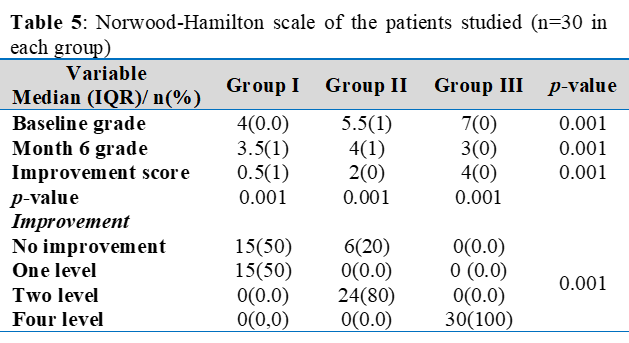
Background: Androgenetic alopecia is the most common reason for progressive hair loss in males. Currently a combination of treatment strategies for improving hair regrowth is recommended over a single treatment. Objective: To compare the therapeutic effectiveness of only 5% minoxidil (topical), 5% minoxidil (topical) plus microneedling, and 5% minoxidil (topical) plus microneedling and dutasteride (oral) in treating androgenetic alopecia in males. Methods: Our study includes 90 males; each group had 30 participants. Group I had 5% minoxidil (topical) alone, Group II had 5% minoxidil (topical) plus weekly microneedling, and Group III had 5% minoxidil (topical), weekly microneedling, and dutasteride (oral) (0.5 mg/day). The patient’s evaluation was done at baseline, the 3rd month, and the 6th month through examining clinically, digital dermoscopy, Hamilton–Norwood and Basic and Specific (BASP) classifications, hair density, hair shaft thickness, the Hair Growth Self-Assessment Scale, and patient satisfaction scores. Results: The clinical and demographic characteristics at baseline were similar between all the groups. All treatment modalities resulted in significant improvement in hair density, hair shaft thickness, Hamilton–Norwood classification, BASP classification, hair growth self-assessment, and patient satisfaction after six months (all p<0.001). However, combination therapy demonstrated significantly superior efficacy compared with topical minoxidil alone. The greatest improvements were detected in Group III; next came Group II, while Group I showed the least improvement across all efficacy outcomes. Conclusions: This multimodal approach represents a therapeutic strategy that is well-tolerated and effective in managing androgenetic alopecia in males.
Downloads
References
Ho CH, Sood T, Zito PM. Androgenetic alopecia. StatPearls Publishing; 2026. Available from: https://www.ncbi.nlm.nih.gov/books/NBK430924/
Rosenthal A, Conde G, Greco JF, Gharavi NM. Management of androgenic alopecia: a systematic review of the literature. J Cosmet Laser Ther. 2024;26(1-4):1-16. doi: 10.1080/14764172.2024.2362126.
Chen S, Li L, Ding W, Zhu Y, Zhou N. Androgenetic alopecia: an update on pathogenesis and pharmacological treatment. Drug Des Devel Ther. 2025;19:7349-7363. doi: 10.2147/DDDT.S542000.
Ding Y, Wang C, Bi L, Du Y, Lu C, Zhao M, et al. Dutasteride for the treatment of androgenetic alopecia: an updated review. Dermatology. 2024;240(5-6):833-843. doi: 10.1159/000541395.
Patel P, Nessel TA, Kumar DD. Minoxidil. StatPearls Publishing; 2026. Available from: https://www.ncbi.nlm.nih.gov/books/NBK482378/
Li G, Geng J, Liang J, Liu Y, Zhang X, Wang H. RETRACTED: Clinical efficacy and mechanisms of microneedling alone or combined with drugs in the treatment of androgenetic alopecia. J Cosmet Dermatol. 2026;25. doi: 10.1111/jocd.70726.
Pozo-Pérez L, Tornero-Esteban P, López-Bran E. Clinical and preclinical approach in AGA treatment: a review of current and new therapies in the regenerative field. Stem Cell Res Ther. 2024;15:260. doi: 10.1186/s13287-024-03801-5.
Choi GS, Sim WY, Kang H, Huh CH, Lee YW, Shantakumar S, et al. Long-term effectiveness and safety of dutasteride versus finasteride in patients with male androgenic alopecia in South Korea: a multicentre chart review study. Ann Dermatol. 2022;34(5):349-359. doi: 10.5021/ad.22.027.
Ahmed KMA, Kozaa YA, Abuawwad MT, Al-Jboori A, Mahmoud AM, Hassan MA. Evaluating the efficacy and safety of combined microneedling therapy versus topical minoxidil in androgenetic alopecia: a systematic review and meta-analysis. Arch Dermatol Res. 2025;317:528. doi: 10.1007/s00403-025-04032-1.
Norwood OT. Male pattern baldness: classification and incidence. South Med J. 1975;68(11):1359-1365. doi: 10.1097/00007611-197511000-00009.
Hamilton JB. Patterned loss of hair in man: types and incidence. Ann N Y Acad Sci. 1951;53(3):708-728. doi: 10.1111/j.1749-6632.1951.tb31971.x.
Lee WS, Ro BI, Hong SP, Bak H, Sim WY, Kim TY, et al. A new classification of pattern hair loss that is universal for men and women: basic and specific (BASP) classification. J Am Acad Dermatol. 2007;57(1):37-46. doi: 10.1016/j.jaad.2006.12.029.
Dhurat R, Sukesh M, Avhad G, Dandale A, Pal A, Pund P. A randomized evaluator blinded study of effect of microneedling in androgenetic alopecia: a pilot study. Int J Trichology. 2013;5(1):6-11. doi: 10.4103/0974-7753.114700.
Nestor MS, Ablon G, Gade A, Han H, Fischer DL. Treatment options for androgenetic alopecia: efficacy, side effects, compliance, financial considerations, and ethics. J Cosmet Dermatol. 2021;20(12):3759-3781. doi: 10.1111/jocd.14537.
Gupta AK, Venkataraman M, Talukder M, Bamimore MA. Relative efficacy of minoxidil and the 5-α reductase inhibitors in androgenetic alopecia treatment of male patients: a network meta-analysis. JAMA Dermatol. 2022;158(3):266-275. doi: 10.1001/jamadermatol.2021.5743.
Pei D, Zeng L, Huang X, Zhou Y, Tang Y, Li J, et al. Efficacy and safety of combined microneedling therapy for androgenic alopecia: a systematic review and meta-analysis of randomized clinical trials. J Cosmet Dermatol. 2024;23(5):1560-1572. doi: 10.1111/jocd.16186.
Faghihi G, Iraji F, Siadat AH, Radan M, Hosseini SM. Comparison between "5% minoxidil plus 2% flutamide" solution vs. "5% minoxidil" solution in the treatment of androgenetic alopecia. J Cosmet Dermatol. 2022;21(10):4447-4453. doi: 10.1111/jocd.14788.
Gubelin Harcha W, Barboza Martínez J, Tsai TF, Katsuoka K, Kawashima M, Tsuboi R, et al. A randomized, active- and placebo-controlled study of the efficacy and safety of different doses of dutasteride versus placebo and finasteride in the treatment of male subjects with androgenetic alopecia. J Am Acad Dermatol. 2014;70(3):489-498. doi: 10.1016/j.jaad.2013.10.049.
English RS, Ruiz S, DoAmaral P. Microneedling and its use in hair loss disorders: a systematic review. Dermatol Ther (Heidelb). 2022;12(1):41-60. doi: 10.1007/s13555-021-00653-2.
Panuganti VK, Kumar Madala P, Ramalingayya Grandhi V, Reddy C, Sharma S. A randomized, double-blind, placebo and active controlled phase II study to evaluate the safety and efficacy of novel dutasteride topical solution (0.01%, 0.02%, and 0.05% w/v) in male subjects with androgenetic alopecia. Cureus. 2025;17. doi: 10.7759/cureus.89309.
Messenger AG, Rundegren J. Minoxidil: mechanisms of action on hair growth. Br J Dermatol. 2004;150(2):186-194. doi:10.1111/j.1365-2133.2004.05785.x.
Abdi P, Awad C, Anthony MR, Chen T, Zhang H. Efficacy and safety of combinational therapy using topical minoxidil and microneedling for the treatment of androgenetic alopecia: a systematic review and meta-analysis. Arch Dermatol Res. 2023;315(9):2775-2785. doi: 10.1007/s00403-023-02688-1.
Abu Obeid MN, Abdel Fattah NS, Elfangary MM, Al Husseni RM. Comparison between topical minoxidil 5% alone versus combined with dutasteride (topical 0.02% through microneedling or oral 0.5 mg) in treatment of androgenetic alopecia. QJM. 2024;117(Suppl 1). doi: 10.1093/qjmed/hcae175.207.
Gupta AK, Wang T, Bamimore MA, Ardekani A. Relative effects of minoxidil 5%, platelet-rich plasma, and microneedling in pattern hair loss: a systematic review and network meta-analysis. Skin Appendage Disord. 2023;9(6):397-406. doi: 10.1159/000534196.
Ahmed K, Abuawwad MT, Kozaa Y, Hassan M, Ali A. P06 Evaluating the efficacy and safety of combined microneedling therapy vs. topical minoxidil in androgenetic alopecia: a systematic review and meta-analysis of randomized controlled trials. Br J Dermatol. 2026;194(Suppl 1). doi: 10.1093/bjd/ljaf429.034.
Gupta AK, Charrette A. The efficacy and safety of 5α-reductase inhibitors in androgenetic alopecia: a network meta-analysis and benefit-risk assessment of finasteride and dutasteride. J Dermatolog Treat. 2014;25(2):156-161. doi: 10.3109/09546634.2013.813011.
Kelly Y, Blanco A, Tosti A. Androgenetic alopecia: an update of treatment options. Drugs. 2016;76(14):1349-1364. doi: 10.1007/s40265-016-0629-5.
Published
How to Cite
Issue
Section
License
Copyright (c) 2026 Al-Rafidain Journal of Medical Sciences ( ISSN 2789-3219 )

This work is licensed under a Creative Commons Attribution-NonCommercial-ShareAlike 4.0 International License.
Published by Al-Rafidain University College. This is an open access journal issued under the CC BY-NC-SA 4.0 license (https://creativecommons.org/licenses/by-nc-sa/4.0/).