Synergistic Cytotoxic and Clonogenic Effects of Paclitaxel and Allicin in MDA-MB-231 Triple-Negative Breast Cancer Cells
DOI:
https://doi.org/10.54133/ajms.v11i2.3168Keywords:
Allicin, Chou–Talalay, Colony formation, Drug synergy, Paclitaxel, Triple-negative breast cancerAbstract
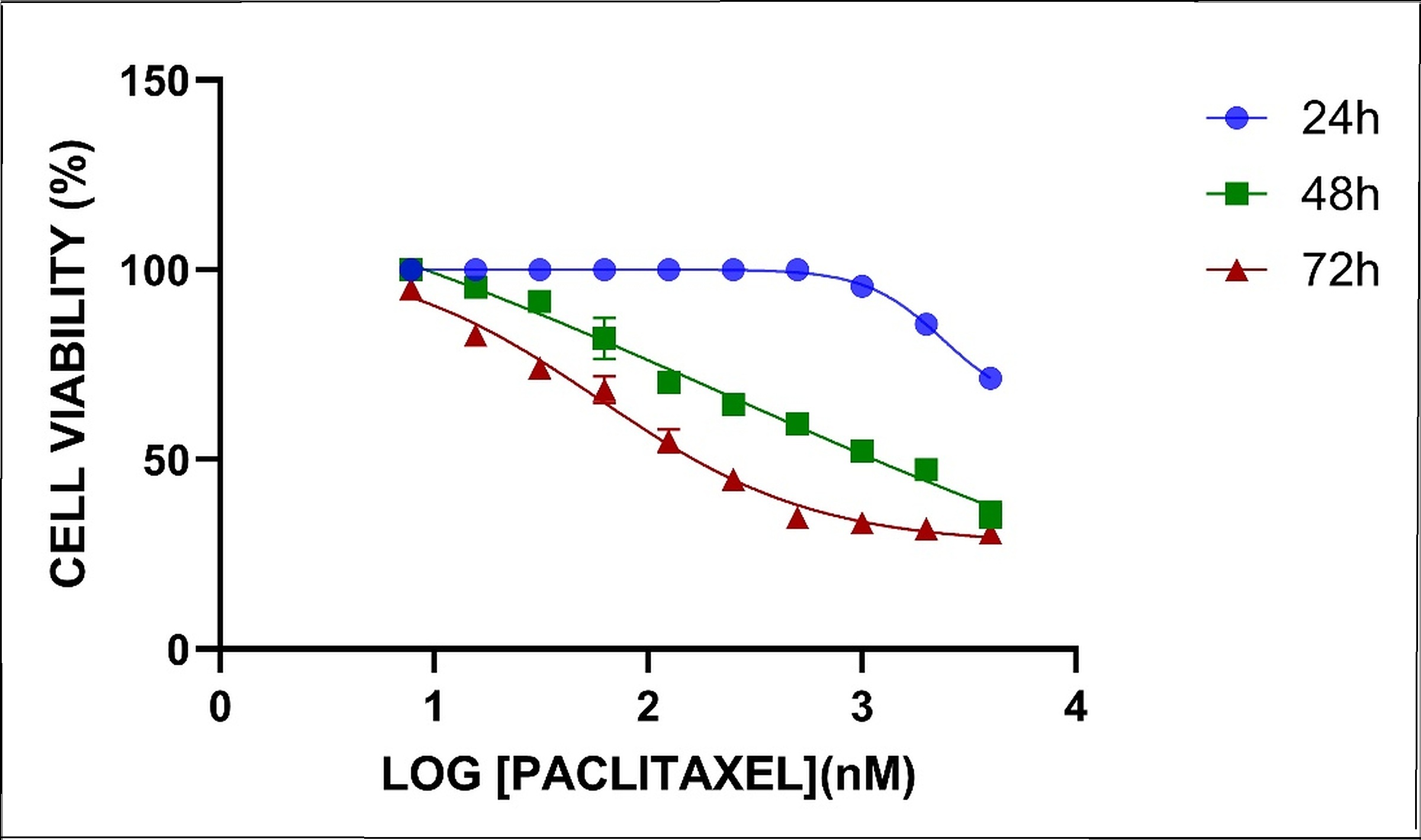
Background: Triple-negative breast cancer (TNBC) lacks validated molecular targets and relies on cytotoxic chemotherapy limited by toxicity. Combining paclitaxel with the redox-active garlic compound allicin may permit dose reduction while preserving activity. Objective: To define the in vitro cytotoxic profiles of paclitaxel and allicin, quantify their interaction, and assess the durability of the effect in MDA-MB-231 cells. Methods: Cytotoxicity was measured by MTT assay after 24, 48, and 72 h, and IC50 values were derived by non-linear regression. The interaction was quantified by the combination index (CI) and dose-reduction index (DRI) using the Chou–Talalay method (CompuSyn). Long-term viability was assessed by colony formation. Results: The 72-h IC50 values were 60 nM (paclitaxel) and 170 µM (allicin). The interaction was effect-dependent: synergism (CI<1.0) occurred at low-to-intermediate effect levels (CI=0.649, 0.776, and 0.880 at fractions affected of 0.452, 0.650, and 0.820), with antagonism at higher levels (CI=1.062 and 1.249). The DRI exceeded unity for both agents across the synergistic range (up to 2.82-fold for paclitaxel and 3.39-fold for allicin). In the colony assay, the combination gave the lowest surviving fraction (0.3094 vs. paclitaxel and 0.5353 for allicin; p<0.0001). Conclusions: In MDA-MB-231 cells, paclitaxel and allicin act synergistically at low-to-intermediate effect levels and durably suppress clonogenic survival in vitro, supporting further mechanistic evaluation of allicin as a potential dose-sparing adjunct to paclitaxel in this model.
Downloads
References
Bray F, Laversanne M, Sung H, Ferlay J, Siegel RL, Soerjomataram I, et al. Global cancer statistics 2022: GLOBOCAN estimates of incidence and mortality worldwide for 36 cancers in 185 countries. CA Cancer J Clin. 2024;74(3):229-263. doi: 10.3322/caac.21834.
Almansour NM. Triple-negative breast cancer: a brief review about epidemiology, risk factors, signaling pathways, treatment and role of artificial intelligence. Front Mol Biosci. 2022;9:836417. doi: 10.3389/fmolb.2022.836417.
Zagami P, Carey LA. Triple negative breast cancer: pitfalls and progress. NPJ Breast Cancer. 2022;8(1):95. doi: 10.1038/s41523-022-00468-0.
Bianchini G, De Angelis C, Licata L, Gianni L. Treatment landscape of triple-negative breast cancer - expanded options, evolving needs. Nat Rev Clin Oncol. 2022;19(2):91-113. doi: 10.1038/s41571-021-00565-2.
Obidiro O, Battogtokh G, Akala EO. Triple negative breast cancer treatment options and limitations: future outlook. Pharmaceutics. 2023;15(7):1796. doi: 10.3390/pharmaceutics15071796.
Chavez KJ, Garimella SV, Lipkowitz S. Triple negative breast cancer cell lines: one tool in the search for better treatment of triple negative breast cancer. Breast Dis. 2010;32(1-2):35-48. doi: 10.3233/BD-2010-0307.
Weaver BA. How Taxol/paclitaxel kills cancer cells. Mol Biol Cell. 2014;25(18):2677-2681. doi: 10.1091/mbc.E14-04-0916.
Abouzeid HA, Kassem L, Liu X, Abuelhana A. Paclitaxel resistance in breast cancer: current challenges and recent advanced therapeutic strategies. Cancer Treat Res Commun. 2025;43:100918. doi: 10.1016/j.ctarc.2025.100918.
Chou TC. Drug combination studies and their synergy quantification using the Chou-Talalay method. Cancer Res. 2010;70(2):440-446. doi: 10.1158/0008-5472.CAN-09-1947.
Talib WH, Awajan D, Hamed RA, Azzam AO, Mahmod AI, Al-Yasari IH. Combination anticancer therapies using selected phytochemicals. Molecules. 2022;27(17):5452. doi: 10.3390/molecules27175452.
Chou TC. Theoretical basis, experimental design, and computerized simulation of synergism and antagonism in drug combination studies. Pharmacol Rev. 2006;58(3):621-681. doi: 10.1124/pr.58.3.10.
Catanzaro E, Canistro D, Pellicioni V, Vivarelli F, Fimognari C. Anticancer potential of allicin: a review. Pharmacol Res. 2022;177:106118. doi: 10.1016/j.phrs.2022.106118.
Borlinghaus J, Albrecht F, Gruhlke MC, Nwachukwu ID, Slusarenko AJ. Allicin: chemistry and biological properties. Molecules. 2014;19(8):12591-12618. doi: 10.3390/molecules190812591.
Bhuker S, Kaur A, Rajauria K, Tuli HS, Saini AK, Saini RV, et al. Allicin: a promising modulator of apoptosis and survival signaling in cancer. Med Oncol. 2024;41(9):210. doi: 10.1007/s12032-024-02459-6.
Pandey P, Khan F, Alshammari N, Saeed A, Aqil F, Saeed M. Updates on the anticancer potential of garlic organosulfur compounds and their nanoformulations: plant therapeutics in cancer management. Front Pharmacol. 2023;14:1154034. doi: 10.3389/fphar.2023.1154034.
Talib WH, Atawneh S, Shakhatreh AN, Hamed RA, Al-Yasari IH. Anticancer potential of garlic bioactive constituents: allicin, Z-ajoene, and organosulfur compounds. Pharmacia. 2024;71:1-23. doi: 10.3897/pharmacia.71.e114556.
Khan MA, Sundaram MK, Hamza A, Quraishi U, Gunasekera D, Ramesh L, et al. Phytochemicals in combination with chemotherapy for breast cancer: a review of synergistic anticancer mechanisms. Pharmaceuticals (Basel). 2023;16(8):1135. doi: 10.3390/ph16081135.
Franken NA, Rodermond HM, Stap J, Haveman J, van Bree C. Clonogenic assay of cells in vitro. Nat Protoc. 2006;1(5):2315-2319. doi: 10.1038/nprot.2006.339.
Ghasemi M, Turnbull T, Sebastian S, Kempson I. The MTT assay: utility, limitations, pitfalls, and interpretation in bulk and single-cell analysis. Int J Mol Sci. 2021;22(23):12827. doi: 10.3390/ijms222312827.
Maddheshiya S, Ahmad A, Ahmad W, Zakaria M, Sharma PK. Echinacea angustifolia extract induces apoptosis and cell cycle arrest and synergizes with paclitaxel in MDA-MB-231 and MCF-7 human breast cancer cell lines. Nutr Cancer. 2021;73(11-12):2287-2305. doi: 10.1080/01635581.2020.1817956.
Yilmaz G, Ozdemir F. Novel anti-tumor strategy for breast cancer: synergistic role of oleuropein with paclitaxel therapeutic in MCF-7 cells. Anticancer Agents Med Chem. 2024;24(3):224-234. doi: 10.2174/0118715206284107231120063630.
Tamanna S, Perumal E, Rajanathadurai J. Enhanced apoptotic effects in MDA-MB-231 triple-negative breast cancer cells through a synergistic action of luteolin and paclitaxel. Cureus. 2024;16(7):e65159. doi: 10.7759/cureus.65159.
Downloads
Published
How to Cite
Issue
Section
License
Copyright (c) 2026 Al-Rafidain Journal of Medical Sciences ( ISSN 2789-3219 )

This work is licensed under a Creative Commons Attribution-NonCommercial-ShareAlike 4.0 International License.
Published by Al-Rafidain University College. This is an open access journal issued under the CC BY-NC-SA 4.0 license (https://creativecommons.org/licenses/by-nc-sa/4.0/).