Assessment of P53 and E-cadherin Immunohistochemical Expression in Endometrial Hyperplasia and Endometrial Carcinoma: A Comparative Clinicopathological Study
DOI:
https://doi.org/10.54133/ajms.v11i2.3302الكلمات المفتاحية:
Endometrial Neoplasm، Endometrial Hyperplasia، E-cadherin، Immunohistochemistry، P53الملخص
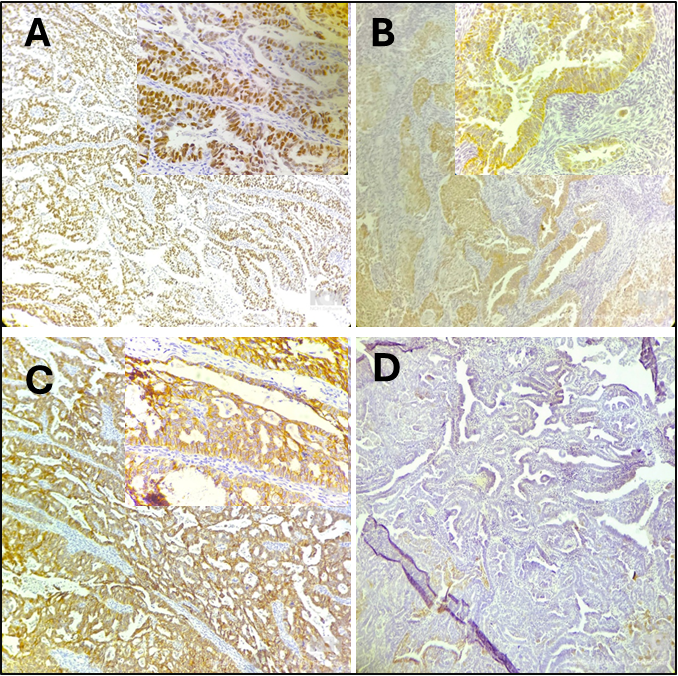
Background: Diverse molecular mutations have been implicated in the pathogenesis of endometrial carcinoma. P53 and E-cadherin are among them and may have a role in the conversion of endometrial hyperplasia to endometrial carcinoma. Objective: to detect the frequency of P53 and E-cadherin expression in endometrial hyperplasia and carcinoma and to study their association with variable clinicopathological parameters in endometrial carcinoma. Methods: In this retrospective and prospective case series study, 20 cases of endometrial hyperplasia without atypia and 52 cases of primary endometrial cancer were included. Formalin-fixed, paraffin-embedded blocks of these cases were collected from Kirkuk General Hospital, Azady Teaching Hospital, and private laboratories in Kirkuk and Mosul cities. Results: In endometrial carcinoma, P53 mutant-type and E-cadherin downregulation were detected in 40.4% and 53.8%, respectively, while in endometrial hyperplasia, they were 20% and 15%, respectively. Mutant P53 expression pattern was significantly related to tumor grade, metastasis, and stage; E-cadherin downregulation was significantly associated with lymphovascular invasion, metastasis, and stage. Conclusions: There was a significant difference in the expression of E-cadherin between endometrial hyperplasia and endometrial carcinoma; downregulation of this marker in endometrial hyperplasia cases may predict a higher risk of these cases changing into cancer. In endometrial carcinoma, P53 mutation and E-cadherin downregulation can be used as supportive biomarkers to identify a subgroup of patients with aggressive behavior and poor prognosis, and P53 appeared as a better predictor than E-cadherin for metastasis and stage.
التنزيلات
المراجع
Wolff K, Gumin D, Abu Shqara R, Sharon A, Sgayer I, Lowenstein L, et al. Risk factors and predictive modeling for occult endometrial cancer in women with atypical hyperplasia: a retrospective study. Arch Gynecol Obstet. 2026;313:67. doi: 10.1007/s00404-026-08329-y.
Kumar V, Abbas AK, Aster JC, Deyrup AT. (Editors). Robbins and Kumar Basic Pathology, (11th ed.), Philadelphia (PA): Elsevier; 2022. Chapter 17:610-612.
Kunchy AK, Guguloth A, Sunethri P. Expression of P53 and E-cadherin in endometrial carcinoma and its histopathological correlation. Int J Acad Med Pharm. 2025;7(1):366-370. doi: 10.47009/jamp.2025.7.1.69.
Vermij L, Léon-Castillo A, Singh N, Powell ME, Edmondson RJ, Genestie C, et al. P53 immunohistochemistry in endometrial cancer: clinical and molecular correlates in the PORTEC-3 trial. Modern Pathol. 2022;35(10):1475-1483. doi: 10.1038/s41379-022-01102-x.
Jayaraman MR, Niveditha EN, Lakshmipriya V, Harikrishnan V. A retrospective study on the expression of E-cadherin in endometrial carcinoma. Cureus. 2024;16(10):e70767. doi: 10.7759/cureus.70767.
Yadav S, Makkar A, Agarwal P, Singh U, Singh US, Goel MM. Immunohistochemical expression of E-cadherin and N-cadherin in endometrioid endometrial carcinoma and its precursor lesions. Clin Epidemiol Glob Health. 2023;21:101296. doi: 10.1016/j.cegh.2023.101296.
Jayaraman MR, Niveditha EN, Harikrishnan V. Expression of E-cadherin in hyperplastic endometrium: A retrospective analysis. Cureus. 2024;16(7):e65225. doi: 10.7759/cureus.65225.
Yasuda M. New clinicopathological concept of endometrial carcinoma with integration of histological features and molecular profiles. Pathol Int. 2024;74(10):557–573. doi:10.1111/pin.13471.
Chang YW, Kuo HL, Chen TC, Chen J, Lim L, Wang KL, et al. Abnormal P53 expression is associated with poor outcomes in grade I or II, stage I, endometrioid carcinoma: a retrospective single-institute study. J Gynecol Oncol. 2024;35(6):e78. doi: 10.3802/jgo.2024.35.e78.
Lizawati RH, Nur Maya Sabrina TL, Muhammad Fakhri MS, Azmawati MN, Nordashima AS. Correlation of E-cadherin expression in endometrial carcinoma with tumour grade and stage. IIUM Med J Malays. 2021;20(3). doi: 10.31436/imjm.v20i3.1737.
Liang X, Daikoku T, Terakawa J, Ogawa Y, Joshi AR, Ellenson LH, et al. The uterine epithelial loss of Pten is inefficient to induce endometrial cancer with intact stromal Pten. PloS Genetics. 2018;14(8):e1007630. doi: 10.1371/journal.pgen.1007630.
Ahmed NY, Isaac RH. P53 expression in endometrial hyperplasia and endometrial carcinoma. Zanco J Med Sci. 2010;14(2):28-34. doi: 10.15218/zjms.2010.019.
Swami RM, Lakhe R, Doshi P, Karandikar MN, Nimbargi R, Mani NS. Immunohistochemical study of ER, PR, P53 and Ki67 expression in patients with endometrial adenocarcinoma and atypical endometrial hyperplasia. IP Arch Cytol Histopathol Res. 2020;5(4):274-279. doi: 10.18231/j.achr.2020.060.
Tresa A, Sambasivan S, Rema P, Dinesh D, Sivaranjith J, Nair SP, et al. Clinical profile and survival outcome of endometrial cancer with P53 mutation. Indian J Surg Oncol. 2022;13(3):580-586. doi: 10.1007/s13193-022-01523-9.
Acat S, Celik ZE, Guler AH, Celik C. Prognostic importance of PTEN, P53, and MDM2 expressions in endometrioid and serous-type endometrial carcinomas. Med Rec. 2024;6(3):528-536. doi: 10.37990/medr.1486449.
Stavropoulos A, Varras M, Vasilakaki T, Varra VK, Tsavari A, Varra FN, et al. Expression of P53 and PTEN in human primary endometrial carcinomas: Clinicopathological and immunohistochemical analysis and study of their concomitant expression. Oncol Lett. 2019;17(5):4575-4589. doi: 10.3892/ol.2019.10093.
Opric D, Suskic A, Halilovic-Suskic SH, Nikolic G, Filipovic I. Value of P53 and estrogen receptors immunohistochemical staining in endometrial carcinoma. Int J Reprod Contracept Obstet Gynecol. 2019;8(12):4885-4890. doi: 10.18203/2320-1770.ijrcog20195339.
Sunita BS, Sen A, Suhag V. To evaluate immunoreactivity of cyclooxygenase-2 in cases of endometrial carcinoma and correlate it with expression of P53 and vascular endothelial growth factor. J Cancer Res Ther. 2018;14(6):1366-1372. doi: 10.4103/0973-1482.202890.
Carico E, Atlante M, Giarnieri E, Raffa S, Bucci B, Giovagnoli MR et al. E-cadherin and alpha-catenin expression in normal, hyperplastic and neoplastic endometrium. Anticancer Res. 2010;30(12):4993-4998.
Koyuncuoglu M, Okyay E, Saatli B, Olgan S, Akin M, Saygili U. Tumor budding and E-cadherin expression in endometrial carcinoma: Are they prognostic factors in endometrial cancer? Gynecol Oncol. 2012;125(1):208-213. doi: 10.1016/j.ygyno.2011.12.433.
Lewczuk Ł, Pryczynicz A, Guzińska-Ustymowicz K. Expression level of E-, N- and P-cadherin proteins in endometrial cancer. Oncol Lett. 2021;21(4):261. doi: 10.3892/ol.2021.12522.
Ahmed ARH, Muhammad EMS. E-cadherin and CD10 expression in atypical hyperplastic and malignant endometrial lesions. J Egypt Natl Canc Inst. 2014;26(4):211-217. doi: 10.1016/j.jnci.2014.08.002.
التنزيلات
منشور
كيفية الاقتباس
إصدار
القسم
الرخصة
الحقوق الفكرية (c) 2026 Al-Rafidain Journal of Medical Sciences

هذا العمل مرخص بموجب Creative Commons Attribution-NonCommercial-ShareAlike 4.0 International License.
Published by Al-Rafidain University College. This is an open access journal issued under the CC BY-NC-SA 4.0 license (https://creativecommons.org/licenses/by-nc-sa/4.0/).