Correlation between Oocyte Morphology and Developmental Stages for Human Oocytes that Failed to Cleave after Intracytoplasmic Sperm Injection
DOI:
https://doi.org/10.54133/ajms.v11i1.3078Keywords:
Developmental stage, Fertilization failure , Meiotic spindle , OocyteAbstract
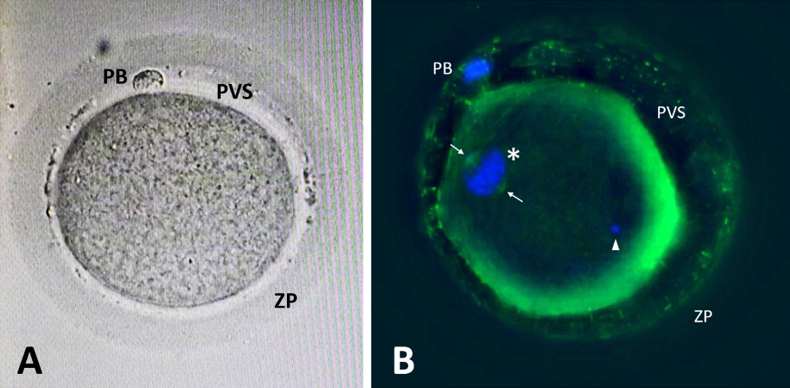
Background: In the context of intracytoplasmic sperm injection (ICSI), oocyte maturity is estimated by the oocyte's appearance only, which may not reflect its actual maturity. Objectives: This study aims to compare the morphology of oocytes that failed to cleave after ICSI with the developmental status at which they were arrested. Methods: Human oocytes that failed to cleave after ICSI were collected from in vitro fertilization cycles. Oocytes were examined and photographed under a light microscope for morphological study, then immunostained to visualize the chromatin material (of the oocyte and the injected sperm) and the meiotic spindle. The morphologic features were compared with the oocyte developmental stage to identify any possible correlation. Results: 193 failed oocytes were collected, of which 182 were successfully immunostained and analyzed. Oocyte measurements did not differ significantly in relation to the developmental stage. Fine oocyte cytoplasmic granulation was connected with better oocyte maturity; dispersed granulation was connected with lower maturity levels, while central granulation was connected with the lowest oocyte maturity. A single polar body was significantly associated with early oocyte developmental stages, while two polar bodies were significantly associated with later developmental stages. Meiotic spindles were confined to metaphase-II oocytes. Oocyte morphology and measurements had no relation to the degree of sperm chromatin condensation. Conclusions: For the oocytes that fail ICSI, morphology correlates with the developmental stages. Fine cytoplasmic granulation is connected with better oocyte maturity, while dispersed and central granulation patterns are connected with lower maturity.
Downloads
References
Holubcová Z, Kyjovská D, Martonová M, Páralová D, Klenková T, Kloudová S. Human egg maturity assessment and its clinical application. J Vis Exp. 2019;(150). doi: 10.3791/60058. DOI: https://doi.org/10.3791/60058
Tomari H, Honjo K, Kunitake K, Aramaki N, Kuhara S, Hidaka N, et al. Meiotic spindle size is a strong indicator of human oocyte quality. Reprod Med Biol. 2018;17(3):268-274. doi: 10.1002/rmb2.12100. DOI: https://doi.org/10.1002/rmb2.12100
Halim B, Putri Lubis H, Adenin I, Angellee J, Samoedra RS. Meiotic spindle view improves the outcome of IVF in poor responders: a retrospective analytical study from an Indonesian IVF center. JBRA Assist Reprod. 2024;28(1):39–46. doi: 10.5935/1518-0557.20240006. DOI: https://doi.org/10.5935/1518-0557.20240006
Alwaeli AM, Al-Khalisy MH, Almarayaty SS. Developmental status of human oocytes that fail to cleave after intracytoplasmic sperm injection. Al-Rafidain J Med Sci. 2025;9(1):255-262. doi: 10.54133/ajms.v9i1.2276. DOI: https://doi.org/10.54133/ajms.v9i1.2276
Rienzi L, Balaban B, Ebner T, Mandelbaum J. The Oocyte, In: Atlas of human embryology: from oocytes to preimplantation embryos. European Society of Human Reproduction and Embryology, 2015.
Rienzi L, Gentile R, Innocenti F, Cimadomo D, Vaiarelli A, Ubaldi FM. Oocyte retrieval and selection”. In textbook of assisted reproductive techniques, (Sixth Edition), Laboratory Perspectives, edited by David K Gardner, Ariel Weissman, Colin M Howles, and Zeef Shoham, CRC Press, Taylor and Francis group, 2024, p94-p102. DOI: https://doi.org/10.1201/9781003268598-9
Kahraman S, Yakin K, Donmez E, Samli H, Bahce M, Cengis G, et al. Relationship between granular cytoplasm of oocytes and pregnancy outcome following intracytoplasmic sperm injection. Hum. Reprod. 2000;15(11):2390-2393. doi: 10.1093/humrep/15.11.2390. DOI: https://doi.org/10.1093/humrep/15.11.2390
Rienzi L, Ubaldi F, Iacobelli M, Romano S, Minasi MG, Ferrero S, et al. Significance of morphological attributes of the early embryo. Reprod Biomed Online. 2005;10(5):669-681. doi: 10.1016/s1472-6483(10)61676-8. DOI: https://doi.org/10.1016/S1472-6483(10)61676-8
Esfandiari N, Burjaq H, Gotlieb L, Casper RF. Brown oocytes: implications for assisted reproductive technology. Fertil Steril. 2006;86(5):1522-5. doi: 10.1016/j.fertnstert.2006.03.056. DOI: https://doi.org/10.1016/j.fertnstert.2006.03.056
Otsuki J, Okada A, Morimoto K, Nagai Y, Kubo H. The relationship between pregnancy outcome and smooth endoplasmic reticulum clusters in MII human oocytes. Hum Reprod. 2004;19(7):1591-1597. doi: 10.1093/humrep/deh258. DOI: https://doi.org/10.1093/humrep/deh258
Ebner T, Moser M, Tews G. Is oocyte morphology prognostic of embryo developmental potential after ICSI? Reprod Biomed Online. 2006;12:507–512. doi: 10.1016/s1472-6483(10)62006-8. DOI: https://doi.org/10.1016/S1472-6483(10)62006-8
Fancsovits P, Murber A, Gilán ZT, János Rigó Jr, Urbancsek J. Human oocytes containing large cytoplasmic vacuoles can result in pregnancy and viable offspring. Reprod Biomed Online. 2011;23(4):513-516. doi: 10.1016/j.rbmo.2011.06.008. DOI: https://doi.org/10.1016/j.rbmo.2011.06.008
Balaban B, Urman B. Effect of oocyte morphology on embryo development and implantation. Reprod Biomed Online. 2006;12:608–615. doi: 10.1016/s1472-6483(10)61187-x.
Rienzi L, Ubaldi FM, Iacobelli M, Minasi MG, Romano S, Ferrero S, et al. Significance of metaphase II human oocyte morphology on ICSI outcome. Fertil Steril. 2008;90(5):1692-1700. doi: 10.1016/j.fertnstert.2007.09.024. DOI: https://doi.org/10.1016/j.fertnstert.2007.09.024
Wilding M, Di Matteo L, D'Andretti S, Montanaro N, Capobianco C, Dale B. An oocyte score for use in assisted reproduction. J Assist Reprod Genet. 2007;24(8):350-358. doi: 10.1007/s10815-007-9143-8. DOI: https://doi.org/10.1007/s10815-007-9143-8
Hu J, Molinari E, Darmon S, Zhang L, Patrizio P, Barad DH, et al. Predictive value of cytoplasmic granulation patterns during in vitro fertilization in metaphase II oocytes: Part I, poor-prognosis patients. Fertil Steril. 2021;116(2):431-443. doi: 10.1016/j.fertnstert.2021.02.022. DOI: https://doi.org/10.1016/j.fertnstert.2021.02.022
Gupta A, Varghese AC, Ashraf MC, Binoy D. Oocyte central granularity and its relation to pregnancy outcome following intracytoplasmic sperm injection-freeze-all cycles. Int J Reprod Contracept Obstet Gynecol. 2022;11(9):2416-2419. doi: 10.18203/2320-1770.ijrcog20222303. DOI: https://doi.org/10.18203/2320-1770.ijrcog20222303
Yi XF, Xi HL, Zhang SL, Yang J. Relationship between the positions of cytoplasmic granulation and the oocytes developmental potential in human. Sci Rep. 2019;10(9):7215. doi: 10.1038/s41598-019-43757-8. DOI: https://doi.org/10.1038/s41598-019-43757-8
Balaban B, Urman B. Effect of oocyte morphology on embryo development and implantation. Reprod Biomed Online. 2006;12:608–615. doi: 10.1016/s1472-6483(10)61187-x. DOI: https://doi.org/10.1016/S1472-6483(10)61187-X
Ciotti PM, Notarangelo L, Morselli-Labate AM, Felletti V, Porcu E, Venturoli S. First polar body morphology before ICSI is not related to embryo quality or pregnancy rate. Hum Reprod. 2004;19(10):2334-2339. doi: 10.1093/humrep/deh433. DOI: https://doi.org/10.1093/humrep/deh433
De Santis L, Cino I, Rabellotti E. Polar body morphology and spindle imaging as predictors of oocyte quality. Reprod Biomed Online. 2005;11:36–42. doi: 10.1016/s1472-6483(10)61296-5. DOI: https://doi.org/10.1016/S1472-6483(10)61296-5
Verlinsky Y, Lerner S, Illkevitch N, Kuznetsov V, Kuznetsov I, Cieslak J, et al. Is there any predictive value of first polar body morphology for embryo genotype or developmental potential? Reprod Biomed Online. 2003;7(3):336-341. doi: 10.1016/s1472-6483(10)61874-3. DOI: https://doi.org/10.1016/S1472-6483(10)61874-3
Ten J, Mendiola J, Vioque J, de Juan J, Bernabeu R. Donor oocyte dysmorphisms and their influence on fertilization and embryo quality. Reprod Biomed Online. 2007;14(1):40-48. doi: 10.1016/s1472-6483(10)60762-6. DOI: https://doi.org/10.1016/S1472-6483(10)60762-6
De los Reyes M, Palomino J, Parraguez VH, Vergara J. Sperm nuclear decondensation induction capacity of in vitro and in vivo matured canine oocytes. Reprod Dom Anim. 2012;47(6):98–101. doi: 10.1111/rda.12013. DOI: https://doi.org/10.1111/rda.12013
Pardinas ML, de Celis C, Gil J, Ortega-Jaen D, Martin A, Mercader A, et al. Oocyte-mediated repair of sperm DNA fragmentation: a critical determinant of embryo viability. Reprod Biomed Online. 2026;52(2):105165. doi: 10.1016/j.rbmo.2025.105165. DOI: https://doi.org/10.1016/j.rbmo.2025.105165
Granot I, Dekel N. Preparation and evaluation of oocytes for intracytoplasmic sperm injection. In: Gardner DK, Weissman A, Howles CM, Shoham Z, (Editors), Textbook of assisted reproductive techniques, (Sixth Edition), Laboratory Perspectives, CRC Press, Taylor and Francis group, 2024. p94-p102. DOI: https://doi.org/10.1201/9781003268598-10
Downloads
Published
How to Cite
Issue
Section
License
Copyright (c) 2026 Al-Rafidain Journal of Medical Sciences ( ISSN 2789-3219 )

This work is licensed under a Creative Commons Attribution-NonCommercial-ShareAlike 4.0 International License.
Published by Al-Rafidain University College. This is an open access journal issued under the CC BY-NC-SA 4.0 license (https://creativecommons.org/licenses/by-nc-sa/4.0/).