Non-linear Burnout Trajectory and Academic Motivation Across Training Stages in Obstetrics and Gynecology Residency
Keywords:
Burnout, Motivation, Obstetrics-Gynecology, ResidencyAbstract
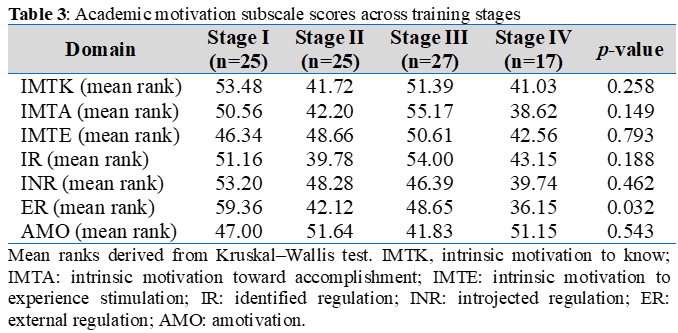
Background: Burnout is prevalent among postgraduate medical trainees, yet stage-stratified data in obstetrics and gynecology (Ob-Gyn) residency remain sparse. The relationship between burnout domains and academic motivation has not been examined in this population. Objectives: To map burnout prevalence and domain severity across four stages of an Ob-Gyn residency program and examine associations between burnout domains and academic motivation subtypes. Methods: This cross-sectional study enrolled 94 Ob-Gyn residents (semesters 2–9) from the Faculty of Medicine, Universitas Airlangga, undergoing clinical training at a major tertiary teaching hospital in Surabaya, Indonesia. Instruments included the Maslach-Trisni Burnout Inventory and Academic Motivation Scale. Results: Overall burnout prevalence was 25.5%, varying markedly across stages: 44.0% (Stage I), 28.0% (Stage II), 7.4% (Stage III), and 23.5% (Stage IV) (p=0.026), forming a non-linear, U-shaped trajectory. Stage I exhibited significantly higher emotional exhaustion than Stage III (p=0.033). Personal accomplishment (PA) positively correlated with all intrinsic motivation subtypes and introjected/identified regulation and negatively with amotivation (p<0.05). External regulation declined from Stage I to IV (p=0.032), independently of burnout. Conclusions: Burnout concentrates at early and late training stages rather than accumulating uniformly. PA co-occurs with autonomous motivation, suggesting a protective resource-like role. Stage-specific interventions and reinforcement of residents’ clinical competence are warranted.
Downloads
References
Maslach C, Leiter MP. Understanding the burnout experience: recent research and its implications for psychiatry. World Psychiatry. 2016;15(2):103-111. doi: 10.1002/wps.20311.
Durand-Moreau QV. Is burn-out finally a disease or not? Occup Environ Med. 2019;76(12):938. doi: 10.1136/oemed-2019-106094.
Low ZX, Yeo KA, Sharma VK, Filippov G, McEwan PD, Ho NTW, et al. Prevalence of burnout in medical and surgical residents: a meta-analysis. Int J Environ Res Public Health. 2019;16(9):1479. doi: 10.3390/ijerph16091479.
Moradi Y, Baradaran HR, Yazdandoost M, Atrak S, Kashanian M. Prevalence of burnout in residents of obstetrics and gynecology: a systematic review and meta-analysis. Med J Islam Repub Iran. 2015;29:235.
Szcześniewska S, Zaręba K, Zgliczyński WS, Ciebiera M, Feduniw S. Occupational burnout among obstetrics and gynaecology residents: a systematic review. Front Public Health. 2025;13:1666659. doi: 10.3389/fpubh.2025.1666659.
West CP, Dyrbye LN, Shanafelt TD. Physician burnout: contributors, consequences and solutions. J Intern Med. 2018;283(6):516-529. doi: 10.1111/joim.12752.
Bourne T, Shah H, Falconieri N, Timmerman D, Lees C, Wright A, et al. Burnout, well-being and defensive medical practice among obstetricians and gynaecologists in the UK: cross-sectional survey study. BMJ Open. 2019;9(11):e030968. doi: 10.1136/bmjopen-2019-030968.
Al-Ma’mari NO, Naimi AI, Tulandi T. Prevalence and predictors of burnout among obstetrics and gynecology residents in Canada. Gynecol Surg. 2016;13(4):323-327. doi:10.1007/s10397-016-0955-3.
Rigby FB, Bynum B, Santen SA, Anabazhagan A, Karjane N. Burnout in OB/GYN students and residents. Clin Obstet Gynecol. 2019;62(3):413-431. doi: 10.1097/GRF.0000000000000467.
Prentice S, Dorstyn D, Benson J, Elliott T. Burnout levels and patterns in postgraduate medical trainees: a systematic review and meta-analysis. Acad Med. 2020;95(9):1444-1454. doi: 10.1097/ACM.0000000000003379.
Zhou AY, Panagioti M, Esmail A, Agius R, Van Tongeren M, Bower P. Factors associated with burnout and stress in trainee physicians. JAMA Netw Open. 2020;3(8):e2013761. doi: 10.1001/jamanetworkopen.2020.13761.
Heppe D, Baduashvili A, Limes JE, McCormick M, Diaz C, Pierce RG, et al. Resident burnout, wellness, professional development, and engagement before and after new training schedule implementation. JAMA Netw Open. 2024;7(2):e240037. doi: 10.1001/jamanetworkopen.2024.0037.
Ryan RM, Deci EL. Intrinsic and extrinsic motivation from a self-determination theory perspective: definitions, theory, practices, and future directions. Contemp Educ Psychol. 2020;61:101860. doi: 10.1016/j.cedpsych.2020.101860.
Howard JL, Bureau J, Guay F, Chong JXY, Ryan RM. Student motivation and associated outcomes: a meta-analysis from self-determination theory. Perspect Psychol Sci. 2021;16(6):1300-1323. doi: 10.1177/1745691620966789.
Bureau JS, Howard JL, Chong JXY, Guay F. Pathways to student motivation: a meta-analysis of antecedents of autonomous and controlled motivations. Rev Educ Res. 2022;92(1):46-72. doi: 10.3102/00346543211042426.
Donald JN, Bradshaw EL, Ryan RM, Basarkod G, Ciarrochi J, Duineveld JJ, et al. Mindfulness and its association with varied types of motivation: a systematic review and meta-analysis using self-determination theory. Pers Soc Psychol Bull. 2020;46(7):1121-1138. doi: 10.1177/0146167219896136.
Van den Broeck A, Ferris DL, Chang CH, Rosen CC. A review of self-determination theory’s basic psychological needs at work. J Manage. 2016;42(5):1195-1229. doi: 10.1177/0149206316632058.
Towair E, Haddad C, Salameh P, El Khoury-Malhame M, Chatila R. Self-determination, motivation and burnout among residents in Lebanon. Sci Rep. 2025;15(1):14248. doi: 10.1038/s41598-025-97028-w.
Poulsen M, Poulsen AA. Optimising motivation and reducing burnout for radiation oncology trainees: a framework using self-determination theory. J Med Imaging Radiat Oncol. 2018;62(5):684-691. doi: 10.1111/1754-9485.12725.
Silva GMC, Borges AR, Ezequiel ODS, Lucchetti ALG, Lucchetti G. Comparison of students’ motivation at different phases of medical school. Rev Assoc Med Bras. 2018;64(10):902-908. doi: 10.1590/1806-9282.64.10.902.
Hansen SE, Defenbaugh N, Mathieu SS, Garufi LC, Dostal JA. A mixed-methods exploration of the developmental trajectory of autonomous motivation in graduate medical learners. Med Sci Educ. 2021;31(6):2017-2031. doi: 10.1007/s40670-021-01396-7.
Kusurkar RA, Orsini C, Somra S, Artino AR, Daelmans HEM, Schoonmade LJ, et al. The effect of assessments on student motivation for learning and its outcomes in health professions education: a review and realist synthesis. Acad Med. 2023;98(9):1083-1092. doi: 10.1097/ACM.0000000000005263.
Rustandi R, Rahman F, Manduaru R, Mochtar CA. Prevalence of burnout among urologist and its risk factors in Indonesia. Afr J Urol. 2024;30(1):13. doi: 10.1186/s12301-024-00417-2.
Daryanto B, Rahmadiani N, Amorga R, Kautsarani I, Susilo H, Isma SPP. Burnout syndrome among residents of different surgical specialties in a tertiary referral teaching hospital in Indonesia during COVID-19 pandemic. Clin Epidemiol Glob Health. 2022;14:100994. doi: 10.1016/j.cegh.2022.100994.
Sutoyo D, Kadarsah RK, Fuadi I. Sindrom Burnout pada Peserta Program Pendidikan Dokter Spesialis Anestesiologi dan Terapi Intensif Fakultas Kedokteran Universitas Padjadjaran. J Perioperative Anesthesia. 2018;6(3):153-161. doi: 10.15851/jap.v6n3.1360.
Moelyo AG, Findyartini A, Tridjaja B, Hendarto A. Pediatric residents’ burnout in Indonesia: a national survey during the pandemic. Paediatr Indones. 2023;63(1):22-28. doi: 10.14238/pi63.1.2023.22-8
Widhianingtanti LT, Van Luijtelaar G. The Maslach-Trisni burnout inventory: adaptation for Indonesia. JP3I. 2022;11(1):1-21. doi: 10.15408/jp3i.v11i1.24400
Dimitriu MCT, Pantea-Stoian A, Smaranda AC, Nica AA, Carap AC, Constantin VD, et al. Burnout syndrome in Romanian medical residents in time of the COVID-19 pandemic. Med Hypotheses. 2020;144:109972. doi: 10.1016/j.mehy.2020.109972.
Dyrbye L, Shanafelt T. A narrative review on burnout experienced by medical students and residents. Med Educ. 2015;50(1):132-149. doi: 10.1111/medu.12927.
Marvianto RD, Widhiarso W. Adaptasi Academic Motivation Scale (AMS) versi Bahasa Indonesia. Gadjah Mada J Psychol. 2019;4(1):87-100. doi: 10.22146/gamajop.45785.
Julianto V, Sumintono B, Almakhi NPZ, Avetazain H, Wilhelmina TM, Wati DA. Academic Motivation Scale’s psychometric attribute: analysis using Rasch measurement model. Curr Psychol. 2024;44(1):114-124. doi: 10.1007/s12144-024-07142-7.
Serenari M, Cucchetti A, Russo PM, Fallani G, Mattarozzi K, Pinna AD, et al. Burnout and psychological distress between surgical and non-surgical residents. Updates Surg. 2019;71(2):323-330. doi: 10.1007/s13304-019-00653-0.
Naji L, Singh B, Shah A, Naji F, Dennis B, Kavanagh O, et al. Global prevalence of burnout among postgraduate medical trainees: a systematic review and meta-regression. CMAJ Open. 2021;9(1):E189-200. doi: 10.9778/cmajo.20200068.
Asmar NE, Yazbeck Karam V, Sakr R, Khoury Malhame M, Chatila R, Akiki Z. Assessing burnout and quality of life among residents and fellows in a high-stress environment: a cross-sectional study. BMC Psychol. 2025;13(1):557. doi: 10.1186/s40359-025-02863-1.
Menaldi SL, Raharjanti NW, Wahid M, Wiweko B, Soemarko DS, Werdhani RA, et al. Burnout and coping strategies among resident physicians at an Indonesian tertiary referral hospital during COVID-19 pandemic. PLoS One. 2023;18(1):e0280313. doi: 10.1371/journal.pone.0280313.
Bakker AB, Demerouti E. Job demands–resources theory: taking stock and looking forward. J Occup Health Psychol. 2017;22(3):273-285. doi: 10.1037/ocp0000056.
Bakker AB, Demerouti E, Sanz-Vergel A. Job demands–resources theory: ten years later. Annu Rev Organ Psychol Organ Behav. 2023;10(1):25-53. doi: 10.1146/annurev-orgpsych-120920-053933.
Sonnentag S, Venz L, Casper A. Advances in recovery research: what have we learned? What should be done next? J Occup Health Psychol. 2017;22(3):365-380. doi: 10.1037/ocp0000079.
Manganelli L, Thibault-Landry A, Forest J, Carpentier J. Self-determination theory can help you generate performance and well-being in the workplace: a review of the literature. Adv Dev Hum Resour. 2018;20(2):227-240. doi: 10.1177/1523422318757210.
Downloads
Published
How to Cite
Issue
Section
License
Copyright (c) 2026 Al-Rafidain Journal of Medical Sciences ( ISSN 2789-3219 )

This work is licensed under a Creative Commons Attribution-NonCommercial-ShareAlike 4.0 International License.
Published by Al-Rafidain University College. This is an open access journal issued under the CC BY-NC-SA 4.0 license (https://creativecommons.org/licenses/by-nc-sa/4.0/).