Risk Factors for Attention-Deficit/Hyperactivity Disorder among Iraqi Children
DOI:
https://doi.org/10.54133/ajms.v11i1.2978Keywords:
ADHD, Prenatal risk factors, Screen exposureAbstract
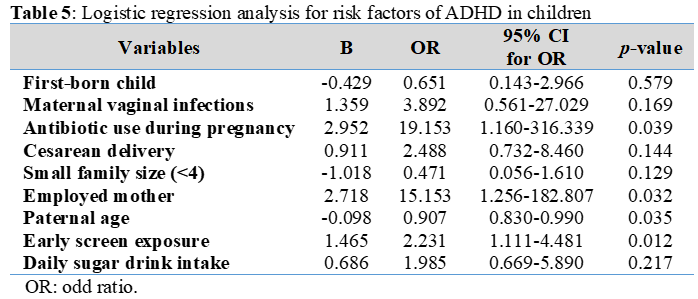
Background: Attention-deficit/hyperactivity disorder (ADHD) is a prevalent neurodevelopmental disorder of unknown etiology. In addition to genetic susceptibility, various exogenic risk factors have been linked to ADHD. Objective: The current study was conducted to identify and assess factors associated with an increased risk of ADHD in children. Methods: A case-control study included 185 ADHD children aged 6-15 years with age- and sex-matched controls recruited from the outpatient clinics of the same tertiary hospital, Baghdad, Iraq. Data were collected using a caregiver-administered structured questionnaire covering sociodemographic and clinical characteristics, perinatal factors, environmental exposure, and lifestyle factors. Variables showing significant univariate associations with ADHD were included in multivariate binary logistic regression to determine independent adjusted odds ratios. Results: The children included in the study had a mean age of 9 years, and males predominated. Four sociodemographic factors significantly relate to ADHD: first-born children, small household size, employed mothers, and young paternal age. Among perinatal factors, cesarean delivery, lower paternal age, maternal vaginal infections, and antibiotic use during pregnancy were significant in univariate analysis. However, multivariate analysis revealed four independent risk factors for ADHD, including antibiotic use during pregnancy, maternal employment, younger paternal age at time of delivery, and early exposure to screens. Conclusions: ADHD is influenced by a combination of sociodemographic and early life factors. Maternal employment, antibiotics use during pregnancy, younger paternal age, and early screen exposure were identified as independent risk factors for ADHD in children.
Downloads
References
Reuben C, Elgaddal N. Attention-deficit/hyperactivity disorder in children Ages 5-17 years: United States, 2020-2022. NCHS Data Brief 2024; (499):1-9. DOI: https://doi.org/10.15620/CDC/148043
Tabibi Z, Ayoubi S, Rabbaniparsa E. Prevalence of attention-deficit hyperactivity disorder (ADHD) in Iranian elementary school children: A systematic review and meta-analysis. Child Psychiatry Hum Dev. 2025. doi: 10.1007/s10578-025-01899-z. DOI: https://doi.org/10.1007/s10578-025-01899-z
Chen L, Liang X, Lu J, Ran H, Che Y, Fang D, et al. Prevalence of attention-deficit hyperactivity disorder (ADHD) and comorbid psychiatric problems in children 12 years and younger: A systematic review and meta-analysis. J Psychiatr Res 2025;190(1):547-556. doi: 10.1016/j.jpsychires.2025.08.024. DOI: https://doi.org/10.1016/j.jpsychires.2025.08.024
Guo Y, Li J, Hu R, Luo H, Zhang Z, Tan J, et al. Associations between ADHD and risk of six psychiatric disorders: a Mendelian randomization study. BMC Psychiatry. 2024;24(1):99. doi: 10.1186/s12888-024-05548-y. DOI: https://doi.org/10.1186/s12888-024-05548-y
Al-Ani RK, Al-Sumiadai MM, Abdulla AI, Sarhat AR. Prevalence of attention deficit hyperactivity disorder among primary school children in Tikrit City, Iraq. Al-Anbar Med J. 2021;17(1):25. doi: 10.33091/amj.2021.171061. DOI: https://doi.org/10.33091/AMJ.1101622020
Mohamed GM, Al-Deen ZN, Alanee AH. Prevalence of attention deficit hyperactivity disorder among primary school students in Tikrit City, Iraq 2023. Med J Tikrit Univ. 2023;29(2):29-35. doi: 10.25130/mjotu.29.1.5. DOI: https://doi.org/10.25130/mjotu.29.1.5
Saadi HR, Shamsuddin K, Sutan R, Alshaham SA. Socio-maternal risk factors of ADHD among Iraqi children: A case-control study. Open J Prev Med. 2013;3(2):251-257. doi: 10.4236/ojpm.2013.32034. DOI: https://doi.org/10.4236/ojpm.2013.32034
Adnan H, Rashak K. Screening for attention deficit hyperactivity disorder at elementary schools in Baghdad City. Iraqi Natl J Nurs Specialties. 2020;33(2):13-21. doi: 10.58897/injns.v33i2.411. DOI: https://doi.org/10.58897/injns.v33i2.411
Alaghband-Rad J. Commentary to attention deficit/hyperactivity disorder among schoolchildren in Baghdad. J Can Acad Child Adolesc Psychiatry. 2009;18(1):5-6. PMID: 19270843.
American Psychiatric Association. Diagnostic and Statistical Manual of Mental Disorders, (Fifth Edn), Washington (DC): American Psychiatric Association Publishing; 2022. doi: 10.1176/appi.books.9780890425787. DOI: https://doi.org/10.1176/appi.books.9780890425787
Pourhoseingholi MA, Vahedi M, Rahimzadeh M. Sample size calculation in medical studies. Gastroenterol Hepatol Bed Bench. 2013;6(1):14-17. doi: 10.22037/ghfbb.v6i1.332.
Iraqi Ministry of Planning. Iraq Household Socio-Economic Survey results. Available at: https://mop.gov.iq, [Accessed May 11th, 2026]
Bitsko RH, Holbrook JR, O’Masta B, Maher B, Cerles A, Saadeh K, et al. A systematic review and meta-analysis of prenatal, birth, and postnatal factors associated with attention-deficit/hyperactivity disorder in children. Prevent Sci. 2024;25(Suppl. 2):203-224. doi: 10.1007/s11121-022-01359-3. DOI: https://doi.org/10.1007/s11121-022-01359-3
Hope H, Pierce M, Gabr H, Radojčić MR, Swift E, Taxiarchi VP, et al. The causal association between maternal depression, anxiety, and infection in pregnancy and neurodevelopmental disorders among 410 461 children: A population study using quasi-negative control cohorts and sibling analysis. Psychol Med. 2024;54(1):1693–1701. doi: 10.1017/S0033291723003604. DOI: https://doi.org/10.1017/S0033291723003604
Walle KM, Askeland RB, Gustavson K, Mjaaland S, Ystrom E, Lipkin WI, et al. Risk of attention-deficit hyperactivity disorder in offspring of mothers with infections during pregnancy. JCPP Adv. 2022;2(2):e12070. doi: 10.1002/jcv2.12070. DOI: https://doi.org/10.1002/jcv2.12070
Zhu CY, Jiang HY, Sun JJ. Maternal infection during pregnancy and the risk of attention-deficit/hyperactivity disorder in the offspring: A systematic review and meta-analysis. Asian J Psychiatr. 2022;68:102972. doi: 10.1016/j.ajp.2021.102972. DOI: https://doi.org/10.1016/j.ajp.2021.102972
Yan GF, Zhao D, Zhao SH. Advanced paternal age-related germline mutations in the offspring with neurodevelopmental disorders: An update. Zhonghua Nan Ke Xue. 2024;30(8):750-756. PMID: 40778803.
Min X, Li C, Yan Y. Parental age and the risk of adhd in offspring: A systematic review and meta-analysis. Int J Environ Res Public Health. 2021;18(9):4939. doi: 10.3390/ijerph18094939. DOI: https://doi.org/10.3390/ijerph18094939
Agnafors S, Bladh M, Svedin CG, Sydsjö G. Mental health in young mothers, single mothers and their children. BMC Psychiatry. 2019;19. doi: 10.1186/s12888-019-2082-y. DOI: https://doi.org/10.1186/s12888-019-2082-y
Tamene A, Habte A, Tagesse M, Sewalem ZW, Afework A. Using household survey data to explore the effects of the domiciliary environment on weight at birth: a multilevel mixed-effects analysis of the 2016 Ethiopian Demographic Health Survey. BMC Pregnancy Childbirth. 2023;23(1):194. doi: 10.1186/s12884-023-05521-9. DOI: https://doi.org/10.1186/s12884-023-05521-9
Reimelt C, Wolff N, Hölling H, Mogwitz S, Ehrlich S, Martini J, et al. Siblings and Birth Order—Are They Important for the Occurrence of ADHD? J Atten Disord. 2021;25. doi: 10.1177/1087054718770020. DOI: https://doi.org/10.1177/1087054718770020
Claussen AH, Holbrook JR, Hutchins HJ, Robinson LR, Bloomfield J, Meng L, et al. All in the family? A systematic review and meta-analysis of parenting and family environment as risk factors for attention-deficit/hyperactivity disorder (ADHD) in children. Prevent Sci. 2024;25(Suppl. 2):249-271. doi: 10.1007/s11121-022-01358-4. DOI: https://doi.org/10.1007/s11121-022-01358-4
Okano L, Ji Y, Riley AW, Wang X. Maternal psychosocial stress and children’s ADHD diagnosis: a prospective birth cohort study. J Psychosomatic Obstet Gynecol. 2019;40(3):217-225. doi: 10.1080/0167482X.2018.1468434. DOI: https://doi.org/10.1080/0167482X.2018.1468434
Vivier PM, Hauptman M, Weitzen SH, Bell S, Quilliam DN, Logan JR. The important health impact of where a child lives: Neighborhood characteristics and the burden of lead poisoning. Matern Child Health J. 2011;15. doi: 10.1007/s10995-010-0692-6. DOI: https://doi.org/10.1007/s10995-010-0692-6
Rosenauer V, Schwarz MI, Vlasak T, Barth A. Childhood lead exposure increases the risk of attention-deficit-hyperactivity disorder: A meta-analysis. Sci Total Environ. 2024;951. doi: 10.1016/j.scitotenv.2024.175574. DOI: https://doi.org/10.1016/j.scitotenv.2024.175574
Dimitrov LV, Kaminski JW, Holbrook JR, Bitsko RH, Yeh M, Courtney JG, et al. A Systematic review and meta-analysis of chemical exposures and attention-deficit/hyperactivity disorder in children. Prevent Sci. 2024;25(Suppl. 2):225-248. doi: 10.1007/s11121-023-01601-6. DOI: https://doi.org/10.1007/s11121-023-01601-6
Max W, Sung HY, Shi Y. Attention deficit hyperactivity disorder among children exposed to second hand smoke: A logistic regression analysis of secondary data. Int J Nurs Stud. 2013;50(6):797-806. doi: 10.1016/j.ijnurstu.2012.10.002. DOI: https://doi.org/10.1016/j.ijnurstu.2012.10.002
Li Y, Xie T, Melo RD, de Vries M, Lakerveld J, Zij Lema W, et al. Longitudinal effects of environmental noise and air pollution exposure on autism spectrum disorder and attention-deficit/hyperactivity disorder during adolescence and early adulthood: The TRAILS study. Environmental Research. 2023; 227:115704. doi: 10.1016/j.envres.2023.115704. DOI: https://doi.org/10.1016/j.envres.2023.115704
Liu H, Chen X, Huang M, Yu X, Gan Y, Wang J, et al. Screen time and childhood attention deficit hyperactivity disorder: A meta-analysis. Rev Environ Health. 2024;39(4):643-650. doi: 10.1515/reveh-2022-0262. DOI: https://doi.org/10.1515/reveh-2022-0262
Al-Baldawi SAA, Akram NN, Abdulmajeed ZA. The impact and risk factors of screen time exposure in children with autism spectrum disorder. Al-Anbar Med J. 2025;21(1): 49-54. doi: 10.33091/amj.2024.153975.1945. DOI: https://doi.org/10.33091/amj.2024.153975.1945
Zink J, O’Connor SG, Blachman-Demner DR, Wolff-Hughes DL, Berrigan D. Examining the bidirectional associations between sleep duration, screen time, and internalizing symptoms in the ABCD study. J Adolesc Health. 2024;74(3):496-503. doi: 10.1016/j.jadohealth.2023.09.001. DOI: https://doi.org/10.1016/j.jadohealth.2023.09.001
Downloads
Published
How to Cite
Issue
Section
License
Copyright (c) 2026 Al-Rafidain Journal of Medical Sciences ( ISSN 2789-3219 )

This work is licensed under a Creative Commons Attribution-NonCommercial-ShareAlike 4.0 International License.
Published by Al-Rafidain University College. This is an open access journal issued under the CC BY-NC-SA 4.0 license (https://creativecommons.org/licenses/by-nc-sa/4.0/).