CT-Detected Incidental Colorectal Wall Thickening: Biomarker-Augmented Triage and Accelerated Colonoscopy in a Prospective Controlled Study
الكلمات المفتاحية:
Biomarker-augmented triage، Computed tomography، Colonoscopy، Fecal immunochemical test، Incidental colorectal wall thickeningالملخص
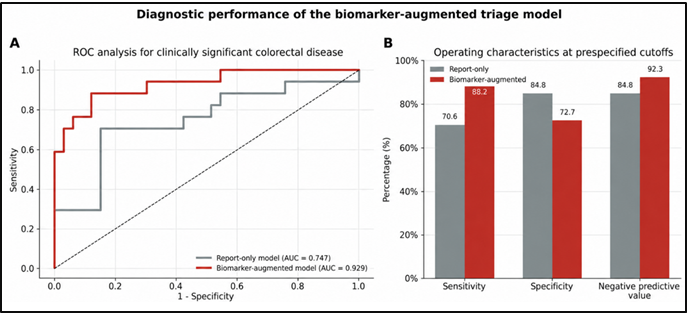
Background: Colorectal wall thickening identified incidentally on imaging of the abdomen poses a clinical challenge because subsequent management is variable. Incorporation of biological markers may enhance triage allocation without the need for additional imaging. Objective: To evaluate whether biomarker-enhanced triage improves colonoscopy prioritization for patients with incidental colorectal wall thickening findings. Methods: A prospective, controlled pilot trial randomized 50 adult outpatients with CT-detected incidental colorectal wall thickening (1:1) with usual care vs. a biomarker-augmented triage pathway. Intervention includes fecal immunochemical testing, fecal calprotectin, C-reactive protein, complete blood counts, albumin, and symptom profiling to prioritize urgent, expedited, or routine endoscopic referral. Results: Biomarker-guided triage accelerated referral patterns overall, with 92.0% of study-arm patients assigned to urgent or expedited referrals vs. 60.0% in the control group. This pathway was associated with a decrease in the median time to colonoscopy (43 vs. 22 days, p<0.01) and a significant improvement in the proportion of colonoscopies performed within 30 days (68.0% vs. 20.0%; p<0.01). Patients with clinically significant disease had significantly higher fecal hemoglobin (83.84±28.84 vs. 3.43±1.88 µg Hb/g) and fecal calprotectin (467.51±129.86 vs. 86.99±40.72 µg/g). Radiologically, the most prominent association with patients having significant disease was with marked wall thickening (OR=28.42). Conclusions: A stool and blood biomarker profile based on routine radiology reports enables rapid appraisal with clinically relevant capabilities to inform subsequent endoscopy. This triage strategy provides a rapid non-imaging assessment of clinical severity and should be extended to a larger cohort for validation.
التنزيلات
المراجع
Malekzadeh S, Rotas I, Fournier I, Hiroz P, Cherbanyk F, Staudenmann D, et al. Diagnostic performance of iodine map for differentiating colorectal cancer from benign colorectal wall thickening. Eur J Radiol. 2026;196:112709. doi: 10.1016/j.ejrad.2026.112709.
Karabay Ö, Hacım NA, Gençtürk M. Relationship between colon wall thickness in computed tomography scan and colon cancer: a retrospective study. J Acad Res Med. 2021;11(1):46-50. doi: 10.4274/jarem.galenos.2021.3822.
Borgheresi A, De Muzio F, Agostini A, Ottaviani L, Bruno A, Granata V, et al. Lymph nodes evaluation in rectal cancer: where do we stand and future perspective. J Clin Med. 2022;11(9):2599. doi: 10.3390/jcm11092599.
Almilaji O. The Importance of Identifying Iron Deficiency Anaemia in the Early Detection of Colorectal Cancer [PhD dissertation]. Bournemouth University. January 2022. Available at: https://eprints.bournemouth.ac.uk/36851/
Turvill J, Turnock D, Cottingham D, Haritakis M, Jeffery L, Girdwood A, et al. The Fast Track FIT study: diagnostic accuracy of faecal immunochemical test for haemoglobin in patients with suspected colorectal cancer. Br J Gen Pract. 2021;71(709):e643-e651. doi: 10.3399/BJGP.2020.1098.
Monahan KJ, Davies MM, Abulafi M, Banerjea A, Nicholson BD, Arasaradnam R, et al. Faecal immunochemical testing (FIT) in patients with signs or symptoms of suspected colorectal cancer (CRC): a joint guideline from the Association of Coloproctology of Great Britain and Ireland (ACPGBI) and the British Society of Gastroenterology (BSG). Gut. 2022;71(10):1939-1962. doi: 10.1136/gutjnl-2022-327985.
Laszlo HE, Seward E, Ayling RM, Lake J, Malhi A, Stephens C, et al. Faecal immunochemical test for patients with 'high-risk' bowel symptoms: a large prospective cohort study and updated literature review. Br J Cancer. 2022;126(5):736-743. doi: 10.1038/s41416-021-01653-x.
Krishnamoorthy A, Arasaradnam R. Colorectal cancer diagnostic biomarkers: beyond faecal haemoglobin. Best Pract Res Clin Gastroenterol. 2023;66:101870. doi: 10.1016/j.bpg.2023.101870.
Nasir Kansestani A, Zare ME, Tong Q, Zhang J. Comparison of faecal protein biomarkers' diagnostic accuracy for colorectal advanced neoplasms: a systematic review and meta-analysis. Sci Rep. 2022;12(1):2623. doi: 10.1038/s41598-022-06689-4.
Wang W, Cao W, Zhang S, Chen D, Liu L. The role of calprotectin in the diagnosis and treatment of inflammatory bowel disease. Int J Mol Sci. 2025;26(5):1996. doi: 10.3390/ijms26051996.
Ross FA, Park JH, Mansouri D, Combet E, Horgan PG, McMillan DC, et al. The role of faecal calprotectin in diagnosis and staging of colorectal neoplasia: a systematic review and meta-analysis. BMC Gastroenterol. 2022;22(1):176. doi: 10.1186/s12876-022-02220-1.
Gerrard AD, Maeda Y, Miller J, Gunn F, Theodoratou E, Noble C, et al. Double faecal immunochemical testing in patients with symptoms suspicious of colorectal cancer. Br J Surg. 2023;110(4):471-480. doi: 10.1093/bjs/znad016.
Hijos-Mallada G, Saura N, Lué A, Velamazan R, Nieto R, Navarro M, et al. A point-of-care faecal test combining four biomarkers allows avoidance of normal colonoscopies and prioritizes symptomatic patients with a high risk of colorectal cancer. Cancers. 2023;15(3):721. doi: 10.3390/cancers15030721.
Boulbadaoui A, Rashid MU, Nair N, Mohamed G, Poh S, Britton I, et al. Straight-to-test pathway in faecal immunochemical testing (FIT)-negative patients: A cost-effective approach. Cureus. 2024;16(11):e73464. doi: 10.7759/cureus.73464.
Mansvelders MSE, Kleif J, Andersen MR, Karstensen JG, Therkildsen C. Use of fecal immunochemical testing for risk stratification of patients with symptoms of colorectal cancer referred for diagnostic colonoscopy. Gastroenterology. 2025;168(4):795-797. doi: 10.1053/j.gastro.2024.11.018.
Shrestha B, Dunn L. The declaration of Helsinki on medical research involving human subjects: a review of seventh revision. J Nepal Health Res Counc. 2020;17(4):548-552. doi: 10.33314/jnhrc.v17i4.1042.
Karacin C, Türker S, Eren T, Imamoglu GI, Yılmaz K, Coskun Y, et al. Predictors of neoplasia in colonic wall thickening detected via computerized tomography. Cureus. 2020;12(9):e10553. doi: 10.7759/cureus.10553.
Bas BO, Pakoz ZB. Endoscopic evaluation of patients with colonic wall thickening detected on computed tomography. Acta Clin Croat. 2020;59(3):463-468. doi: 10.20471/acc.2020.59.03.10.
Daniel F, Alsheikh M, Ghieh D, Hosni M, Tayara Z, Tamim H, et al. Bowel wall thickening on computed tomography scan: inter-observer agreement and correlation with endoscopic findings. Arab J Gastroenterol. 2020;21(4):219-223. doi: 10.1016/j.ajg.2020.04.012.
Somuncu E, Topal Ü, Sönmez S, Kara Y, Bozdağ E, Özcan A, et al. Incidentally detected gastrointestinal wall thickness on abdominal computed tomography; what does it mean for endoscopy? Arch Iran Med. 2021;24(4):296-300. doi: 10.34172/aim.2021.41.
Xu W, Li H, Guo Z, Zhang L, Zhang R, Zhang L, et al. Combined SUVmax and localized colonic wall thickening parameters to identify high-risk lesions from incidental focal colorectal 18F-FDG uptake foci. Front Oncol. 2022;12:972096. doi: 10.3389/fonc.2022.972096.
Wahlig S, Hassan O, Behr S. Colorectal cancer detection on routine abdomen/pelvis CT. Royal Coll Radiol Open. 2024;2:100157. doi: 10.1016/j.rcro.2024.100157.
Ergin M, Kıvrakoğlu F. Evaluation of endoscopic findings in gastrointestinal tract wall thickening detected on abdominal radiological imaging: a two-center retrospective descriptive study. Medicina. 2025;61(9):1699. doi: 10.3390/medicina61091699.
Lué A, Hijos G, Sostres C, Perales A, Navarro M, Barra MV, et al. The combination of quantitative faecal occult blood test and faecal calprotectin is a cost-effective strategy to avoid colonoscopies in symptomatic patients without relevant pathology. Ther Adv Gastroenterol. 2020;13:1756284820920786. doi: 10.1177/1756284820920786.
Zhu M, Fan L, Han M, Zhu S, Zhang S, Shi H, et al. The usefulness of fecal hemoglobin and calprotectin tests in diagnosing significant bowel diseases: a prospective study. Scand J Gastroenterol. 2023;58(4):368-374. doi: 10.1080/00365521.2022.2133551.
Lanas Á, Balaguer F, Sánchez-Luengo M, Hijos-Mallada G, Hernández-Mesa G, Piñero M, et al. Fecal occult blood and calprotectin testing to prioritize primary care patients for colonoscopy referral: the advantage study. United Eur Gastroenterol J. 2023;11(7):692-699. doi: 10.1002/ueg2.12446.
Limsrivilai J, Yodmalai C, Chaemsupaphan T, Sattayalertyanyong O, Subdee N, Permpim P, et al. Evaluating the efficacy of fecal immunochemical test, fecal calprotectin, and serum C-reactive protein in diagnosing patients with chronic lower gastrointestinal symptoms. Clin Transl Gastroenterol. 2024;15(8):e00747. doi: 10.14309/ctg.0000000000000747.
Yamakawa T, Miyake T, Yokoyama Y, Kazama T, Hayashi Y, Hirayama D, et al. Clinical performance of fecal calprotectin, lactoferrin, and hemoglobin for evaluating the disease activity of IBD and detecting colorectal tumors. JGH Open. 2024;8(6):e13077. doi: 10.1002/jgh3.13077.
Ball AJ, Ray M, Manji A, Aziz I, Sargur RB, Kurien M, et al. Faecal immunochemical testing in symptomatic primary care patients: a diagnostic accuracy study. Eur J Cancer Care. 2024;2024(1):4849620. doi: 10.1155/2024/4849620.
Barlow M, Messenger D, Preece R, Prowse A, Abel G, Hamilton W, et al. The diagnostic accuracy of the faecal immunochemical test for the detection of early-onset colorectal cancer: an age-stratified analysis in South West England. Br J Cancer. 2025;133(8):1170-1177. doi: 10.1038/s41416-025-03154-7.
Loveday C, Sud A, Jones ME, Broggio J, Scott S, Gronthound F, et al. Prioritisation by FIT to mitigate the impact of delays in the 2-week wait colorectal cancer referral pathway during the COVID-19 pandemic: a UK modelling study. Gut. 2021;70(6):1053-1060. doi: 10.1136/gutjnl-2020-321650.
D'Souza N, Georgiou Delisle T, Chen M, Benton S, Abulafi M. Faecal immunochemical test is superior to symptoms in predicting pathology in patients with suspected colorectal cancer symptoms referred on a 2WW pathway: a diagnostic accuracy study. Gut. 2021;70(6):1130-1138. doi: 10.1136/gutjnl-2020-321956.
Booth R, Carten R, D'Souza N, Westwood M, Kleijnen J, Abulafi M, et al. Role of the faecal immunochemical test in patients with risk-stratified suspected colorectal cancer symptoms: a systematic review and meta-analysis to inform the ACPGBI/BSG guidelines. Lancet Reg Health Eur. 2022;23:100518. doi: 10.1016/j.lanepe.2022.100518.
Pin-Vieito N, García Nimo L, Bujanda L, Román Alonso B, Gutierrez-Stampa MÁ, Aguilar-Gama V, et al. Optimal diagnostic accuracy of quantitative faecal immunochemical test positivity thresholds for colorectal cancer detection in primary health care: a community-based cohort study. United Eur Gastroenterol J. 2021;9(2):256-267. doi: 10.1177/2050640620949714.
Bailey SER, Abel GA, Atkins A, Byford R, Davies S-J, Mays J, et al. Diagnostic performance of a faecal immunochemical test for patients with low-risk symptoms of colorectal cancer in primary care: an evaluation in the South West of England. Br J Cancer. 2021;124(7):1231-1236. doi: 10.1038/s41416-020-01221-9.
Boulbadaoui A, Bibi A, Mohamed G, Gaunt A, Varghese P, Rashid MU, et al. Faecal immunochemical test (FIT) value-based algorithm to triage symptomatic colorectal patients: A retrospective study from a tertiary care hospital. Cureus. 2024;16(9):e69889-e. doi: 10.7759/cureus.69889.
Falvey J, Stedman CM, Dunn J, Sies C, Levin S. Faecal immunochemical test (FIT) based prioritisation of new patient symptomatic cases referred for colorectal investigation. N Z Med J. 2024;137(1602):102-110. doi: 10.26635/6965.6582.
Saw KS, Ngatai L-a, Whiteside C, Parry S, Bissett I. Faecal immunochemical test to triage patients with possible colorectal cancer symptoms: insights from the New Zealand FIT for symptomatic pilot. Front Gastroenterol. 2025;4:1622258. doi: 10.3389/fgstr.2025.1622258.
التنزيلات
منشور
كيفية الاقتباس
إصدار
القسم
الرخصة
الحقوق الفكرية (c) 2026 Al-Rafidain Journal of Medical Sciences

هذا العمل مرخص بموجب Creative Commons Attribution-NonCommercial-ShareAlike 4.0 International License.
Published by Al-Rafidain University College. This is an open access journal issued under the CC BY-NC-SA 4.0 license (https://creativecommons.org/licenses/by-nc-sa/4.0/).