Incidence and Associated Factors of Intraventricular Hemorrhage in Preterm Neonates at Ramadi Teaching Hospital for Maternity and Children, Ramadi City, Iraq
DOI:
https://doi.org/10.54133/ajms.v11i1.3088Keywords:
Intraventricular hemorrhage, Incidence, Iraq, Preterm, RamadiAbstract
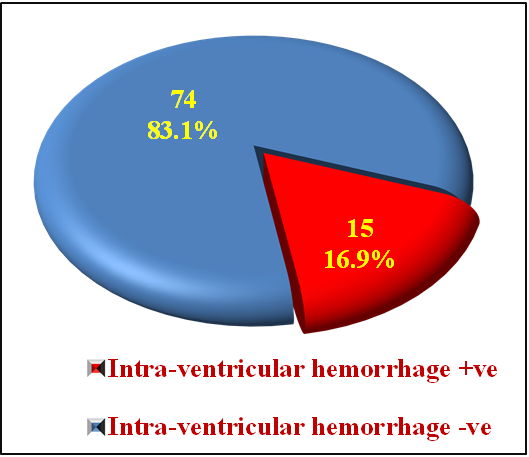
Background: Intraventricular hemorrhage (IVH) is a common complication in premature infants, and it is associated with a high risk of neurodevelopmental impairment and mortality. Objective: To estimate the incidence of IVH in preterm neonates and the associated factors that increase it. Methods: This is a prospective cohort study that included 89 preterm newborns admitted to the neonatal intensive care unit (NICU) in Ramadi Maternity and Children Teaching Hospital from December 2024 to June 2025. IVH was diagnosed by ultrasonography on day 3 and day 7 of the delivery and admission to the NICU. Results: 89 neonates revealed different grades of IVH in 15(16.9%). There are significant associations between IVH and neonate male sex (p=0.021), lowest gestational age (p=0.045), low birthweight (p=0.015), need for positive pressure (p=0.042), and the use of Continuous Positive Airway Pressure (CPAP) and surfactant (p=0.031). There is a significant association between sepsis and the incidence of IVH (p<0.001) and preterm infants who developed hypoglycemia (p=0.005). Preterm infants were found to have a murmur due to patent ductus arteriosus (p=0.02). Conclusions: The incidence of IVH in preterm neonates at Ramadi, Iraq, was 16.9%. Neonatal factors were male sex, decreased gestational age, low birth weight, the need for positive pressure for resuscitation, the need for CPAP and surfactant, having sepsis, hypoglycemia, and having a murmur due to patent ductus arteriosus. Regarding maternal factors: premature rupture of membrane and multiparity.
Downloads
References
Rabe H, Diaz-Rossello JL, Duley L, Dowswell T. Effect of timing of umbilical cord clamping and other strategies to influence placental transfusion at preterm birth on maternal and infant outcomes. Cochrane Database Syst Rev. 2019;9(9):CD003248. doi: 10.1002/14651858.CD003248.pub4. DOI: https://doi.org/10.1002/14651858.CD003248.pub4
Juul SE, Comstock BA, Wadhawan R, Mayock DE, Courtney SE, Robinson T, et al. A randomized trial of erythropoietin for neuroprotection in preterm infants. N Engl J Med. 2020;382(3):233-243. doi: 10.1056/NEJMoa1907423. DOI: https://doi.org/10.1056/NEJMoa1907423
Bao L, Huang J. Risk factors for intraventricular hemorrhage in very low birth weight infants: a systematic review and meta-analysis. Front Pediatr. 2026;13:1728632. doi: 10.3389/fped.2025.1728632. DOI: https://doi.org/10.3389/fped.2025.1728632
Smyser CD, Kidokoro H, Inder TE. Magnetic resonance imaging of the brain at term equivalent age in extremely premature neonates: to scan or not to scan? J Paediatr Child Health. 2012;48(9):794-800. doi: 10.1111/j.1440-1754.2012.02535.x. DOI: https://doi.org/10.1111/j.1440-1754.2012.02535.x
Vohr BR. Neurodevelopmental outcomes of premature infants with intraventricular hemorrhage across a lifespan. In: Seminars in Perinatology. 2022 Aug 1 (Vol. 46, No. 5, p. 151594). WB Saunders. doi: 10.1016/j.semperi.2022.151594. DOI: https://doi.org/10.1016/j.semperi.2022.151594
Schmid MB, Hopfner RJ, Lenhof S, Hummler HD, Fuchs H. Cerebral oxygenation during intermittent hypoxemia and bradycardia in preterm infants. Neonatology. 2015;107(2):137-146. doi: 10.1159/000368294. DOI: https://doi.org/10.1159/000368294
Khanafer-Larocque I, Soraisham A, Stritzke A, Al Awad E, Thomas S, Murthy P, et al. Intraventricular hemorrhage: risk factors and association with patent ductus arteriosus treatment in extremely preterm neonates. Front Pediatr. 2019;7:408. doi: 10.3389/fped.2019.00408. DOI: https://doi.org/10.3389/fped.2019.00408
Conde-Agudelo A, Díaz-Rossello JL. Kangaroo mother care to reduce morbidity and mortality in low birthweight infants. Cochrane Database Syst Rev. 2016;(8):CD002771. doi: 10.1002/14651858.CD002771. DOI: https://doi.org/10.1002/14651858.CD002771.pub4
Song J, Wang Y, Xu F, Sun H, Zhang X, Xia L, et al. Erythropoietin improves poor outcomes in preterm infants with intraventricular hemorrhage. CNS Drugs. 2021;35(6):681-690. doi: 10.1007/s40263-021-00817-w. DOI: https://doi.org/10.1007/s40263-021-00817-w
Dan AM, Vasilescu DI, Dragomir I, Vasilescu SL, Voicu D, Cîrstoiu MM. Cranial ultrasonography—Standards in diagnosis of intraventricular hemorrhage and ventricular dilatation in premature neonates. Children. 2025;12(6):768. doi: 10.3390/children12060768, DOI: https://doi.org/10.3390/children12060768
Stewart DL, Barfield WD; Committee on fetus and newborn. Updates on an at-risk population: Late-preterm and early-term infants. Pediatrics. 2019;144(5):e20192760. doi: 10.1542/peds.2019-2760. DOI: https://doi.org/10.1542/peds.2019-2760
Hamilton BE, Martin JA, Osterman MJK. Births: Provisional data for 2020. Vital Statistics Rapid Release; no 12. Hyattsville, MD: National Center for Health Statistics. May 2021. doi: 10.15620/ cdc:104993. DOI: https://doi.org/10.15620/cdc:104993
Adamkin DH. Neonatal hypoglycemia. Semin Fetal Neonatal Med. 2017;22(1):36-41. doi: 10.1016/j.siny.2016.08.007. DOI: https://doi.org/10.1016/j.siny.2016.08.007
Mohammed SI, Razzak Obaid AA, Majeed BA. Maternal risk factors and outcomes of premature neonates admitted to the neonatal care unit in Al-Elwiya pediatric teaching hospital in Baghdad, Iraq. Iranian J Neonatol. 2022;13(3). doi: 10.22038/IJN.2022.61680.2176.
Abolfotouh MA, Al Saif S, Altwaijri WA, Al Rowaily MA. Prospective study of early and late outcomes of extremely low birthweight in Central Saudi Arabia. BMC Pediatrics. 2018;18(1):280. doi: 10.1186/s12887-018-1248-y. DOI: https://doi.org/10.1186/s12887-018-1248-y
Huang J, Wang Y, Tian T, Zhu T, Tang J, Gao Q, et al. Risk factors for periventricular-intraventricular haemorrhage severity in preterm infants: a propensity score-matched analysis. BMC Pediatrics. 2023;23(1):341. doi: 10.1186/s12887-023-04114-x. DOI: https://doi.org/10.1186/s12887-023-04114-x
Çizmeci MN, Akın MA, Özek E. Turkish neonatal society guideline on the diagnosis and management of germinal matrix hemorrhage-intraventricular hemorrhage and related complications. Turkish Arch Pediatrics. 2021;56(5):499-512. doi: 10.5152/TurkArchPediatr.2021.21142. DOI: https://doi.org/10.5152/TurkArchPediatr.2021.21142
Wang Y, Song J, Zhang X, Kang W, Li W, Yue Y, et al. The impact of different degrees of intraventricular hemorrhage on mortality and neurological outcomes in very preterm infants: a prospective cohort study. Front Neurol. 2022;13:853417. doi: 10.3389/fneur.2022.853417. DOI: https://doi.org/10.3389/fneur.2022.853417
El-Atawi K, Elhalik M, Kulkarni T, Abdelsamed A, Alexander L, Satyan AD. Risk factors, diagnosis, and current practices in the management of intraventricular hemorrhage in preterm infants: a review. System. 2016;16:17. doi: 10.19080/AJPN.2016.01.555561. DOI: https://doi.org/10.19080/AJPN.2016.01.555561
Zhao Y, Zhang W, Tian X. Analysis of risk factors of early intraventricular hemorrhage in very-low-birth-weight premature infants: a single center retrospective study. BMC Pregnancy Childbirth. 2022;22(1):890. doi: 10.1186/s12884-022-05245-2. DOI: https://doi.org/10.1186/s12884-022-05245-2
Tsao PC. Pathogenesis and prevention of intraventricular hemorrhage in preterm infants. J Korean Neurosurg Soc. 2023;66(3):228-238. doi: 10.3340/jkns.2022.0288. DOI: https://doi.org/10.3340/jkns.2022.0288
Marzban A. Factors associated with intraventricular hemorrhage in very low birth weight neonates in Mousavi Hospital in Zanjan in 2012-2013. Ultrasound. 2017;4(8):9. Available at: http://nmcjournal.zums.ac.ir/article-1-487-en.html
Helwich E, Rutkowska M, Bokiniec R, Gulczyńska E, Hożejowski R. Intraventricular hemorrhage in premature infants with respiratory distress syndrome treated with surfactant: incidence and risk factors in the prospective cohort study. J Mother Child. 2017;21(4):328-335. doi: 10.34763/devperiodmed.20172104.328335.
Kartam M, Embaireeg A, Albalool S, Almesafer A, Hammoud M, Al-Hathal M, et al. Late-onset sepsis in preterm neonates is associated with higher risks of cerebellar hemorrhage and lower motor scores at three years of age. Oman Med J. 2022;37(2):e368. doi: 10.5001/omj.2022.41. DOI: https://doi.org/10.5001/omj.2022.41
Kapoor S, Sharma R, Sapare AK, Aggarwal R. Intraventricular haemorrhage in very preterm neonates. Int J Contemp Pediatr. 2018;5(4):1414-1418. doi: 10.18203/2349-3291.ijcp20182538. DOI: https://doi.org/10.18203/2349-3291.ijcp20182538
De Angelis LC, Brigati G, Polleri G, Malova M, Parodi A, Minghetti D, et al. Neonatal hypoglycemia and brain vulnerability. Front Endocrinol. 2021;12:634305. doi: 10.3389/fendo.2021.634305. DOI: https://doi.org/10.3389/fendo.2021.634305
Jagła M, Szymońska I, Starzec K, Kwinta P. Impact of early glycemic variability on mortality and neurologic outcome of very low birth weight infants: Data from a continuous glucose monitoring system. Dev Period Med. 2019;23(1):7-14. doi: 10.34763/devperiodmed.20192301.071.
McLoughlin RJ, Dacier BM, Hazeltine MD, Hirsh MP, Sullivan KP, Cleary MA, et al. Intraventricular hemorrhage and patent ductus arteriosus ligation association with infant mortality. J Surg Res. 2020;252:192-199. doi: 10.1016/j.jss.2020.03.011. DOI: https://doi.org/10.1016/j.jss.2020.03.011
Terrin G, Di Chiara M, Boscarino G, Metrangolo V, Faccioli F, Onestà E, et al. Morbidity associated with patent ductus arteriosus in preterm newborns: a retrospective case-control study. Italian J Pediatr. 2021;47(1):9. doi: 10.1186/s13052-021-00956-2. DOI: https://doi.org/10.1186/s13052-021-00956-2
Pekcevik Y, Pasinli A, Ozer EA, Erdogan N. Risk factors of germinal matrix intraventricular hemorrhage in premature infants. Iranian J Pediatr. 2014;24(2):191. PMID: 25535539.
Al-Mouqdad MM, Abdelrahim A, Abdalgader AT, Alyaseen N, Khalil TM, Taha MY, et al. Risk factors for intraventricular hemorrhage in premature infants in the central region of Saudi Arabia. Int J Pediatr Adolesc Med. 2021;8(2):76-81. doi: 10.1016/j.ijpam.2019.11.005, DOI: https://doi.org/10.1016/j.ijpam.2019.11.005
Wei JC, Catalano R, Profit J, Gould JB, Lee HC. Impact of antenatal steroids on intraventricular hemorrhage in very-low-birth weight infants. J Perinatol. 2016;36(5):352-356. doi: 10.1038/jp.2016.38. DOI: https://doi.org/10.1038/jp.2016.38
Chevallier M, Debillon T, Pierrat V, Delorme P, Kayem G, Durox M, et al. Leading causes of preterm delivery as risk factors for intraventricular hemorrhage in very preterm infants: results of the EPIPAGE 2 cohort study. Am J Obstet Gynecol. 2017;216(5):518-e1. doi: 10.1016/j.ajog.2017.01.002. DOI: https://doi.org/10.1016/j.ajog.2017.01.002
Downloads
Published
How to Cite
Issue
Section
License
Copyright (c) 2026 Al-Rafidain Journal of Medical Sciences ( ISSN 2789-3219 )

This work is licensed under a Creative Commons Attribution-NonCommercial-ShareAlike 4.0 International License.
Published by Al-Rafidain University College. This is an open access journal issued under the CC BY-NC-SA 4.0 license (https://creativecommons.org/licenses/by-nc-sa/4.0/).