The Clinical Impacts of Stray Ammunition on Craniocerebral Injuries
DOI:
https://doi.org/10.54133/ajms.v11i1.3048Keywords:
Craniocerebral injuries, Gravitational bullet injury, Head trauma, Stray ammunitionsAbstract
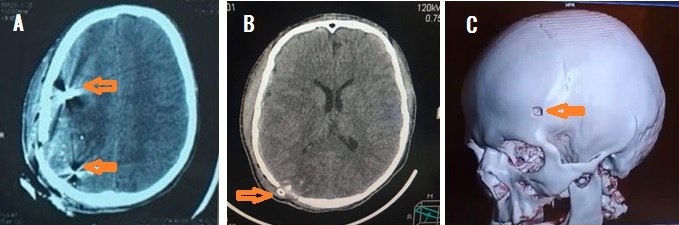
Background: Stray ammunition injuries are firearm injuries inflicted outdoors by an unidentified assailant caused by shooting into the sky to celebrate a happy event or to express anger. Aerial shooting during a riot and mob control is noted in conflict zones. Objective: To assess the severity of stray ammunitions and the clinical impact of such injury on the craniocerebral structures. Methods: It was a case series study conducted retrospectively at the Neurosurgery Teaching Hospital, Baghdad, from the 1st of February 2019 to the 1st of October 2025. 109 patients with cranial stray bullet injuries, where patients with direct shootings to the head and blast injuries were excluded from the study. Results: There was male predominance, and the initial Glasgow Coma Scale (GCS) played a major role in indicating the severity of injury and was highly significant in relation to outcome (p=0.002) with a mortality rate reaching 43%. The worst outcome occurred from a deeper brain injury that reached the midline structures like the brainstem (p=0.001).Regression models were employed to identify variables that independently influenced functional recovery. Conclusions: Iraq is one of the countries that are affected by stray ammunition injuries, with a mortality rate reaching 43%. The initial GCS at presentation plays a crucial role in determining the fate and outcome of the injured patients, and understanding this fact helps us in the sorting and triage system in the emergency room. Thus, the use of guns and firearms must be restricted and under control.
Downloads
References
Parada SA, DeVine JG, Arrington ED. Celebratory gunfire injury to a United States soldier sustained during Operation Iraqi Freedom (OIF). Injury Extra. 2009;40(8):149–151. doi: 10.1016/j.injury.2009.03.010. DOI: https://doi.org/10.1016/j.injury.2009.03.010
Wani AA, Ramzan AU, Shoib Y, Malik NK, Nizami FA, Dhar A, et al. Stray bullet: An accidental killer during riot control. Surg Neurol Int. 2011;2(1):122. doi: 10.4103/2152-7806.84769. DOI: https://doi.org/10.4103/2152-7806.84769
Shuker ST, Raid Sadda. Craniomaxillofacial falling bullet injuries and management. J Oral Maxillofac Surg. 2010;68(7):1593-1601. doi: 10.1016/j.joms.2009.06.039. DOI: https://doi.org/10.1016/j.joms.2009.06.039
Wintemute GJ, Claire BE, McHenry VS, Wright MA. Epidemiology and clinical aspects of stray bullet shootings in the United States. J Trauma Acute Care Surg. 2012;73(1):215-223. doi: 10.1097/TA.0b013e31824c3abc. DOI: https://doi.org/10.1097/TA.0b013e31824c3abc
Enam S, Kazim S, Tahir M, Waheed S, Shamim M. Management of penetrating brain injury. J Emerg Trauma Shock. 2011;4(3):395. doi: 10.4103/0974-2700.83871. DOI: https://doi.org/10.4103/0974-2700.83871
Kong V, Odendaal J, Sartorius B, Clarke D, Brysiewicz P, Jerome E, et al. Civilian cerebral gunshot wounds: a South African experience. ANZ J Surg. 2016;87(3):186–189. doi: 10.1111/ans.13846. DOI: https://doi.org/10.1111/ans.13846
Jimenez CM, Polo J, España JA. Risk factors for intracranial infection secondary to penetrating craniocerebral gunshot wounds in civilian practice. World Neurosurg. 201;79(5-6):749-755. doi: 10.1016/j.wneu.2012.06.025. DOI: https://doi.org/10.1016/j.wneu.2012.06.025
FrancoisAE, Eisenberg HM, Saydjari C, Foulkes MA, Jane JA, Marshall LF, et al. Predictors of mortality in severely head-injured patients with civilian gunshot wounds: A report from the nih traumatic coma data bank. Surg Neurol. 1992;38(6):418-423. doi: 10.1016/0090-3019(92)90109-Z. DOI: https://doi.org/10.1016/0090-3019(92)90109-Z
Kennedy F, Gonzalez P, Dang C, Fleming A, Sterling-Scott R. The Glasgow Coma Scale and prognosis in gunshot wounds to the brain. J Trauma Acute Care Surg. 1993;35(1):75-77. doi: 10.1097/00005373-199307000-00013. DOI: https://doi.org/10.1097/00005373-199307000-00013
Levy ML, Masri LS, Lavine S, Apuzzo ML. Outcome prediction after penetrating craniocerebral injury in a civilian population: aggressive surgical management in patients with admission Glasgow Coma Scale scores of 3, 4, or 5. Neurosurgery. 1994;35(1):77-85. doi: 10.1227/00006123-199407000-00012. DOI: https://doi.org/10.1097/00006123-199407000-00012
Zafonte RD, Wood DL, Harrison-Felix CL, Valena NV, Black K. Penetrating head injury: a prospective study of outcomes. Neurol Res. 2001;23(2-3):219-226. doi: 10.1179/016164101101198370. DOI: https://doi.org/10.1179/016164101101198370
Frösen J, Frisk O, Raj R, Hernesniemi J, Tukiainen E, Barner-Rasmussen I. Outcome and rational management of civilian gunshot injuries to the brain-retrospective analysis of patients treated at the Helsinki University Hospital from 2000 to 2012. Acta Neurochir (Wien). 2019;161(7):1285-1295. doi: 10.1007/s00701-019-03952-y. DOI: https://doi.org/10.1007/s00701-019-03952-y
Ambrosi PB, Valença MM, Azevedo-Filho H. Prognostic factors in civilian gunshot wounds to the head: a series of 110 surgical patients and brief literature review. Neurosurg Rev. 2012;35(3):429-436. doi: 10.1007/s10143-012-0377-2. DOI: https://doi.org/10.1007/s10143-012-0377-2
Polin RS, Shaffrey ME, Phillips CD, Germanson T, Jane JA. Multivariate analysis and prediction of outcome following penetrating head injury. Neurosurg Clin North Am. 1995;6(4):689-699. doi: 10.1016/S1042-3680(18)30425-X. DOI: https://doi.org/10.1016/S1042-3680(18)30425-X
Clark WC, Muhlbauer MS, Watridge CB, Ray MW. Analysis of 76 civilian craniocerebral gunshot wounds. J Neurosurg. 1986;65(1):9-14. doi: 10.3171/jns.1986.65.1.0009. DOI: https://doi.org/10.3171/jns.1986.65.1.0009
Cushing H. A study of a series of wounds involving the brain and its enveloping structures. Br J Surg. 1917;5(20):558-684. DOI: https://doi.org/10.1002/bjs.1800052004
Selden BS, Goodman JM, Cordell W, Rodman Jr GH, Schnitzer PG. Outcome of self-inflicted gunshot wounds of the brain. Ann Emerg Med. 1988;17(3):247-253. doi: 10.1016/S0196-0644(88)80117-3. DOI: https://doi.org/10.1016/S0196-0644(88)80117-3
Ozdemir M, Unlü A. Gunshot injuries due to celebratory gun shootings. Turk Neurosurg. 2009;19(1):73-76. PMID: 19263358.
Downloads
Published
How to Cite
Issue
Section
License
Copyright (c) 2026 Al-Rafidain Journal of Medical Sciences ( ISSN 2789-3219 )

This work is licensed under a Creative Commons Attribution-NonCommercial-ShareAlike 4.0 International License.
Published by Al-Rafidain University College. This is an open access journal issued under the CC BY-NC-SA 4.0 license (https://creativecommons.org/licenses/by-nc-sa/4.0/).