Adherence to Guideline-Directed Medical Therapy and its Impact on Clinical Outcomes in Heart Failure Patients Admitted to a Teaching Hospital
DOI:
https://doi.org/10.54133/ajms.v11i1.2960Keywords:
Guideline-directed medical therapy, Heart failure, Medication adherence, Morisky scaleAbstract
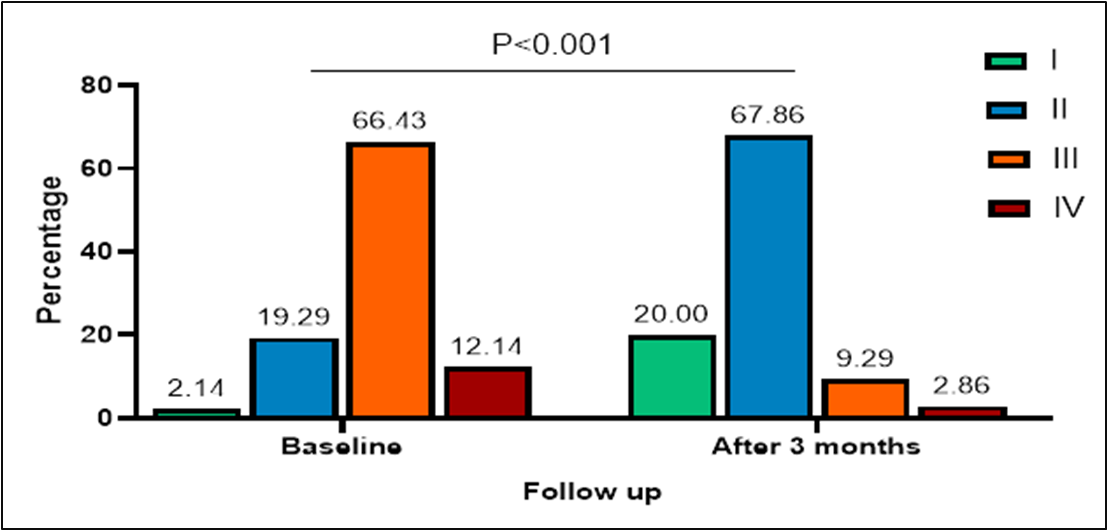
Background: Adherence to guideline-directed medical therapy (GDMT) remains suboptimal among heart failure (HF) patients despite proven benefits in reducing mortality and hospitalizations. Data on adherence patterns and their clinical impact in Middle Eastern settings remain limited. Objective: To evaluate adherence to GDMT among HF patients at Shar Teaching Hospital, Sulaimani; identify sociodemographic correlates; and assess associations with short-term clinical outcomes, including NYHA class, hospitalizations, and quality of life. Methods: This prospective observational study enrolled 140 adult patients with HFrEF (diagnosed >3 months) at Shar Teaching Hospital cardiology wards/outpatient clinics (April–December 2025). Adherence was assessed using the validated 8-item Morisky Medication Adherence Scale (MMAS-8), categorizing patients as low (<6), medium (6–<8), or high adherence. Sociodemographic/clinical data were collected via structured interviews and medical record review. Results: Low adherence predominated (81.43%, n=114), with medium (12.86%, n=18) and high adherence (5.71%, n=8) less common (p<0.001). Higher adherence correlated with older age (p=0.009) and being male (p=0.037). Key non-adherence barriers included lack of understanding (24.24%), cost (23.48%), and regimen complexity (21.21%). After GDMT optimization/adherence counseling, significant NYHA class improvement occurred (p<0.001), HF-related 3-month hospitalization was low (10.71%), and quality of life improved in 70.71%. Conclusions: Alarmingly high low-adherence rates exist among HF patients in this setting, though older age and being male predict better adherence. Higher adherence, supported by GDMT optimization and counseling, was associated with better NYHA class, fewer hospitalizations, and improved quality of life.
Downloads
References
Oosterom-Calo R, van Ballegooijen AJ, Terwee CB, te Velde SJ, Brouwer IA, Jaarsma T, et al. Determinants of adherence to heart failure medication: a systematic literature review. Heart Fail Rev. 2012;18(4):409-27. doi: 10.1007/s10741-012-9321-3. DOI: https://doi.org/10.1007/s10741-012-9321-3
Silavanich V, Nathisuwan S, Phrommintikul A, Permsuwan U. Relationship of medication adherence and quality of life among heart failure patients. Heart Lung. 2019;48(2):105-110. doi: 0.1016/j.hrtlng.2018.09.009. DOI: https://doi.org/10.1016/j.hrtlng.2018.09.009
Moon SJ, Lee WY, Hwang JS, Hong YP, Morisky DE. Accuracy of a screening tool for medication adherence: A systematic review and meta-analysis of the Morisky Medication Adherence Scale-8. PloS one. 2017 Nov 2;12(11):e0187139. doi:10.1371/journal.pone.0187139. DOI: https://doi.org/10.1371/journal.pone.0187139
Ekman I, Wolf A, Vaughan Dickson V, Bosworth HB, Granger BB. Unmet expectations of medications and care providers among patients with heart failure assessed to be poorly adherent: results from the Chronic Heart Failure Intervention to Improve MEdication Adherence (CHIME) study. Eur J Cardiovasc Nurs. 2017;16(7):646-654. doi: 10.1177/1474515117707669. DOI: https://doi.org/10.1177/1474515117707669
Bansilal S, Castellano JM, Garrido E, Wei HG, Freeman A, Spettell C, et al. Assessing the impact of medication adherence on long-term cardiovascular outcomes. J Am Coll Cardiol. 2016 Aug 23;68(8):789-801. doi: 10.1016/j.jacc.2016.06.005. DOI: https://doi.org/10.1016/j.jacc.2016.06.005
Raffaa HSM, Alasmari BA, Abadi SA, Al Metrek MA, Raffaa HS, Al Qarni HZM, et al. Adherence of heart failure patients to heart failure medications and its determinants in the Aseer region, Southern Saudi Arabia. J Family Med Prim Care. 2020;9(9):5041-5045. doi: 10.4103/jfmpc.jfmpc_904_20. DOI: https://doi.org/10.4103/jfmpc.jfmpc_904_20
Kinsara AJ, Aljehani R, Wolszakiewicz J, Staron A, Alsulaimy MA. The prevention and Cardiac Rehabilitation Group of the Saudi Heart Association Recommendations Regarding Establishing a Cardiac Rehabilitation Service. J Saudi Heart Assoc. 2023;35(3):205-213. doi: 10.37616/2212-5043.1346. DOI: https://doi.org/10.37616/2212-5043.1346
Savarese G, Lund LH. Global public health burden of heart failure. Card Fail Rev. 2017;3(1):7-11. doi: 10.15420/cfr.2016:25:2. DOI: https://doi.org/10.15420/cfr.2016:25:2
Alfaqeeh M, Abdullah R, Zakiyah N, Suwantika AA, Postma MJ, Rahmawati F, et al. Medication adherence and contributing factors in patients with heart failure within the Middle East: A systematic review. Glob Heart. 2025;20(1):47. doi: 10.5334/gh.1431. DOI: https://doi.org/10.5334/gh.1431
O'Donnell MJ, Xavier D, Liu L, Zhang H, Chin SL, Rao-Melacini P, et al. Risk factors for ischaemic and intracerebral haemorrhagic stroke in 22 countries (the INTERSTROKE study): a case-control study. Lancet. 2010;376(9735):112-123. doi: 10.1016/S0140-6736(10)60834-3. DOI: https://doi.org/10.1016/S0140-6736(10)60834-3
Yusuf S, Hawken S, Ounpuu S, Dans T, Avezum A, Lanas F, et al. Effect of potentially modifiable risk factors associated with myocardial infarction in 52 countries (the INTERHEART study): case-control study. Lancet. 2004;364(9438):937-952. doi: 10.1016/S0140-6736(04)17018-9. DOI: https://doi.org/10.1016/S0140-6736(04)17018-9
Frishman WH. Importance of medication adherence in cardiovascular disease and the value of once-daily treatment regimens. Cardiol Rev. 2007;15(5):257-263. doi: 10.1097/CRD.0b013e3180cabbe7. DOI: https://doi.org/10.1097/CRD.0b013e3180cabbe7
Omer RD, Ahmed HF, Rashid BZ. Prevalence of compliance among hypertensive patients visiting Rizgary Teaching Hospital in Erbil City. South East Eur J Public Health, 2024;XXV:1364–1372. doi: 10.70135/seejph.vi.2464. DOI: https://doi.org/10.70135/seejph.vi.2464
Jarrah M, Khader Y, Alkouri O, Al-Bashaireh A, Alhalaiqa F, Al Marzouqi A, et al. Medication adherence and its influencing factors among patients with heart failure: A Cross sectional study. Medicina (Kaunas). 2023;59(5):960. doi: 10.3390/medicina59050960. DOI: https://doi.org/10.3390/medicina59050960
Raijmann RCMA, Haverkamp M, van der Meer MG, Knol W, Tseng CCS, Keijsers CJPW, et al. Adherence to guideline-directed medical therapy in hospitalized older people with heart failure at discharge and 3-month follow-up. J Clin Med. 2025;14(19):6928. doi: 10.3390/jcm14196928. DOI: https://doi.org/10.3390/jcm14196928
Tan E, Meei-Wah C, Teo YH, Tan LF, Ho VWT, Lin W, et al. Survival benefit of guideline-directed medical therapy in older patients with heart failure: a systematic review and meta-analysis. Heart. 2026;heartjnl-2025-326305. doi: 10.1136/heartjnl-2025-326305. DOI: https://doi.org/10.1136/heartjnl-2025-326305
Rezaei S, Vaezi F, Afzal G, Naderi N, Mehralian G. Medication adherence and health literacy in patients with heart failure: A cross-sectional survey in Iran. Health Lit Res Pract. 2022;6(3):e191-e199. doi: 10.3928/24748307-20220718-02. DOI: https://doi.org/10.3928/24748307-20220718-02
Jarab AS, Al-Qerem WA, Hamam HW, Alzoubi KH, Abu Heshmeh SR, Mukattash TL, et al. Medication adherence and its associated factors among outpatients with heart failure. Patient Prefer Adherence. 2023;17:1209-1220. doi: 10.2147/PPA.S410371. DOI: https://doi.org/10.2147/PPA.S410371
Amininasab SS, Lolaty HA, Moosazadeh M, Shafipour V. Medication adherence and its predictors among patients with heart failure. Nurs Midwifery Stud. 1018;7(2)81-86. doi: 10.5812/nms.63855. DOI: https://doi.org/10.4103/nms.nms_9_17
Al-Zaazaai AZM, Al-Amrani M, Alakhali K, Aljaber N. Evaluation of medication compliance in patients with congestive heart failure in Yemen. Int J Pharm Pharm Sci. 2019;11(3):278-283. doi: 10.22159/ijpps2019v11i3.29988.
Sadeghiazar S, Mobasseri K, Gholizadeh L, Sarbakhsh P, Allahbakhshian A. Illness acceptance, medication adherence and the quality of life in patients with heart failure: A path analysis of a conceptual model. Appl Nurs Res. 2022;65:151583. doi: 10.1016/j.apnr.2022.151583. DOI: https://doi.org/10.1016/j.apnr.2022.151583
Beezer J, Al Hatrushi M, Husband A, Kurdi A, Forsyth P. Polypharmacy definition and prevalence in heart failure: a systematic review. Heart Fail Rev. 2022;27(2):465-492. doi: 10.1007/s10741-021-10135-4. DOI: https://doi.org/10.1007/s10741-021-10135-4
Stolfo D, Iacoviello M, Chioncel O, Anker MS, Bayes-Genis A, Braunschweig F, et al G. How to handle polypharmacy in heart failure. A clinical consensus statement of the Heart Failure Association of the ESC. Eur J Heart Fail. 2025;27(5):747-759. doi: 10.1002/ejhf.3642. DOI: https://doi.org/10.1002/ejhf.3642
Li R, Li S, Xiao N, Pan S, Yang J, Liu G, et al. Cost-related non-adherence in US adults with heart failure: a repeated cross-sectional analysis of the medical expenditure panel survey, 2012 to 2021. BMJ Open. 2025;15(5):e098899. doi: 10.1136/bmjopen-2025-098899. DOI: https://doi.org/10.1136/bmjopen-2025-098899
Wu Y, Li X. Outcomes of heart failure: gaps in knowledge and needs for action. Lancet Glob Health. 2024;12,(4):e539-e540. doi: 10.1016/S2214-109X(24)00060-3. DOI: https://doi.org/10.1016/S2214-109X(24)00060-3
Tarekegn GY, Dagnew FN, Moges TA, Asmare ZA, Tsega SS, Damtie DG, et al. Medication non-adherence and its predictors among chronic heart failure patients in Northwest Amhara region. Sci Rep. 2025;15(1):19968. doi: 10.1038/s41598-025-03748-4. DOI: https://doi.org/10.1038/s41598-025-03748-4
Ruppar TM, Cooper PS, Mehr DR, Delgado JM, Dunbar-Jacob JM. Medication adherence interventions improve heart failure mortality and readmission rates: Systematic review and meta-analysis of controlled trials. J Am Heart Assoc. 2016;5(6):e002606. doi: 10.1161/JAHA.115.002606. DOI: https://doi.org/10.1161/JAHA.115.002606
Savarese G, Lindberg F, Cannata A, Adamo M, Ambrosio G, Ameri P, et al. Adherence to guideline-directed medical treatments in heart failure. A scientific statement of the Heart Failure Association (HFA) of the ESC and the ESC Working Group on Cardiovascular Pharmacotherapy. Eur J Heart Fail. 2025;27(12):2716-2731. doi: 10.1002/ejhf.70090. DOI: https://doi.org/10.1002/ejhf.70090
Downloads
Published
How to Cite
Issue
Section
License
Copyright (c) 2026 Al-Rafidain Journal of Medical Sciences ( ISSN 2789-3219 )

This work is licensed under a Creative Commons Attribution-NonCommercial-ShareAlike 4.0 International License.
Published by Al-Rafidain University College. This is an open access journal issued under the CC BY-NC-SA 4.0 license (https://creativecommons.org/licenses/by-nc-sa/4.0/).