Prenatal Diagnosis of a Rare Dicephalic Parapagus Twin at 21 Weeks: A Case Report
DOI:
https://doi.org/10.54133/ajms.v10i2.2942Keywords:
Dicephalic parapagus twin, MRI, Perinatal diagnosis, UltrasoundAbstract
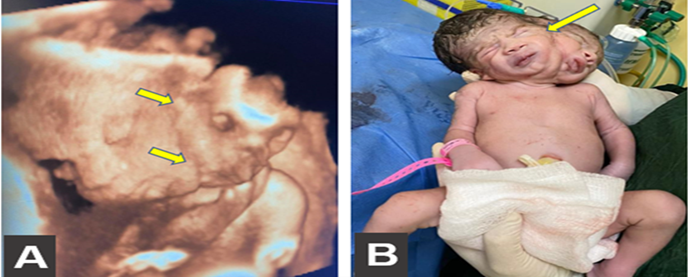
Background: Dicephalus parapagus twinning (DPT) is the rarest conjoined twinning entity of all conjoined twins. The presence of DPT is always associated with mortality before or after delivery. Antenatal diagnosis is crucial for planning labor, assembling a team, and providing counseling. Case presentation: A 23-year-old patient (G2P1A0) at 21 weeks of pregnancy attended the ultrasound clinic for routine care. A monoamniotic-monochorionic pregnancy was observed; the twin fetuses had two heads but one body, which corresponded to dicephalus parapagus twinning. A detailed ultrasound and fetal echocardiography reveal one heart without congenital anomalies. The liver, kidneys, and bladder appeared to be normally developed. Fetal MRI and karyotyping were not carried out after counseling the parents regarding the poor outcome. A multidisciplinary team followed the case; the patient chose to continue the pregnancy. A planned elective cesarean delivery was done at 36 weeks in a tertiary medical facility. A 3,200 g newborn baby boy was delivered alive; however, he quickly developed respiratory insufficiency and failure of heart function. He deceased within 4 hours of birth; an autopsy was declined. Conclusion: The prenatal diagnosis of DPT helps manage the case thoroughly and carefully to avoid maternal complications. All cases of DPT have a very poor prognosis. Prenatal confirmation permits structured, proactive management rather than emergent, multidisciplinary responses.
Downloads
References
Boer LL, Winter E, Gorissen B, Oostra RJ. Phenotypically discordant anomalies in conjoined twins: quirks of nature governed by molecular pathways? Diagnostics (Basel). 2023;13(22):3427. doi: 10.3390/diagnostics13223427. DOI: https://doi.org/10.3390/diagnostics13223427
Ferrer-Vaquer A, Hadjantonakis AK. Birth defects associated with perturbations in preimplantation, gastrulation, and axis extension: from conjoined twinning to caudal dysgenesis. Wiley Interdiscip Rev Dev Biol. 2013;2(4):427-442. doi: 10.1002/wdev.97. DOI: https://doi.org/10.1002/wdev.97
Gondal MF, Butt NU, Iftkhar U, Atique H, Abbasi J, Fraz MO, et al. Beyond conjoined: a tale of successful separation of pyopagus twins. Glob Pediatr. 2024;9:100226. doi: 10.1016/j.gpeds.2024.100226 DOI: https://doi.org/10.1016/j.gpeds.2024.100226
Shah UK, Shah D, Rijal P, Yadav K, Bista M, Lamichhane S, et al. Dicephalic parapagus dibrachius tripus conjoined twins: a case report of an unusual twinning phenomenon. Clin Case Rep. 2025;13(10):e70956. doi: 10.1002/ccr3.70956 DOI: https://doi.org/10.1002/ccr3.70956
Karaer A, Tanrıkulu I, Güneş N, Cakır E, Oztaş A. Parapagus dicephalus dibrachus dipus: A case of conjoined twins. J Turk Ger Gynecol Assoc. 2009;10(4):241-243. PMID: 24591881.
Sanhal CY, Ozekinci M, Mendilcioglu I, Sakinci M, Simsek M. Prenatal diagnosis of total type 1 vertical craniopagus with three-dimensional sonography. J Ultrasound Med. 2014;33(1):179-181. doi: 10.7863/ultra.33.1.179. DOI: https://doi.org/10.7863/ultra.33.1.179
Ulker K, Akyer SP, Temur I, Tan T, Karaca M, Adiguzel E, et al. First trimester diagnosis of parapagus diprosopus dibrachius dipus twins with craniorachischisis totalis by three-dimensional ultrasound. J Obstet Gynaecol Res. 2012;38(2):431-434. doi: 10.1111/j.1447-0756.2011.01708.x. DOI: https://doi.org/10.1111/j.1447-0756.2011.01708.x
Gothwal M, Sharma C, Yadav G, Singh P, Raikar S. Dicephalus parapagus conjoined twin: a rare case with review of literature. Int J Reprod Contracept Obstet Gynecol. 2018;7(8):3410-3412. doi: 10.18203/2320-1770.ijrcog20183357. DOI: https://doi.org/10.18203/2320-1770.ijrcog20183357
Harma MI, Harma M, Mil Z, Oksuzler C. Vaginal delivery of dicephalic parapagus conjoined twins: case report and literature review. Tohoku J Exp Med. 2005;205:179-185. doi: 10.1620/tjem.205.179. DOI: https://doi.org/10.1620/tjem.205.179
Camuzcuoglu H, Toy H, Vural M, Cece H, Aydin H. Prenatal diagnosis of dicephalic parapagus conjoined twins. Arch Gynecol Obstet. 2010;281(3):565-567. doi: 10.1007/s00404-009-1219-5. DOI: https://doi.org/10.1007/s00404-009-1219-5
Kaveh M, Kamrani K, Naseri M, Danaeian M, Asadi F, Davari-Tanha F. Dicephalic parapagus tribrachius conjoined twins in a triplet pregnancy: a case report. J Fam Reprod Health. 2014;8(2):83. PMID: 24971140.
Yadav A, Yadav M. Dicephalic parapagus with neural tube defect: a case report. J Evol Med Dent Sci. 2014;3(28):7763-7767. doi:10.14260/jemds/2014/2968.
N’Guessan E, N’Guessan RK, Gbeli F, Guie P. (2019). A rare case of dicephalic parapagus conjoined twins. Int J Reprod Contracept Obstet Gynecol. 2019;9(1);415–417. doi: 10.18203/2320-1770.ijrcog20196057. DOI: https://doi.org/10.18203/2320-1770.ijrcog20196057
Banjarnahor DPP, Wardhana MP, Sulistyono A. Case Report : Dicephalic parapagus conjoined twins. Int J Health Sci. 2022;6(S7):2992–2997. doi: 10.53730/ijhs.v6nS7.12443. DOI: https://doi.org/10.53730/ijhs.v6nS7.12443
Guerrero Cevallos ER, Ruiz Jumbo KL, Madrid Montesdeoca JE. Gemelos parápagos dicéfalos: reporte de caso. Alfa Publicaciones. 2023. doi: 10.25077/aoj.8.2.815-822.2024. DOI: https://doi.org/10.33262/ap.v5i2.1.353
Febrianda A, Sriyanti R. Dicephalus parapagus conjoined twins. Andalas Obstet Gynecol J. 2024;8(2):815-822. doi: 10.25077/aoj.8.2.815-822.2024. DOI: https://doi.org/10.25077/aoj.8.2.815-822.2024
Kenner C, Press J, Ryan D. Recommendations for palliative and bereavement care in the NICU: a family-centered integrative approach. J Perinatol. 2015;35(Suppl 1):S19-23. doi: 10.1038/jp.2015.145. DOI: https://doi.org/10.1038/jp.2015.145
Hara K, Kikuchi A, Miyachi K, Sunagawa S, Takagi K. Clinical features of polyhydramnios associated with fetal anomalies. Congenit Anom (Kyoto). 2006;46(4):177-179. doi: 10.1111/j.1741-4520.2006.00125.x. DOI: https://doi.org/10.1111/j.1741-4520.2006.00125.x
Hassan WN, Shallal F, Roomi AB. Prediction of successful induction of labor using ultrasonic fetal parameters. Curr Womens Health Rev. 2022;18(1):134-139. doi: 10.2174/1573404817666210105151803. DOI: https://doi.org/10.2174/1573404817666210105151803
Yaseen MJ, Neamaa EK, Haji GF. Assessment of High Risk Pregnant Women by Fetal Echocardiography. Al-Rafidain J Med Sci. 2024;7(2):157–162. doi: 10.54133/ajms.v7i2.1476. DOI: https://doi.org/10.54133/ajms.v7i2.1476
Deignan JL, De Castro M, Horner VL, Johnston T, Macaya D, Maleszewski JJ, et al. Points to consider in the practice of postmortem genetic testing: a statement of the American College of Medical Genetics and Genomics (ACMG). Genet Med. 2023;25(5):100017. doi: 10.1016/j.gim.2023.100017. DOI: https://doi.org/10.1016/j.gim.2023.100017
Bouya CC, Karoui A, Rouis H, Nadia B, Jaouadi R, Menjli S, et al . Conjoined parapagus dicephalus twins: about two cases with confrontation between ultrasound and fetopathological examination. Ultrasound Obstetr Gynecol. 2021;2;58. doi: 10.1002/uog.24233. DOI: https://doi.org/10.1002/uog.24233
Pelayo I, Sancho J, Abarca LL, Cabezas E, Lazaro J, Diaz‐Recuero J. Conjoined twins: rare case of dicephalus parapagus–first trimester ultrasound diagnosis. Ultrasound Obstetr Gynecol. 2019;54. doi: 10.1002/uog.21577. DOI: https://doi.org/10.1002/uog.21577
Downloads
Published
How to Cite
Issue
Section
License
Copyright (c) 2026 Al-Rafidain Journal of Medical Sciences ( ISSN 2789-3219 )

This work is licensed under a Creative Commons Attribution-NonCommercial-ShareAlike 4.0 International License.
Published by Al-Rafidain University College. This is an open access journal issued under the CC BY-NC-SA 4.0 license (https://creativecommons.org/licenses/by-nc-sa/4.0/).