Percutaneous Partial Plantar Fascia Release as a Minimally Invasive Treatment Following Failure of Conservative Management for Chronic Plantar Fasciitis: A Prospective Study
DOI:
https://doi.org/10.54133/ajms.v10i2.2938Keywords:
Fasciitis, Fasciotomy, Minimally invasive surgical procedures , Plantar , Visual analogue scaleAbstract
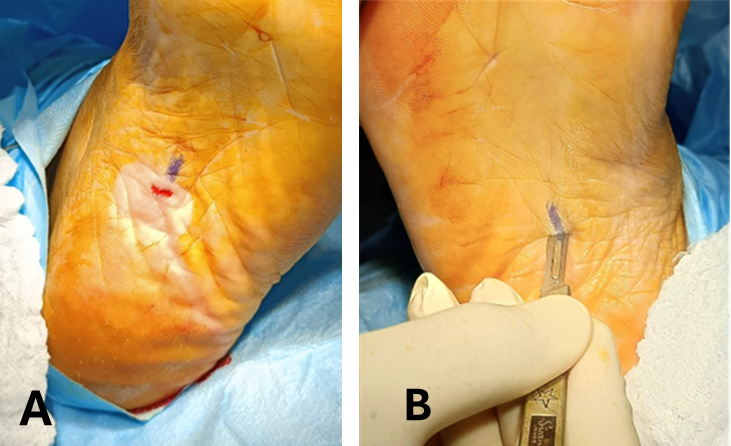
Background: Chronic recalcitrant plantar fasciitis influences 5–10% of patients who are unresponsive to conservative treatment, necessitating surgical intervention. Percutaneous partial plantar fascia release is an emerging minimally invasive technique, but there is limited prospective evidence available proving the safety and effectiveness of the technique under general anesthesia. Objective: To evaluate the clinical outcomes, safety, and efficacy of percutaneous partial plantar fascia release done under general anesthesia. Methods: This prospective interventional study comprised 32 patients with chronic plantar fasciitis, unresponsive to a minimum of six months of conservative management. All patients underwent percutaneous medial plantar fascia release under general anesthesia. We used the visual analog scale (VAS) and the American Orthopedic Foot and Ankle Society (AOFAS) score to measure the outcomes of surgical intervention at baseline and six months after surgery. Results: The mean VAS score decreased from 8.1±0.9 preoperatively to 1.6±0.8 at six months after surgery (−6.5; p<0.001). The mean AOFAS score increased from 46.73±8.73 to 93.80±10.46 (47.07; p<0.001). There was no significant difference between the patients with calcaneal spur and those without it (p > 0.05). Complications were infrequent (6.25%). Conclusions: Percutaneous partial release of the plantar fascia under general anesthesia is a safe and effective minimally invasive procedure for chronic plantar fasciitis that provides significant pain relief and improves functional status with a minimal incidence of complications. Large-scale comparative studies with extended follow-up are needed.
Downloads
References
Gautham P, Nuhmani S, Kachanathu SJ. Plantar fasciitis - an update. Bangladesh J Med Sci. 2015;14:3–8. doi: 10.3329/bjms.v14i1.17052. DOI: https://doi.org/10.3329/bjms.v14i1.17052
Latt LD, Jaffe DE, Tang Y, Taljanovic MS. Evaluation and treatment of chronic plantar fasciitis. Foot Ankle Orthop. 2020;5. doi.: 10.1177/2473011419896763. DOI: https://doi.org/10.1177/2473011419896763
Tseng WC, Chen YC, Lee TM, Chen WS. Plantar fasciitis: an updated review. J Med Ultrasound. 2023;31:268. doi: 10.4103/jmu.jmu_2_23. DOI: https://doi.org/10.4103/jmu.jmu_2_23
Trojian T, Tucker AK. Plantar fasciitis. Am Fam Physician. 2019;99:744–50. PMID: 31194492.
Hamstra-Wright KL, Huxel Bliven KC, Bay RC, Aydemir B. Risk factors for plantar fasciitis in physically active individuals: a systematic review and meta-analysis. Sports Health. 2021;13:296–303. doi: 10.1177/1941738120970976. DOI: https://doi.org/10.1177/1941738120970976
Rhim HC, Kwon J, Park J, Borg-Stein J, Tenforde AS. A systematic review of systematic reviews on the epidemiology, evaluation, and treatment of plantar fasciitis. Life (Basel). 2021;11. doi: 10.3390/life11121287. DOI: https://doi.org/10.3390/life11121287
Di Caprio F, Gigli M, Ponziani L. Plantar fasciitis: a literature review. J Orthop Trauma Rehabil. 2025; 32:221–227. doi: 10.1177/22104917241303777. DOI: https://doi.org/10.1177/22104917241303777
Beauperthuy AG, Homolka L, Waldron P, Falgiano PA, Rowland RJ, Mercadal G, et al. Combination endoscopic plantar fasciotomy and gastrocnemius recession in the treatment of recalcitrant plantar fasciitis: clinical outcomes from a case series. Foot Ankle Orthop. 2026;11. doi: 10.1177/24730114251412894. DOI: https://doi.org/10.1177/24730114251412894
Nweke TC. Comprehensive review and evidence-based treatment framework for optimizing plantar fasciitis diagnosis and management. Cureus. 2025;17:e88745. doi: 10.7759/cureus.88745. DOI: https://doi.org/10.7759/cureus.88745
Macinnes A, Roberts SC, Kimpton J, Pillai A. Long-term outcome of open plantar fascia release. Foot Ankle Int. 2016;37:17–23. doi: 10.1177/1071100715603189. DOI: https://doi.org/10.1177/1071100715603189
Yu J, An J, Wang S, Liu W, Bu Z, Huang J, et al. Endoscopic plantar fascia release via dual medial deep fascia approach for refractory plantar fasciitis: an effective, safe, and rapid surgical approach. Int Orthop. 2025;49:1373. doi: 10.1007/s00264-025-06499-z. DOI: https://doi.org/10.1007/s00264-025-06499-z
Ward L, Mercer NP, Azam MT, Hoberman A, Hurley ET, Butler JJ, et al. Outcomes of endoscopic treatment for plantar fasciitis: a systematic review. Foot Ankle Spec. 2025;18:193–201. doi: 10.1177/19386400221129167. DOI: https://doi.org/10.1177/19386400221129167
Balalis KM, Dimitriou R, Balalis M, Christoforidis C, Chaniotakis C, Siligardou MR, et al. Clinical outcomes of percutaneous plantar fasciotomy in patients with refractory plantar fasciitis: a retrospective cohort study. Maedica (Bucur). 2025;20. doi: 10.26574/maedica.2025.20.4.753. DOI: https://doi.org/10.26574/maedica.2025.20.4.753
Landorf KB, Twyford GN, Cotchett MP, Whittaker GA. Revised minimal important difference values for the visual analog scale and Foot Health Status Questionnaire when used for plantar heel pain. J Foot Ankle Res. 2024;17:e70021. doi: 10.1002/JFA2.70021. DOI: https://doi.org/10.1002/jfa2.70021
Negm MA, Elshal EA, Abdelkader ME. Percutaneous release of plantar fasciitis. Al-Azhar Assiut Med J. 2024;22:1–6. doi: 10.4103/azmj.azmj_210_20. DOI: https://doi.org/10.4103/azmj.azmj_210_20
Kandasamy S, Valencia A, Turner A, Wang J, Liu GT, Vanpelt MD. Percutaneous ultrasonic tenotomy for patients with plantar fasciitis: a retrospective review. J Orthop Exp Innov. 2026;7:2026. doi: 10.60118/001c.143383. DOI: https://doi.org/10.60118/001c.143383
Maes R, Safar A, Ghistelinck B, Labadens A, Hernigou J. Percutaneous plantar fasciotomy: radiological evolution of medial longitudinal arch and clinical results after one year. Int Orthop. 2021;46:861–866. doi: 10.1007/s00264-021-05186-z. DOI: https://doi.org/10.1007/s00264-021-05186-z
Yilmaz E, Kirac M, Yozgatli TK, Bayram B, Ulku TK, Kocaoglu B. Comparison of endoscopic plantar fascia release with and without calcaneal spur excision for recalcitrant plantar fasciitis. Foot Ankle Orthop. 2026;11. doi: 10.1177/24730114261427476. DOI: https://doi.org/10.1177/24730114261427476
De Prado M, Cuervas-Mons M, De Prado V, Golanó P, Vaquero J. Does the minimally invasive complete plantar fasciotomy result in deformity of the plantar arch? A prospective study. Foot Ankle Surg. 2020;26:347–353. doi: 10.1016/j.fas.2019.04.010. DOI: https://doi.org/10.1016/j.fas.2019.04.010
Bashi SAK, Isam Y. Functional outcome of mid-sole percutaneous plantar fasciotomy versus open plantar fasciotomy in treatment of refractory plantar fasciitis. Genij Ortop. 2026;32:65–73. doi: 10.18019/1028-4427-2026-32-1-65-73. DOI: https://doi.org/10.18019/1028-4427-2026-32-1-65-73
Cheung JTM, An KN, Zhang M. Consequences of partial and total plantar fascia release: a finite element study. Foot Ankle Int. 2006;27:125–132. doi: 10.1177/107110070602700210. DOI: https://doi.org/10.1177/107110070602700210
Brugh AM, Fallat LM, Savoy-Moore RT. Lateral column symptomatology following plantar fascial release: a prospective study. J Foot Ankle Surg. 2002;41:365–371. doi: 10.1016/S1067-2516(02)80082-5. DOI: https://doi.org/10.1016/S1067-2516(02)80082-5
Thordarson DB, Kumar PJ, Hedman TP, Ebramzadeh E. Effect of partial versus complete plantar fasciotomy on the windlass mechanism. Foot Ankle Int. 1997;18:16–20. doi: 10.1177/107110079701800104. DOI: https://doi.org/10.1177/107110079701800104
Fallat LM, Cox JT, Chahal R, Morrison P, Kish J. A retrospective comparison of percutaneous plantar fasciotomy and open plantar fasciotomy with heel spur resection. J Foot Ankle Surg. 2013;52:288–290. doi: 10.1053/j.jfas.2012.10.005. DOI: https://doi.org/10.1053/j.jfas.2012.10.005
Downloads
Published
How to Cite
Issue
Section
License
Copyright (c) 2026 Al-Rafidain Journal of Medical Sciences ( ISSN 2789-3219 )

This work is licensed under a Creative Commons Attribution-NonCommercial-ShareAlike 4.0 International License.
Published by Al-Rafidain University College. This is an open access journal issued under the CC BY-NC-SA 4.0 license (https://creativecommons.org/licenses/by-nc-sa/4.0/).