Short-term Course of PDA in Preterm Infants with RDS and Factors Associated with its Persistence
Keywords:
Mechanical ventilation, NCPAP, Patent ductus arteriosus, Respiratory support, SurfactantAbstract
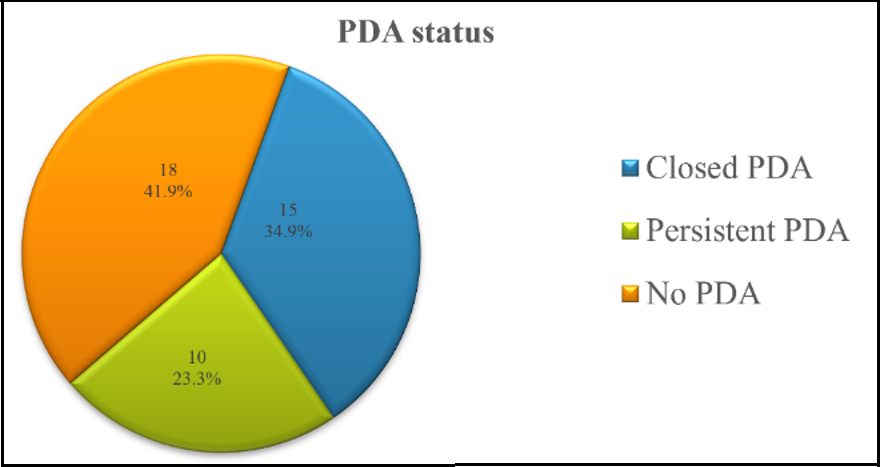
Background: Patent ductus arteriosus (PDA) refers to the continued existence postnatally of the fetal link (ductus arteriosus) connecting the aorta and the pulmonary artery. Objective: determine whether the surfactant replacement therapy used for the treatment of respiratory distress syndrome (RDS) is affecting the incidence and/or the closure of PDA. Also to study the different treatment strategies for RDS and PDA and its effects on the PDA closure in preterm infants. Methods: A prospective observational study done in the neonatal intensive care unit in a tertiary center in Baghdad, Iraq. The study was conducted from July 2024 to February 2025. The patients included in the study are all preterm infants less than 37 weeks' gestational age who were diagnosed with RDS and treated for that by either nasal continuous positive airway pressure (CPAP), mechanical ventilation (MV), or both. Results: 43 preterm infants were included with a median gestational age at labor of 30 (IQR=8-33) weeks; birth weight ranged between 750 and 2250 grams with a median of 1400 grams (IQR=1100-1900). Males were the dominant contributor, accounting for 60.5%. Only 20.9% of infants were breastfed, 46.5% were on formula, and 32.6% received mixed feeding. The closure of PDA occurred in 15 (34.9%) infants, while closure failed (persistent PDA) in 10 (23.3%) and 18 (41.9%) remained with no PDA. Conclusions: There was no difference in the treatment of PDA between infants who received surfactant and those who received respiratory support with NCPAP or MV, despite the increased number of closed PDAs in treated infants; however, there was a significant difference in PDA closure based on whether the infants received treatment.
Downloads
References
1. Doherty TM, Hu A, Salik I. Physiology, Neonatal. 2023. In: StatPearls [Internet]. Treasure Island (FL): StatPearls Publishing; 2026 Jan–. PMID: 30969662.
2. Alwahab Mahdy SA, Alwahab Mahdi NA. Death rate and causes of death in the neonatal intensive care unit in the Children Welfare Teaching Hospital (2018-2021). J Fac Med Baghdad. 2023;65. doi: 10.32007/jfacmedbagdad.2047.
3. Backes CH, Hill KD, Shelton EL, Slaughter JL, Lewis TR, Weisz DE, et al. Patent ductus arteriosus: A contemporary perspective for the pediatric and adult cardiac care provider. J Am Heart Assoc. 2022;11. doi: 10.1161/JAHA.122.025784.
4. Sweet DG, Carnielli VP, Greisen G, Hallman M, Klebermass-Schrehof K, Ozek E, et al. European consensus guidelines on the management of respiratory distress syndrome: 2022 Update. Neonatology. 2023;120. doi: 10.1159/000528914.
5. Budajaja F, Lahage N, Hand IL. Non-invasive surfactant administration in preterm infants. Children. 2026;13. doi: 10.3390/children13010150.
6. Al-shehri H. Targeted neonatal echocardiography in neonatal patent ductus arteriosus management: A systematic review of clinical utility and outcomes. Medicina (Lithuania). 2025;61. doi: 10.3390/medicina61081442.
7. McNamara PJ, Jain A, El-Khuffash A, Giesinger R, Weisz D, Freud L, et al. Guidelines and recommendations for targeted neonatal echocardiography and cardiac point-of-care ultrasound in the neonatal intensive care unit: An update from the American Society of Echocardiography. J Am Soc Echocardiography. 2024;37. doi: 10.1016/j.echo.2023.11.016.
8. Buvaneswarran S, Wong YL, Liang S, Quek SC, Lee J. Active treatment vs. expectant management of patent ductus arteriosus in preterm infants: A meta-analysis. JAMA Pediatr. 2025;179. doi: 10.1001/jamapediatrics.2025.1025.
9. Dani C, Lista G, Bianchi S, Mosca F, Schena F, Ramenghi L, et al. Intravenous paracetamol in comparison with ibuprofen for the treatment of patent ductus arteriosus in preterm infants: a randomized controlled trial. Eur J Pediatr. 2021;180. doi: 10.1007/s00431-020-03780-8.
10. Khan SZ, Lengyel CG. Challenges in the management of colorectal cancer in low- and middle-income countries. Cancer Treat Res Commun. 2023;35. doi: 10.1016/j.ctarc.2023.100705.
11. Foligno S, Luca D De. Porcine versus bovine surfactant therapy for RDS in preterm neonates: Pragmatic meta-analysis and review of physiopathological plausibility of the effects on extra-pulmonary outcomes. Respir Res. 2020;21. doi: 10.1186/s12931-019-1267-8.
12. Cucerea M, Moscalu M, Ognean ML, Fagarasan A, Toma D, Marian R, et al. Impact of early surfactant administration on ductus arteriosus assessed at 24 h in preterm neonates less than 32 weeks of gestational age. Biomedicines. 2024;12. doi: 10.3390/biomedicines12061136.
13. Gupta S, Subhedar NV, Bell JL, Field D, Bowler U, Hutchison E, et al. Trial of selective early treatment of patent ductus arteriosus with ibuprofen. New Engl J Med. 2024;390. doi: 10.1056/nejmoa2305582.
14. Bixler GM, Powers GC, Clark RH, Walker MW, Tolia VN. Changes in the diagnosis and management of patent ductus arteriosus from 2006 to 2015 in United States Neonatal Intensive Care Units. J Pediatr. 2017;189. doi: 10.1016/j.jpeds.2017.05.024.
15. Yaseen MJ, Alwahab SA, Akram NN, Nori W. Transcatheter balloon valvuloplasty for children with severe pulmonary valve stenosis: A single-center experience. Acta Marisiensis - Seria Medica. 2025;71:18–24. doi: 10.2478/amma-2025-0005.
16. Santos J, Soares P, Ferreras C, Flor-de-Lima F, Guimarães H. Patent ductus arteriosus in preterm newborns: A tertiary hospital experience. Revista Portuguesa de Cardiologia. 2022;41. doi: 10.1016/j.repc.2021.01.008.
17. Ohlsson A, Shah PS. Paracetamol (acetaminophen) for patent ductus arteriosus in preterm or low birth weight infants. Cochrane Database Syst Rev. 2018;2018. doi: 10.1002/14651858.CD010061.pub3.
18. Bardanzellu F, Neroni P, Dessì A, Fanos V. Paracetamol in patent ductus arteriosus treatment: efficacious and safe? Biomed Res Int. 2017;2017. doi: 10.1155/2017/1438038.
19. Mitra S, Florez ID, Tamayo ME, Mbuagbaw L, Vanniyasingam T, Veroniki AA, et al. Association of placebo, indomethacin, ibuprofen, and acetaminophen with closure of hemodynamically significant patent ductus arteriosus in preterm infants a systematic review and meta-analysis. JAMA. 2018;319. doi: 10.1001/jama.2018.1896.
20. Loomba R, Nijhawan K. Ibuprofen versus indomethacin for medical closure of the patent arterial duct: A pooled analysis by route of administration. Cureus. 2015. doi: 10.7759/cureus.274.
21. Ohlsson A, Walia R, Shah SS. Ibuprofen for the treatment of patent ductus arteriosus in preterm or low birth weight (or both) infants. Cochrane Database Syst Rev. 2020;2020. doi: 10.1002/14651858.CD003481.pub8.
22. Huang X, Wang F, Wang K. Paracetamol versus ibuprofen for the treatment of patent ductus arteriosus in preterm neonates: a meta-analysis of randomized controlled trials. J Maternal Fetal Neonat Med. 2018;31. doi: 10.1080/14767058.2017.1338263.
Downloads
Published
How to Cite
Issue
Section
License
Copyright (c) 2026 Al-Rafidain Journal of Medical Sciences ( ISSN 2789-3219 )

This work is licensed under a Creative Commons Attribution-NonCommercial-ShareAlike 4.0 International License.
Published by Al-Rafidain University College. This is an open access journal issued under the CC BY-NC-SA 4.0 license (https://creativecommons.org/licenses/by-nc-sa/4.0/).