The Frequency and Severity of Nasal Trauma Secondary to Nasal Continuous Positive Airway Pressure in Neonates
DOI:
https://doi.org/10.54133/ajms.v10i1.2712Keywords:
NCPAP, Nasal trauma , Neonates , Pressure injury , Risk Factors , Severity progressionAbstract
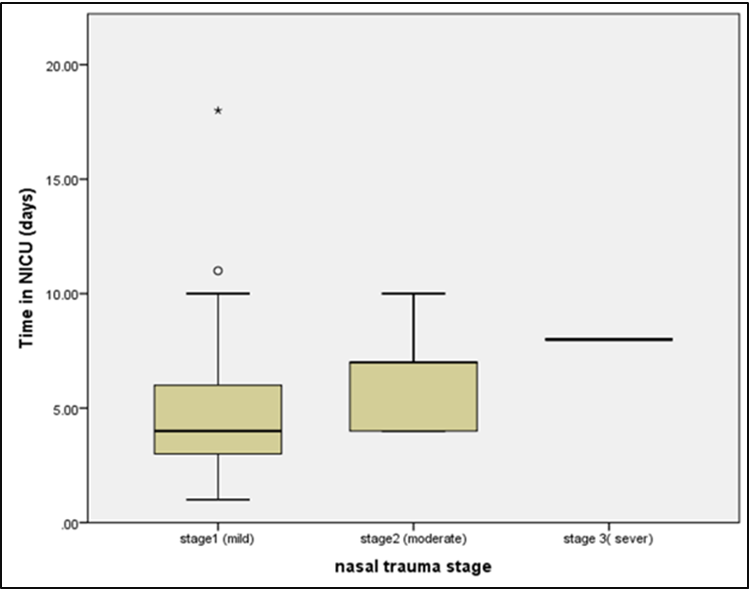
Background: Nasal trauma is a well-recognized iatrogenic complication in neonates with respiratory distress using nasal continuous positive airway pressure (NCPAP). The severity of nasal injury ranges from mild erythema to necrosis. Objective: to determine the frequency of nasal trauma and risk factors associated with the severity progression secondary to NCPAP. Methods: A prospective observational study was conducted in Mosul City. Newborns who received NCPAP were included to assess nasal trauma and its severity. Univariate and multivariate logistic regression were used to identify factors associated with the nasal trauma. The Mann-Whitney U test was used to compare continuous variables and nasal trauma stages, and the effect sizes were reported. Results: The incidence of nasal trauma was 46.2%. In univariate analysis, factors associated with increased odds of trauma were lower gestational age (OR=3.367; p<0.001), lower birth weight (OR=2.923; p<0.001), and NICU stay ≥7 days (OR=2.507; p=0.049), while the duration of NCPAP was not statistically significant (OR=1.341; p=0.515). However, in the multivariate analysis, none of the factors emerged as an independent predictor. NICU stay ≥7 days in the Mann-Whitney U test was the only significant predictor of severity progression (p=0.034), with a medium to large effect size. Conclusions: Nasal trauma is a common and significant complication of NCPAP in neonates. Severity is usually mild, but moderate and severe cases do occur. Lower gestational age, lower birth weight, and longer NCPAP duration are risk factors for nasal injury, but prolonged NICU stay appeared to be a strong predictor for nasal trauma progression.
Downloads
References
Prakash R, De Paoli AG, Davis PG, Oddie SJ, McGuire W. Bubble devices versus other pressure sources for nasal continuous positive airway pressure in preterm infants. Cochrane Database Syst Rev. 2023;3(3): CD015130. doi: 10.1002/14651858.CD015130. DOI: https://doi.org/10.1002/14651858.CD015130
Massa-Buck B, Rastogi D, Rastogi S. Complications associated with incorrect use of nasal CPAP. J Perinatol. 2023;43:975–981. doi: 10.1038/s41372-023-01700-w. DOI: https://doi.org/10.1038/s41372-023-01700-w
Wu Y, Lv J, Xu J, Zhang S, Zhang L, Fu L. Application of a photoelectric magnifier to nasal injury in preterm infants receiving non-invasive ventilation: A prospective observational study. J Tissue Viability. 2022;31:130–134. doi: 10.1016/j.jtv.2021.08.005. DOI: https://doi.org/10.1016/j.jtv.2021.08.005
Dai T, Lv L, Liu X, Chen J, Ye Y, Xu L. Nasal pressure injuries due to nasal continuous positive airway pressure treatment in newborns: A prospective observational study. J Wound Ostomy Continence Nurs. 2020;47:26–31. doi:10.1097/WON.0000000000000604 DOI: https://doi.org/10.1097/WON.0000000000000604
Rezaei P, Jafari-Mianaeib S, Sadeghnia A, Heidari Z. Protective dressings, injury, and device failure in preterm infants receiving nasal continuous positive airway pressure: A randomized controlled trial. Adv Skin Wound Care. 2021;34:1–6. doi: 10.1097/01.ASW.0000767344.37591.b6. DOI: https://doi.org/10.1097/01.ASW.0000767344.37591.b6
Fischer C, Bertelle V, Hohlfeld J, Forcada-Guex M, Stadelmann-Diaw C, Tolsa JF. Nasal trauma due to continuous positive airway pressure in neonates. Arch Dis Child Fetal Neonatal Ed. 2010;95. doi: 10.1136/adc.2009.179416. DOI: https://doi.org/10.1136/adc.2009.179416
Bashir T, Murki S, Kiran S, Reddy VK, Oleti TP. “Nasal mask” in comparison with “nasal prongs” or “rotation of nasal mask with nasal prongs” reduces the incidence of nasal injury in preterm neonates supported on nasal continuous positive airway pressure (nCPAP): A randomized controlled trial. PLoS One. 2019;14. doi: 10.1371/journal.pone.0211476. DOI: https://doi.org/10.1371/journal.pone.0211476
Gautam G, Gupta N, Sasidharan R, Thanigainathan S, Yadav B, Singh K, et al. Systematic rotation versus continuous application of ‘nasal prongs’ or ‘nasal mask’ in preterm infants on nCPAP: a randomized controlled trial. Eur J Pediatr. 2023;182:2645–2654. doi: 10.1007/s00431-023-04933-1. DOI: https://doi.org/10.1007/s00431-023-04933-1
Chen CY, Chou AK, Chen YL, Chou HC, Tsao PN, Hsieh WS. Quality improvement of nasal continuous positive airway pressure therapy in neonatal intensive care unit. Pediatr Neonatol. 2017;58:229–235. doi: 10.1016/j.pedneo.2016.04.005. DOI: https://doi.org/10.1016/j.pedneo.2016.04.005
Imbulana DI, Manley BJ, Dawson JA, Davis PG, Owen LS. Nasal injury in preterm infants receiving non-invasive respiratory support: a systematic review. Arch Dis Child Fetal Neonatal Ed. 2018;103: F29–35. doi: 10.1136/archdischild-2017-313418. DOI: https://doi.org/10.1136/archdischild-2017-313418
Bartella AK, Halama D, Pausch NC, Lethaus B. Persistent fistula of the palate: Cleft surgery meets microsurgery for the next rung of the ladder. Plast Reconstr Surg. 2021;147:178e–179e. doi: 10.1097/PRS.0000000000007479. DOI: https://doi.org/10.1097/PRS.0000000000007479
Gong T, Yu JL, Yang H, Tang YF, Huang A, Wang YX. Prevention of nasal injury in preterm infants during positive pressure ventilation: a systematic review of interface and dressing selection. BMC Pediatr. 2025;25(1):423. doi: 10.1186/s12887-025-05700-x. DOI: https://doi.org/10.1186/s12887-025-05875-3
Shamim M, Patra T, Kumari N. A randomized controlled comparative assessment of the of incidence and severity of nasal complications while using nasal prongs and nasal mask as CPAP interface in preterm neonates. Int J Pharm Clin Res. 2023;15(1):832–837.
Sharma D, Kaur A, Farahbakhsh N, Agarwal S. To compare nasal mask with binasal prongs in delivering continuous positive airway pressure for reducing need of invasive ventilation: randomized controlled trial. J Matern Fetal Neonatal Med. 2021;34:1890–1896. doi: 10.1080/14767058.2019.1651272. DOI: https://doi.org/10.1080/14767058.2019.1651272
Singh J, Bhardwar V, Chirla D. To compare the efficacy and complication of nasal prongs vs nasal mask CPAP in neonates. Int J Med Dent Sci. 2017;6:1392. doi: 10.19056/IJMDSJSSMES/2017/V6I1/125561. DOI: https://doi.org/10.19056/ijmdsjssmes/2017/v6i1/125561
Ribeiro DFC, Barros FS, Fernandes BL, Nakato AM, Nohama P. Incidence and severity of nasal injuries in preterm infants associated to non-invasive ventilation using short binasal prong. Glob Pediatr Health. 2021;8:2333794X211010459. doi: 10.1177/2333794X211010459. DOI: https://doi.org/10.1177/2333794X211010459
Newnam KM, McGrath JM, Salyer J, Estes T, Jallo N, Bass WT. A comparative effectiveness study of continuous positive airway pressure-related skin breakdown when using different nasal interfaces in the extremely low birth weight neonate. Appl Nurs Res. 2015;28:36–41. doi: 10.1016/j.apnr.2014.05.005. DOI: https://doi.org/10.1016/j.apnr.2014.05.005
Camillo DF, Barros FS, Costa TD, Nohama P. Incidence and risks associated with nasal injury in newborns undergoing non-invasive ventilation through the binasal prong. In: Torres I, Bustamante J, Sierra D, editors. VII Latin American Congress on Biomedical Engineering CLAIB 2016, IFMBE Proceedings, vol 60. Singapore: Springer; 2017, p. 469–472. doi: 10.1007/978-981-10-4086-3_118. DOI: https://doi.org/10.1007/978-981-10-4086-3_118
Pascual A, Wielenga JM. Nasal pressure injuries among newborns caused by nasal CPAP: An incidence study. J Neonatal Nurs. 2023;29:477–481. doi: 10.1016/j.jnn.2022.09.006. DOI: https://doi.org/10.1016/j.jnn.2022.09.006
Naha N, Pournami F, Prabhakar J, Jain N. Nasal injury with continuous positive airway pressure: Need for “Privileging” nursing staff. Indian J Pediatr. 2019;86:595–598. doi: 10.1007/s12098-019-02960-1. DOI: https://doi.org/10.1007/s12098-019-02960-1
Khan J, Sundaram V, Murki S, Bhatti A, Saini SS, Kumar P. Nasal injury and comfort with jet versus bubble continuous positive airway pressure delivery systems in preterm infants with respiratory distress. Eur J Pediatr. 2017;176:1629–1635. doi: 10.1007/s00431-017-3016-7. DOI: https://doi.org/10.1007/s00431-017-3016-7
Downloads
Published
How to Cite
Issue
Section
License
Copyright (c) 2026 Al-Rafidain Journal of Medical Sciences ( ISSN 2789-3219 )

This work is licensed under a Creative Commons Attribution-NonCommercial-ShareAlike 4.0 International License.
Published by Al-Rafidain University College. This is an open access journal issued under the CC BY-NC-SA 4.0 license (https://creativecommons.org/licenses/by-nc-sa/4.0/).