Effectiveness of an AI-Based Educational Video Generator in Enhancing Oral Health Knowledge and Behavior Among Children: A Randomized Controlled Trial
DOI:
https://doi.org/10.54133/ajms.v11i2.3358Keywords:
Artificial intelligence, Children, Dental plaque index, Education, Oral health knowledgeAbstract
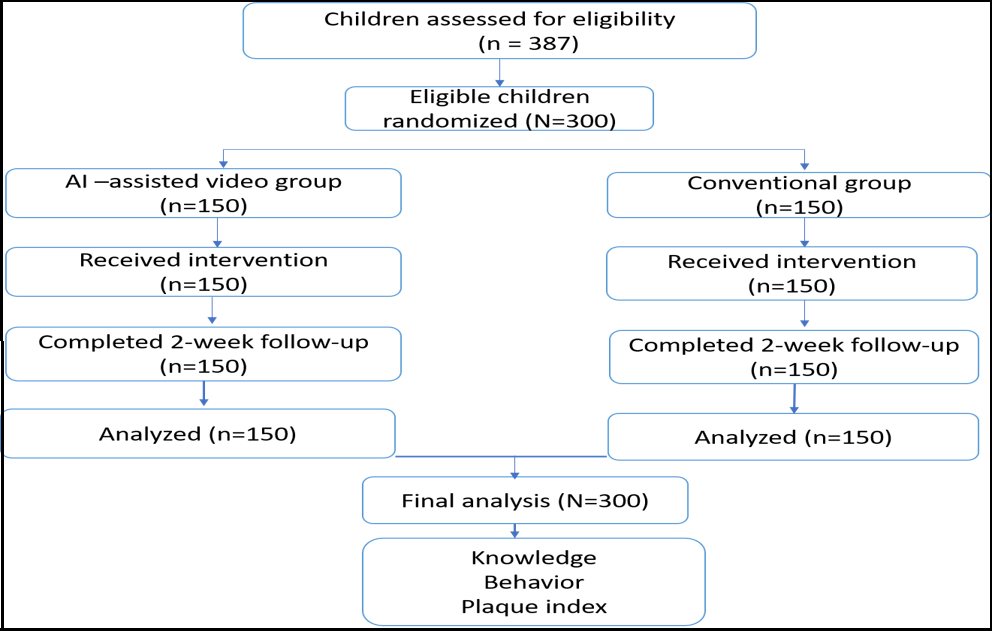
Background: Artificial intelligence (AI) is a new innovation that presents an opportunity for oral health education in children. Objective: To evaluate the effectiveness of an AI-assisted educational video versus standardized in-person oral health education for children regarding oral health knowledge and behaviors. Methods: This randomized controlled trial included 300 children aged 10-12 years (n=150 per group), both boys and girls, who were divided into AI video and standardized face-to-face oral health education groups. Baseline and 2-week follow-up evaluations were conducted for knowledge scores, four behavioral items, and the Silness and Löe Plaque Index. The internal consistency of the knowledge scale was checked (Cronbach's α=0.79). Wilcoxon signed-rank and Mann–Whitney U tests were the primary non-parametric tests used for statistical evaluations, with a median, (IQR), and effect size r provided. Chi-square tests with a Bonferroni adjustment at α=0.0125 were used to evaluate behavioral items. Results: There were significant enhancements in intra-group knowledge (p<0.0001 for both groups; r=0.663 for AI; r=0.345 for Control). The clinical efficacy was similar for both strategies with significant reduction of intra-group plaque (AI: p< 0.001, r= 0.425; Control: p< 0.001, r= 0.331), but no inter-group difference at the end of the intervention (p= 0.608; r= 0.030). In the conventional group, the utilization of dental floss was significantly improved (p=0.0056), and no other behaviors showed significant improvement across groups. Conclusions: The AI-assisted educational video demonstrated better knowledge retention than the standardized face-to-face oral health education, achieved similar clinical plaque reduction, and can be easily scaled for pediatric preventive dentistry.
Downloads
References
1. Kassebaum NJ, Smith AGC, Bernabé E, Fleming TD, Reynolds AE, Vos T, et al. Global, regional, and national prevalence of oral conditions. J Dent Res. 2017;96(4):380-387. doi: 10.1177/0022034517693566.
2. Peres MA, Macpherson LMD, Weyant RJ, Daly B, Venturelli R, Mathur MR, et al. Oral diseases: a global public health challenge. Lancet. 2019;394(10194):249-260. doi: 10.1016/S0140-6736(19)31146-8.
3. Tinanoff N, Baez RJ, Diaz Guillory C, Donly KJ, Feldens CA, McGrath C, et al. Early childhood caries epidemiology, etiology, risk assessment, societal burden, management, education, and policy. Pediatr Dent. 2019;41(3):16-23. PMID: 31302108.
4. Watt RG, Daly B, Allison P, Macpherson LMD, Venturelli R, Listl S, et al. Ending the neglect of global oral health. Lancet. 2019;394(10194):261-272. doi: 10.1016/S0140-6736(19)31133-X.
5. Khanagar SB, Al-Ehaideb A, Maganur PC, Vishwanathaih S, Patil S, Baeshen HA, et al. Developments, application, and performance of artificial intelligence in dentistry – a systematic review. J Dent Sci. 2021;16(1):508-522. doi: 10.1016/j.jds.2020.06.019.
6. Schwendicke F, Golla T, Krois J, Paris S. Artificial intelligence for oral health promotion. Caries Res. 2022;56(1):1-9. doi: 10.1159/000521227.
7. Lee JH, Yoon HJ. A review of artificial intelligence in dentistry. J Korean Dent Sci. 2021;14(1):1-6. doi: 10.5856/JKDS.2021.14.1.1.
8. Pagrut S, Reche AM, Madhu PP, Vishnani R, Deotare P, Toshniwal K, et al. Evaluating the effect of artificial intelligence-based oral health education model among 10 to 15-year-old children in Adivasi Ashram School of Central India - an interventional study. J Educ Health Promot. 2026;15:73. doi: 10.4103/jehp.jehp_561_25.
9. Lim JN, Nhu Ngoc VT, Vu TM, Lee JY. Experimental validation of an AI-driven digital healthcare platform for oral health behavior and plaque assessment among vietnamese children. Methods. 2026;254:50-58. doi: 10.1016/j.ymeth.2026.05.015.
10. Gautam A, Dhillon BS, Ramachandra SS, Sharma A. Efficacy of audiovisual aids vs. traditional teaching methods in imparting oral health education to school children: a randomized controlled trial. J Clin Exp Dent. 2018;10(11):e1085-e1091. doi: 10.4317/jced.55160.
11. Angelopoulou M, Oulis CJ, Kavvadia K. School-based oral health education program using experiential learning or instructional lectures in 10-to-12-year-old children. Int J Paediatr Dent. 2014;24(5):360-366. doi: 10.1111/ipd.12079.
12. Silness J, Löe H. Periodontal disease in pregnancy II. Correlation between oral hygiene and periodontal condition. Acta Odontol Scand. 1964;22(1):121-135. doi: 10.3109/00016356408993968.
13. Kim M, Duncan C, Yip S, Sankey D. Beyond the theoretical and pedagogical constraints of cognitive load theory, and towards a new cognitive philosophy in education. Educ Philos Theory. 2024:1-12. doi: 10.1080/00131857.2024.2441389.
14. Bali C, Tasdelen B, Bandi S, Zsidó A. Understanding the cognitive cost of multimedia learning: effects of visual load and language proficiency. Cogn Res Princ Implic. 2026;11(1):2. doi: 10.1186/s41235-025-00688-w.
15. Wang Y. A comparative study on the effectiveness of traditional and modern teaching methods. In: Proceedings of the 5th International Conference on Humanities Education and Social Sciences (ICHESS 2022). 2022. p. 270-277. doi: 10.2991/978-2-494069-89-3_32.
16. Aktas M, Cambon L, Aromatario O. Engagement of users in digital health applications: scoping review. JMIR Mhealth Uhealth. 2026;14(1):e66002. doi: 10.2196/66002.
17. Lally P, van Jaarsveld CH, Potts HW, Wardle J. How are habits formed: modelling habit formation in the real world. Eur J Soc Psychol. 2010;40(6):998-1009. doi: 10.1002/ejsp.674.
18. Yuan S, Humphris G, MacPherson LM, Ross AL, Freeman R. Communicating with parents and preschool children: a qualitative exploration of dental professional-parent-child interactions during paediatric dental consultations to prevent early childhood caries. Front Public Health. 2021;9:669395. doi: 10.3389/fpubh.2021.669395.
19. Schwab Y, Elias MJ. From compliance to responsibility: social-emotional learning and classroom management, In: Handbook of classroom management, (2nd ed.), 2015. p. 319-352. doi: 10.4324/9780203874134.
20. Van der Weijden FA, Slot DE. Oral hygiene coping strategies: the effect of toothbrushing frequency and time on plaque and gingivitis. Periodontol 2000. 2015;69(1):187-204. doi: 10.1111/prd.12094.
21. Ganser A, Schlueter N, Klug J. Evaluation of the relationship between toothbrushing frequency, technique proficiency, and oral hygiene status in school-aged children. Int J Paediatr Dent. 2019;29(4):452-460. doi: 10.1111/ipd.12480.
22. Feil PH, Grauer JS, Gadbury-Amyot CC, Kula K, McCunniff MD. Intentional use of the Hawthorne effect in oral hygiene instruction research. J Dent Educ. 2002;66(10):1129-1135. PMID: 12449206.
Downloads
Published
How to Cite
Issue
Section
License
Copyright (c) 2026 Al-Rafidain Journal of Medical Sciences ( ISSN 2789-3219 )

This work is licensed under a Creative Commons Attribution-NonCommercial-ShareAlike 4.0 International License.
Published by Al-Rafidain University College. This is an open access journal issued under the CC BY-NC-SA 4.0 license (https://creativecommons.org/licenses/by-nc-sa/4.0/).