Characteristics and Predictors of Serious Adverse Drug Reactions Reported to the Pharmacovigilance Unit, Anbar General Health Directorate, Iraq (2020–2025)
Keywords:
Adverse drug reactions, Anbar, Pharmacovigilance, SeriousnessAbstract
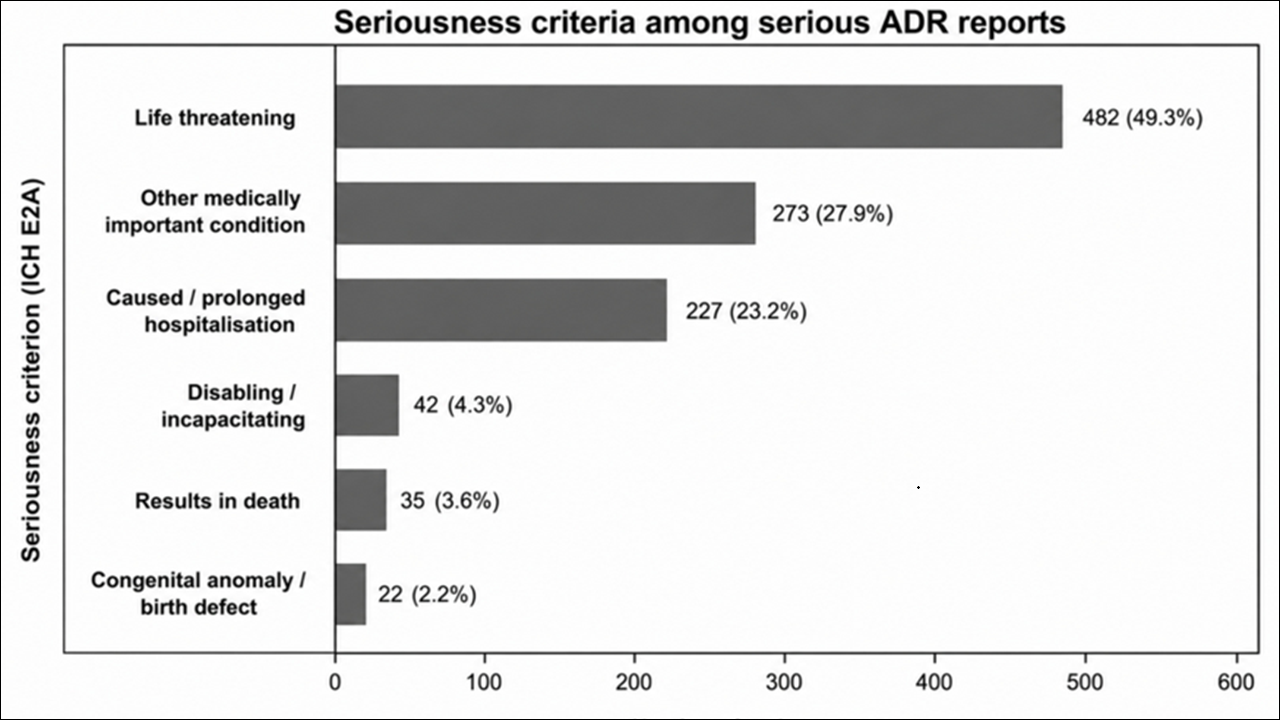
Background: Seriousness classification under ICH E2A criteria determines which adverse drug reaction (ADR) reports receive expedited regulatory attention; this has not previously been assessed in Iraqi regional pharmacovigilance data. Objectives: To characterize the proportion, clinical basis, and independent predictors of serious ADR reporting among individual case safety reports (ICSRs) submitted to the pharmacovigilance section within the Anbar General Health Directorate, 2020–2025. Methods: A retrospective analysis was conducted involving all ICSRs submitted through the VigiFlow platform. A case was classified as serious if at least one reaction met an ICH E2A criterion. Suspected medicines were harmonized to International Nonproprietary Names and classified by ATC level-1 group. Associations with seriousness were assessed using multivariable logistic regression, with adjusted odds ratios (aORs) and 95% confidence intervals reported. Results: Of 3264 submitted reports, 3164(96.9%) had a recorded seriousness status, of which 978(30.9%) were serious (30% of all submitted reports). Life-threatening reactions were the commonest criterion (49.3%); 3.6% resulted in death. Anti-infectives were the leading ATC group among serious reports (36.1%), and ceftriaxone was the leading suspected medicine. Blood/blood-forming products, antineoplastic/immunomodulating agents, “various” products, and neonatal and infant age showed the strongest independent associations with seriousness (aORs=2.4–4.0), followed by nervous-system medicines, physician reporting, and increasing numbers of suspected drugs and reaction terms. Conclusions: Nearly one-third of ICSRs submitted to the Anbar pharmacovigilance section met formal seriousness criteria. Blood products, antineoplastic agents, nervous-system medicines, and infant age were associated with seriousness, supporting risk-based pharmacovigilance and targeted safety monitoring in western Iraq.
Downloads
References
1. World Health Organization. Pharmacovigilance [Internet]. [cited 2026 Aug 19]. Available from: https://www.who.int/teams/regulation-prequalification/regulation-and-safety/pharmacovigilance
2. Jiao XF, Pu L, Lan S, Li H, Zeng L, Wang H, et al. Adverse drug reaction signal detection methods in spontaneous reporting system: a systematic review. Pharmacoepidemiol Drug Saf. 2024;33(3):e5768. doi: 10.1002/pds.5768.
3. Cutroneo PM, Sartori D, Tuccori M, Crisafulli S, Battini V, Carnovale C, et al. Conducting and interpreting disproportionality analyses derived from spontaneous reporting systems. Front Drug Saf Regul. 2024;3:1323057. doi: 10.3389/fdsfr.2023.1323057.
4. International Conference on Harmonisation of Technical Requirements for Registration of Pharmaceuticals for Human Use. Clinical safety data management: definitions and standards for expedited reporting (E2A). 1994. Available from: https://database.ich.org/sites/default/files/E2A_Guideline.pdf
5. Mueller M, Lewis DJ, Alexe A. The evolution of pharmacovigilance ecosystems: does Moore’s law invite the use of Occam’s razor? Br J Clin Pharmacol. 2023;89(2):470-482. doi: 10.1111/bcp.15573.
6. Holm L, Ekman E, Jorsäter Blomgren K. Influence of age, sex and seriousness on reporting of adverse drug reactions in Sweden. Pharmacoepidemiol Drug Saf. 2017;26(3):335-343. doi: 10.1002/pds.4155.
7. Montané E, Sanz Y, Martin S, Pérez-Mañá C, Papaseit E, Hladun O, et al. Spontaneous adverse drug reactions reported in a thirteen-year pharmacovigilance program in a tertiary university hospital. Front Pharmacol. 2024;15:1427772. doi: 10.3389/fphar.2024.1427772.
8. Al-Jumaili AA, Younus MM, Kannan YJA, Nooruldeen ZE, Al-Nuseirat A. Pharmaceutical regulations in Iraq: from medicine approval to postmarketing. East Mediterr Health J. 2021;27(10):1007-1015. doi: 10.26719/emhj.21.025.
9. National Population Commission (Iraq). Population situation analysis in Iraq 2012: the second national report on the state of Iraq population in the context of the ICPD and MDGs. UNFPA-Iraq; 2012.
10. Graeff V, Wehler M, Dormann H, Stingl JC, Just KS, Eisert A. Comparative analysis of drugs frequently suspected of causing adverse drug reactions reported via the spontaneous reporting system versus in a prospective multicentre cohort study in hospital emergency departments. J Clin Med. 2025;14(17):5921. doi: 10.3390/jcm14175921.
11. Dubrall D, Christ P, Domgörgen S, Schmid M, Sachs B. Factors associated with the completeness of information provided in adverse drug reaction reports of physicians, pharmacists and consumers from Germany. Sci Rep. 2025;15(1):23751. doi: 10.1038/s41598-025-07973-9.
12. Matlala MF, Lubbe MS, Steyn H. The completeness of adverse drug reaction reports in South Africa: an analysis in VigiBase®. Afr J Prim Health Care Fam Med. 2023;15(1):e1–e9. doi: 10.4102/phcfm.v15i1.3659.
13. López-Valverde L, Domènech È, Roguera M, Gich I, Farré M, Rodrigo C, et al. Spontaneous reporting of adverse drug reactions in a pediatric population in a tertiary hospital. J Clin Med. 2021;10(23):5531. doi: 10.3390/jcm10235531.
14. Nasso C, Mecchio A, Rottura M, Valenzise M, Menniti-Ippolito F, Cutroneo PM, et al. A 7-years active pharmacovigilance study of adverse drug reactions causing children admission to a pediatric emergency department in Sicily. Front Pharmacol. 2020;11:1090. doi: 10.3389/fphar.2020.01090.
15. Bin Yousef N, Yenugadhati N, Alqahtani N, Alshahrani A, Alshahrani M, Al Jeraisy M, et al. Patterns of adverse drug reactions (ADRs) in Saudi Arabia. Saudi Pharm J. 2022;30(1):8-13. doi: 10.1016/j.jsps.2021.08.014.
16. Shalviri G, Yousefian S, Gholami K. Adverse events induced by ceftriaxone: a 10-year review of reported cases to Iranian Pharmacovigilance Centre. J Clin Pharm Ther. 2012;37(4):448-451. doi: 10.1111/j.1365-2710.2011.01321.x.
17. Kiguba R, Karamagi C, Bird SM. Antibiotic-associated suspected adverse drug reactions among hospitalized patients in Uganda: a prospective cohort study. Pharmacol Res Perspect. 2017;5(2):e00298. doi: 10.1002/prp2.298.
18. Srour A, Arous B, Al-Mardini MA. Fatal adverse reactions to injectable ceftriaxone sodium in Syrian Arab Republic. East Mediterr Health J. 2026;32(5):320–324. doi: 10.26719/2026.32.5.320.
19. Kim TH, Park J, Jo H, Oh J, Lee K, Oh J, et al. Identification of the top 15 drugs associated with anaphylaxis: a pharmacovigilance study. Clin Exp Allergy. 2025;55:541-551. doi: 10.1111/cea.70092.
20. Pierce R, Agarwal R, Kayira D, Lyles JL, Sivilus M, Morrison MA, et al. A multistate investigation of serious adverse events, including deaths, following ceftriaxone injections, September 2024–June 2025. Open Forum Infect Dis. 2026;13(Suppl 1):ofaf695.024. doi: 10.1093/ofid/ofaf695.024.
21. Qiu X, Li Q, Rong Y, Wang L, Ke J, Wang M, et al. Cardiotoxicity associated with antineoplastic agents: a pharmacovigilance study based on FDA Adverse Event Reporting System. Ther Adv Drug Saf. 2025;16:20420986251401122. doi: 10.1177/20420986251401122
22. Lu J, Shen C, Ma W, Lin Z, Gao W. FAERS based disproportionality analysis and network pharmacology investigation of doxorubicin associated drug induced cardiotoxicity. Sci Rep. 2025;15(1):33278. doi: 10.1038/s41598-025-18383-2
23. Shi L, Wang Y, Qu Y, Chen R. Hepatotoxicity associated with anti-neoplastic agents: a pharmacovigilance analysis of the Food and Drug Administration Adverse Event Reporting System database. Front Immunol. 2025;16:1665425. doi: 10.3389/fimmu.2025.1665425.
24. Van Doren L, Steinheiser M, Boykin K, Taylor KJ, Menendez M, Auerbach M. Expert consensus guidelines: intravenous iron uses, formulations, administration and management of reactions. Am J Hematol. 2024;99(7):1338-1348. doi: 10.1002/ajh.27220.
25. Lu BW, Li JC, Wen MT, Luo D, Guo YQ, Li G. Safety comparisons among different subcutaneous anticoagulants for venous thromboembolism using FDA adverse event reporting system. Sci Rep. 2025;15(1):17070. doi: 10.1038/s41598-025-01527-9.
26. Alharbi L, Almuraee D, AteeqAllah L, Belal W, Ali S. Magnitude and characteristics of adverse drug events in Saudi Arabia: a systematic review. Saudi J Med Med Sci. 2025;13(2):79–89. doi: 10.4103/sjmms.sjmms_582_24.
27. Girgis MMF, Farkasinszky G, Fekete K, Fekete I, Vecsernyés M, Bácskay I, et al. Seriousness and outcomes of reported adverse drug reactions in old and new antiseizure medications: a pharmacovigilance study using EudraVigilance database. Front Pharmacol. 2024;15:1411134. doi: 10.3389/fphar.2024.1411134.
28. Khan MAA, Khalid M, Malik O. The safety of herbal medicines in low- and middle-income countries (LMICs): current landscape and promoting the pharmacovigilance practices. J Pharm Policy Pract. 2025;18(1). doi: 10.1080/20523211.2025.2574651.
29. Shukur AM, Alezzi JI, Kadhim TJ. Morbidity and mortality associated with community used herbal (Sagwa) use in children with acute gastroenteritis in Diyala Governorate. Diyala J Med. 2019;17(2):92-106. doi: 10.26505/DJM.17024690527.
30. Huweidy BT, Hasan JS, Mohammed BI, Shukri AA, Atrushi AM, Fawzi MF. Traditional remedy Sagwa as a risk factor for severe morbidity and mortality in Iraqi infants with acute diarrhea. A case-control study. F1000Research. 2026;15:184. doi: 10.12688/f1000research.175745.2.
31. Younus MM, Ibrahim IR. Pharmacovigilance for herbal medicines in Iraq. In: Barnes J, (editor). Pharmacovigilance for herbal and traditional medicines: advances, challenges and international perspectives. Springer International Publishing; 2022. p. 385–394. doi: 10.1007/978-3-031-07275-8_25.
32. Allela O. Explore adverse drug reactions (ADRs) reporting by clinical and community pharmacists in Duhok, Kurdistan region-Iraq: hampered and perspective. Pharmacia. 2022;69(4):1057-1062. doi: 10.3897/pharmacia.69.e95691.
33. Abdul-Husseein HK, Abood NA, Al-Akkam KA. Knowledge, attitudes and practices toward pharmacovigilance and adverse drug reaction reporting among healthcare professionals in Iraq: a cross-sectional study. Hilla Univ Coll J Med Sci. 2026;4(2):Article 1. doi: 10.62445/2958-4515.1107.
Downloads
Published
How to Cite
Issue
Section
License
Copyright (c) 2026 Al-Rafidain Journal of Medical Sciences ( ISSN 2789-3219 )

This work is licensed under a Creative Commons Attribution-NonCommercial-ShareAlike 4.0 International License.
Published by Al-Rafidain University College. This is an open access journal issued under the CC BY-NC-SA 4.0 license (https://creativecommons.org/licenses/by-nc-sa/4.0/).