Orthodontic Assessment of Mandibular Third Molar Impaction Patterns Across Skeletal Malocclusion Classes: A Retrospective Panoramic-Cephalometric Study
Keywords:
Cephalometry, Impaction, Mandibular third molar, Orthodontics, Panoramic radiography, Skeletal malocclusionAbstract
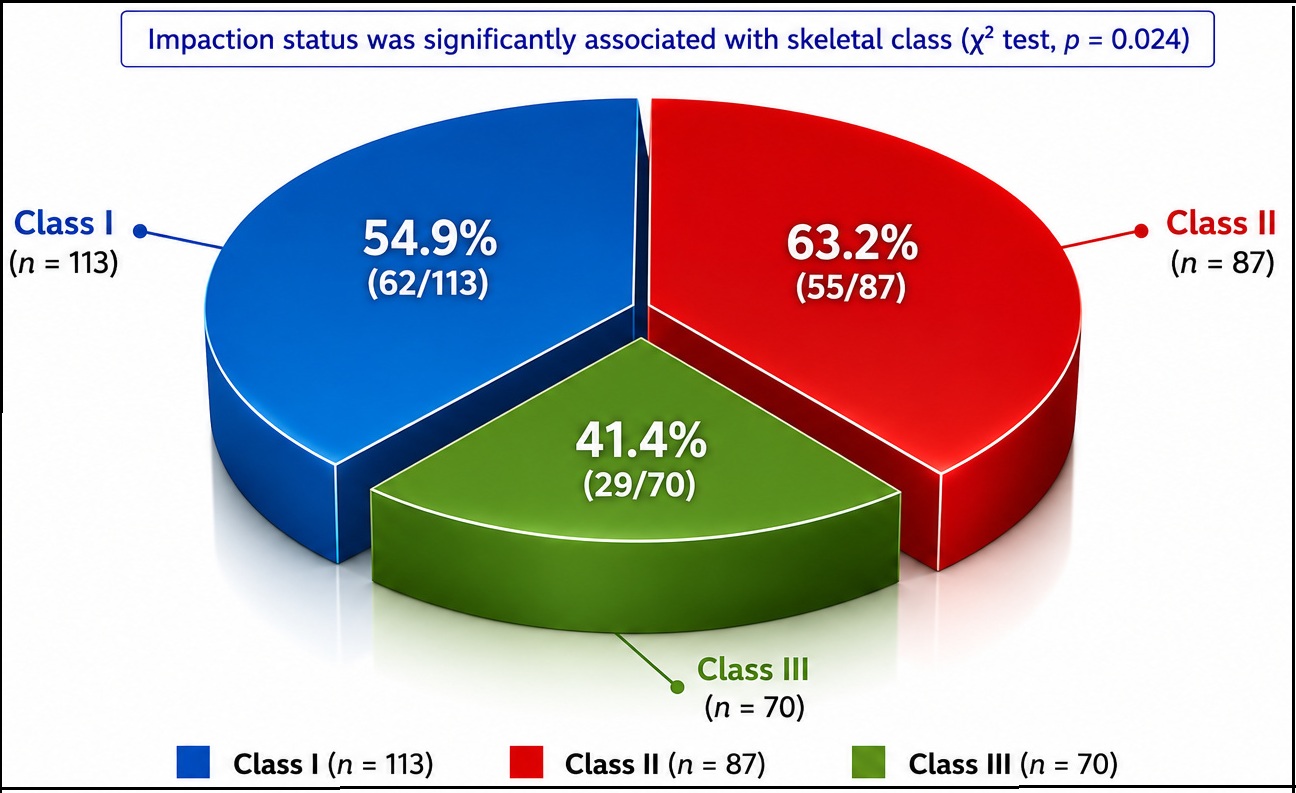
Background: Mandibular third molars are often evaluated during orthodontic diagnosis because their eruption or impaction can be influenced by the retromolar space and mandibular morphology. Objectives: This study aimed to assess mandibular third molar impaction patterns across skeletal malocclusion classes among Iraqi orthodontic patients using pretreatment panoramic and cephalometric records. Methods: This retrospective panoramic-cephalometric study included 270 orthodontic patients and 540 mandibular third molar sites. The skeletal class was determined using the ANB angle and categorized as Class I, II, or III. Mandibular third molar status was recorded as impacted, erupted, missing, or extracted. Impacted teeth were classified according to Winter’s and Pell and Gregory classifications. Associations were assessed using chi-square tests or the Fisher-Freeman-Halton exact test with Monte Carlo estimation, as appropriate. Age differences were evaluated using Welch’s t test and the Mann-Whitney U test. Results: Mandibular third molar impaction was present in 146 patients. Impaction status was significantly associated with skeletal class, with the highest frequency in Class II (63.2%) and the lowest in Class III (41.4%). Impaction pattern was also significantly associated with skeletal class. Mesioangular impaction was the most common Winter's pattern (67.0%), but Winter’s classification was not significantly associated with skeletal class. The Pell and Gregory level and the Pell and Gregory class were not significantly associated with skeletal classes. Conclusions: Mandibular third molar impaction was associated with skeletal malocclusion class, particularly Class II. Panoramic and cephalometric assessment may support orthodontic pretreatment evaluation.
Downloads
References
1. Bishara SE. Third molars: a dilemma, or is it? Am J Orthod Dentofacial Orthop. 1999;115(6):628-633. doi: 10.1016/s0889-5406(99)70287-8.
2. Proffit WR, Fields HW, Larson BE, Sarver DM, (Editors), Contemporary orthodontics, (6th ed.), St. Louis (MO): Elsevier; 2018. Available at: https://shop.elsevier.com/books/contemporary-orthodontics/proffit/978-0-323-54387-3
3. Silvestri AR, Singh I. The unresolved problem of the third molar: would people be better off without it? J Am Dent Assoc. 2003;134(4):450-455. doi: 10.14219/jada.archive.2003.0194.
4. Abu Alhaija ESJ, AlBhairan HM, AlKhateeb SN. Mandibular third molar space in different antero-posterior skeletal patterns. Eur J Orthod. 2011;33(5):570-576. doi: 10.1093/ejo/cjq125.
5. Gao Q, Zhou X, Zhao Z, Chen B, Huang M, Lin H, et al. Comparison of the mandibular retromolar space in adults with different sagittal skeletal types and eruption patterns of the mandibular third-molar: a cone-beam computed tomography study. BMC Oral Health. 2024;24:1112. doi: 10.1186/s12903-024-04815-4.
6. Balel Y, Sağtaş K. Deep learning-based approach to third molar impaction analysis with clinical classifications. Sci Rep. 2025;15:23688. doi: 10.1038/s41598-025-93783-y.
7. Maruta N, Morita K, Harazono Y, Anzai E, Akaike Y, Yamazaki K, et al. Automatic machine learning-based classification of mandibular third molar impaction status. J Oral Maxillofac Surg Med Pathol. 2023;35(4):327-334. doi: 10.1016/j.ajoms.2022.12.010.
8. Yasa Y, Altynbekov K, Kalafatoğlu BS, Meiramkul S, Alhusain M, Altynbekov C. Prevalence and radiographic patterns of third molar impaction and agenesis in the Kazakh population. Int Dent J. 2025;75(5):100897. doi: 10.1016/j.identj.2025.100897.
9. Alhajj MN, Amran AG, Alhaidary S, Amran AN, Al-Sosowa AA, Abdulghani EA, et al. Prevalence and pattern of third molars impaction in a large Yemeni sample: a retrospective study. Sci Rep. 2024;14:22642. doi: 10.1038/s41598-024-73556-9.
10. Gebeyehu T, Abaynew Y. Prevalence and patterns of third molar impaction among Ethiopians in Addis Ababa: a retrospective pilot study. Sci Rep. 2024;14:8952. doi: 10.1038/s41598-024-59821-x.
11. Pinto AC, Francisco H, Marques D, Martins JNR, Caramês J. Worldwide prevalence and demographic predictors of impacted third molars: systematic review with meta-analysis. J Clin Med. 2024;13(24):7533. doi: 10.3390/jcm13247533.
12. Al-Salmany LHA, Hussein LK, Altaee ZH. Impacted canine prevalence, localization, and related etiological factors among orthodontic sample of Fallujah city. J Orthod Sci. 2025;14:15. doi: 10.4103/jos.jos_109_24.
13. Al-Salmany LHA, Altaee ZH, Hussein LK, Mudher SH. Epidemiological profile of non-syndromic tooth agenesis and associated transposition among Iraqi orthodontic patients: a clinic-based study. Al-Rafidain J Med Sci. 2026;10(1):86-89. doi: 10.54133/ajms.v10i1.2636.
14. Fatah LM, Alzubadee AF, Khalid RF, Samad A, Al-Kamali R. Prevalence and patterns of upper and lower third molar impaction: a radiographic retrospective study based on a population in Erbil, Iraq. Erbil Dent J. 2025;8(1):93-101. doi: 10.15218/edj.2025.11.
15. Alsharif SB, Alsharif MB. Patterns of mandibular third molar impactions and its association with carious lesions and periodontal defects: a retrospective cross-sectional study. Clin Cosmet Investig Dent. 2025;17:481-490. doi: 10.2147/CCIDE.S559569.
16. Madfa AA, Alshammari AF, Alshammari BB, Alenezi TM, Aledaili EA, Bhagwath SS, et al. Prevalence and patterns of impacted third molars and their association with distal caries incidence in adjacent second molars: a CBCT-based study in a Saudi subpopulation. BMC Oral Health. 2025;25:1869. doi: 10.1186/s12903-025-07257-8.
Downloads
Published
How to Cite
Issue
Section
License
Copyright (c) 2026 Al-Rafidain Journal of Medical Sciences ( ISSN 2789-3219 )

This work is licensed under a Creative Commons Attribution-NonCommercial-ShareAlike 4.0 International License.
Published by Al-Rafidain University College. This is an open access journal issued under the CC BY-NC-SA 4.0 license (https://creativecommons.org/licenses/by-nc-sa/4.0/).