Golden Billion Theory and Psychological Stress: A Cross-Sectional Study in Two Middle Eastern Countries
DOI:
https://doi.org/10.54133/ajms.v10i1.2623Keywords:
Anxiety, Conspiracy, Golden Billion theory, Middle East, Stress , VaccineAbstract
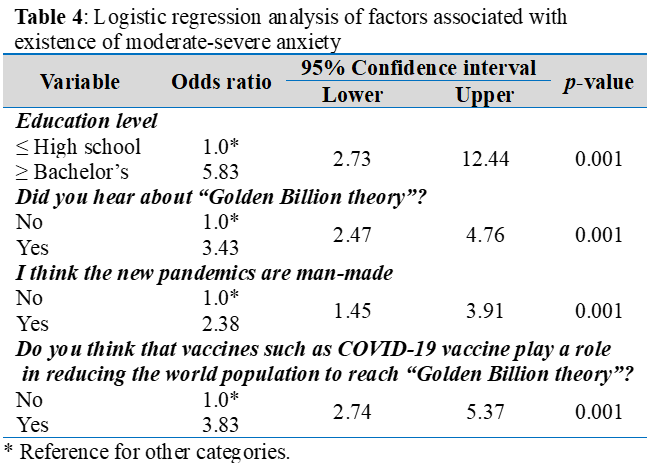
Background: The Golden Billion theory posits global inequality where a small elite benefits at the world's expense, often linked to resources and geopolitical power dynamics. Objective: To explore beliefs about the Golden Billion theory and associated psychological stress, focusing on impacts on vaccine refusal and belief in man-made pandemics of COVID-19. Methods: This cross-sectional study in Jordan and Iraq explored beliefs about this theory and associated psychological stress. A convenience sample of 1113 participants was recruited via social media platforms (Facebook, WhatsApp, and X) between 14 June 2024 and 13 October 2024. Results: Sex, knowledge about the "Golden Billion theory," and vaccine-related conspiracy beliefs were significantly associated with anxiety levels (p<0.001). Higher education (OR=5.83, p=0.001), having heard about the “Golden Billion theory” (OR=3.43, p=0.001), believing COVID-19 was man-made (OR=2.38, p=0.001), and believing vaccines reduce world population (OR=3.83, p=0.001) were all linked to higher anxiety. Conclusions: The perception of intentional population control through pandemics and wars is strongly correlated with higher levels of anxiety, with significant associations identified between gender, knowledge of the “Golden Billion theory," and beliefs regarding vaccines.
Downloads
References
Banko OH. The politics of SARS-CoV-2 (COVID-19) pandemic and conspiracy theories: The implications for travesty of scientific logic. Afr J Politics Admin Studies. 2020;13(1):1-24.
Charvátová D, JUST P. They want to implant chips to our bodies: COVID 19 conspiracy theories and their impact on Czech society. J Comparative Politics. 2024;17(2):49-65.
Douglas KM, Sutton RM, Cichocka A. Belief in conspiracy theories: Looking beyond gullibility. In: Forgas J, Baumeister R, (eds.), The Social Psychology of Gullibility: Conspiracy Theories, Fake News and Irrational Beliefs. Sydney Symposium of Social Psychology, Routledge; 2019. doi: 10.4324/9780429203787. DOI: https://doi.org/10.4324/9780429203787-4
Flaskerud JH. Myths and conspiracies. Issues Ment Health Nurs. 2021;42. doi: 10.1080/01612840.2020.1806967. DOI: https://doi.org/10.1080/01612840.2020.1806967
Kużelewska E, Tomaszuk M. Rise of conspiracy theories in the pandemic times. Int J Semiotics Law. 2022;35. doi: 10.1007/s11196-022-09910-9. DOI: https://doi.org/10.1007/s11196-022-09910-9
Van Prooijen JW, (Ed.), (2018). The Psychology of Conspiracy Theories, (1st ed.), Tylor and Francis Group, London, UK; 2018. doi: 10.4324/9781315525419. DOI: https://doi.org/10.4324/9781315525419-1
Raabe JV. The Impact of Social Media on Conspiracy Theories in Times of Public Health Crises. University of Twente, 2022. Available at: https://essay.utwente.nl/
Uscinski JE, Enders AM. Conspiracy theories: A Primer, (2nd edn.), Lanham, Maryland: Rowman & Littlefield; 2023. DOI: https://doi.org/10.5040/9798881835194
Rezq KA, Ai Zaghmouri AH. Perception and acceptance of COVID-19 vaccine among nurses in Jordan. SAGE Open Nurs. 2023;9:23779608231177560. doi: 10.1177/23779608231177560. DOI: https://doi.org/10.1177/23779608231177560
Spitzer RL, Kroenke K, Williams JBW, Löwe B. A brief measure for assessing generalized anxiety disorder: the GAD-7. Arch Intern Med. 2006;166:1092–1097. doi: 10.1001/archinte.166.10.1092. DOI: https://doi.org/10.1001/archinte.166.10.1092
World Bank Group. Educational attainment by level of education, cumulative (% population 25+); 2024. Retrieved on January 8, 2026, from UNESCO website: https://genderdata.worldbank.org/
Hakim MS. SARS-CoV-2, Covid-19, and the debunking of conspiracy theories. Rev Med Virol. 2021;31. doi: 10.1002/rmv.2222. DOI: https://doi.org/10.1002/rmv.2222
Nattrass N. Promoting conspiracy theory: From AIDS to COVID-19. Glob Public Health. 2023;18:2172199. doi: 10.1080/17441692.2023.2172199. DOI: https://doi.org/10.1080/17441692.2023.2172199
Tsamakis K, Tsiptsios D, Stubbs B, Ma R, Romano E, Mueller C, et al. Summarising data and factors associated with COVID-19 related conspiracy theories in the first year of the pandemic: a systematic review and narrative synthesis. BMC Psychol. 2022;10:244. doi: 10.1186/s40359-022-00959-6. DOI: https://doi.org/10.1186/s40359-022-00959-6
Uscinski J, Enders AM, Klofstad C, Stoler J. Cause and effect: On the antecedents and consequences of conspiracy theory beliefs. Curr Opin Psychol. 2022;47. doi: 10.1016/j.copsyc.2022.101364. DOI: https://doi.org/10.1016/j.copsyc.2022.101364
Ullah I, Khan KS, Tahir MJ, Ahmed A, Harapan H. Myths and conspiracy theories on vaccines and COVID-19: Potential effect on global vaccine refusals. Vacunas. 2021;22:93–97. doi: 10.1016/j.vacun.2021.01.001. DOI: https://doi.org/10.1016/j.vacun.2021.01.001
Fotakis EA, Simou E. Belief in COVID-19 related conspiracy theories around the globe: A systematic review. Health Policy. 2023;137:104903. doi: 10.1016/j.healthpol.2023.104903. DOI: https://doi.org/10.1016/j.healthpol.2023.104903
Sharabi A. The scientist, the therapist, and the conspiracy theorist: Three responses to the COVID-19 pandemic within the ultra-orthodox Jewish revival movement in Israel. J Relig Health. 2024;63:2633–2653. doi: 10.1007/s10943-024-02057-w. DOI: https://doi.org/10.1007/s10943-024-02057-w
Hammad AM, Hamed R, Al-Qerem W, Bandar A, Hall FS. Optimism bias, pessimism bias, magical beliefs, and conspiracy theory beliefs related to COVID-19 among the Jordanian population. Am J Trop Med Hyg. 2021;104:1661–1671. doi: 10.4269/ajtmh.20-1412. DOI: https://doi.org/10.4269/ajtmh.20-1412
Sato Y, Kawachi I, Saijo Y, Yoshioka E, Osaka K, Tabuchi T. Correlates of COVID-19 conspiracy theory beliefs in Japan: A cross-sectional study of 28,175 residents. PLoS One. 2024;19:e0310673. doi: 10.1371/journal.pone.0310673. DOI: https://doi.org/10.1371/journal.pone.0310673
Vranic A, Hromatko I, Tonković M. “I Did My Own Research”: Overconfidence, (Dis)trust in science, and endorsement of conspiracy theories. Front Psychol. 2022;13:931865. doi: 10.3389/fpsyg.2022.931865. DOI: https://doi.org/10.3389/fpsyg.2022.931865
Downloads
Published
How to Cite
Issue
Section
License
Copyright (c) 2026 Al-Rafidain Journal of Medical Sciences ( ISSN 2789-3219 )

This work is licensed under a Creative Commons Attribution-NonCommercial-ShareAlike 4.0 International License.
Published by Al-Rafidain University College. This is an open access journal issued under the CC BY-NC-SA 4.0 license (https://creativecommons.org/licenses/by-nc-sa/4.0/).