Kaiser Score in Multiparametric Breast MRI: Prospective Validation and Comparison with BI-RADS for Predicting Malignancy
الكلمات المفتاحية:
Breast malignancy، BI-RADS، Kaiser score، Lesion، MRIالملخص
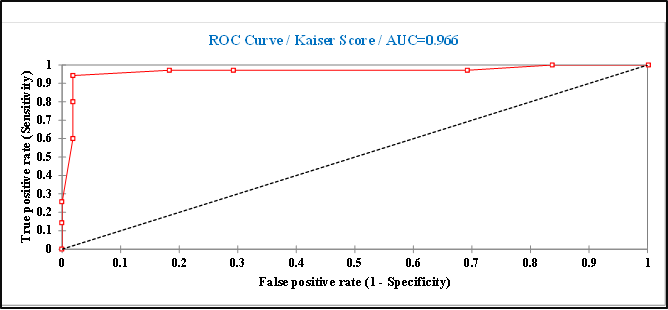
Background: Early detection is essential to determine breast cancer prognosis. The reliability of BI-RADS diagnoses varies, and the level of agreement between radiologists who read the same test is moderate at best. Kaiser Score offers a framework for evaluating breast lesions. Objective: To evaluate the breast cancer diagnostic landscape in Iraq by analyzing the Kaiser Score compared to the combination with BI-RADS. Methods: A prospective, cross-sectional diagnostic accuracy study was conducted at Private Radiology Center in Baghdad during December 2023 to December 2025. The study comprised 52 female patients, with a total of 90 suspected breast lesions, who needed multiparametric MRI to assess a recent abnormality found through ultrasonography or mammography, or to diagnose breast complaints with available Kaiser Score parameters, and underwent histopathological examination for confirmation of diagnosis. Results: Kaiser score was significantly higher in malignant than in benign lesions (8.62 vs. 3.23, p<0.001). Regarding BI-RADS, the highest proportion of malignant lesions was seen significantly among lesions classified as BI-RADS 5 (95%, p<0.001). A Kaiser score >6 is a predictor for malignant breast lesions. It was 94.3% sensitive, 98.2% specific, and 96.7% accurate. Sensitivity for lesions with a score of 4 or 5 BI-RADS was 97.1%, specificity was 67.3%, and accuracy was 78.9%. Conclusions: With KS, we can achieve better overall accuracy and more specificity. On its own, BI‑RADS is quite sensitive, but it lacks specificity. Implementing a combination of the two could lead to better decisions and fewer needless biopsies.
التنزيلات
المراجع
Wilkinson L, Gathani T. Understanding breast cancer as a global health concern. Br J Radiol. 2022;95(1130):20211033. doi: 10.1259/bjr.20211033.
Freihat O, Sipos D, Kovacs A. Global burden and projections of breast cancer incidence and mortality to 2050: a comprehensive analysis of GLOBOCAN data. Front Public Health. 2025;13:1622954. doi: 10.3389/fpubh.2025.1622954.
Khan AQ, Touseeq M, Rehman S, Tahir M, Ashfaq M, Jaffar E, et al. Advances in breast cancer diagnosis: a comprehensive review of imaging, biosensors, and emerging wearable technologies. Front Oncol. 2025;15:2025. doi: 10.3389/fonc.2025.1587517.
Albahadili M, Ismael SM, Al-Samarraee MF. Is it possible to manage appendicular mass without surgery? Al-Rafidain J Med Sci. 2025;9(2):46-50. doi: 10.54133/ajms.v9i2.2322.
Siegel RL, Miller KD, Fuchs HE, Jemal A. Cancer statistics, 2022. Cancer J Clinicians. 2022;72(1):7-33. doi: 10.3322/caac.21708.
Pace LE, Uwihaye JdD, Mukandayisenga V, Fata AM, Rositch AF, Byiringiro J, et al. Early experience scaling up a breast cancer early detection initiative integrated with cervical cancer screening in Rwanda. BMJ Glob Health. 2025;10(10):e021235. doi: 10.1136/bmjgh-2025-021235.
Wilkerson AD, Gentle CK, Ortega C, Al-Hilli Z. Disparities in breast cancer care—How factors related to prevention, diagnosis, and treatment drive inequity. Healthcare. 2024;12(4):462. doi: 10.3390/healthcare12040462.
Washington I, Palm RF, White J, Rosenberg SA, Ataya D. The role of MRI in breast cancer and breast conservation therapy. Cancers (Basel). 2024;16(11). doi: 10.3390/cancers16112122.
Giannakaki AG, Giannakaki MN, Baroutis D, Koura S, Papachatzopoulou E, Marinopoulos S, et al. Preoperative breast MRI and histopathology in breast cancer: Concordance, challenges and emerging role of CEM and mpMRI. Diagnostics. 2025;15(23):3032. doi: 10.3390/diagnostics15233032.
Ren T, Li X, Xiang Y, Zhang Y, Jiang M, Zhang C. The diagnostic significance of the BI-RADS classification combined with automated breast volume scanner and shear wave elastography for breast lesions. J Ultrasound Med. 2023;42(7):1459-1469. doi: 10.1002/jum.16154.
Baltzer PAT, Krug KB, Dietzel M, (Eds.), Evidence-based and structured diagnosis in breast MRI using the Kaiser Score. Georg Thieme Verlag KG. 2022;194(11):1216-1228. doi: 10.1055/a-1829-5985.
Erkan M, Ozcan SGG. Diagnostic performance of kaiser score for characterization of breast lesions on modified abbreviated breast MRI and comparison with full-protocol breast MRI. J Clin Med. 2025;14(1):264. doi: 10.3390/jcm14010264.
Dietzel M, Baltzer PA. How to use the Kaiser score as a clinical decision rule for diagnosis in multiparametric breast MRI: a pictorial essay. Insights Imaging. 2018;9(3):325-335. doi: 10.1007/s13244-018-0611-8.
Zhou XZ, Liu LH, He S, Yao HF, Chen LP, Deng C, et al. Diagnostic value of Kaiser score combined with breast vascular assessment from breast MRI for the characterization of breast lesions. Front Oncol. 2023;13:1165405. doi: 10.3389/fonc.2023.1165405.
Li J, Knigge R, Chen K, Leary EV. PASSED: calculate power and sample size for two sample tests. RJ. 2021;13(2): 542-560. doi: 10.32614/RJ-2021-094.
Al-Samarraee MF, Kadhim ST, Al-Atta DM, Fadhil AA. Impact of sleep patterns on glycemic control in type 2 diabetes mellitus. Al-Anbar Med J. 2026;22(1). doi: 10.33091/amj.2025.161334.2283.
Ghaemian N, Haji Ghazi Tehrani N, Nabahati M. Accuracy of mammography and ultrasonography and their BI-RADS in detection of breast malignancy. Caspian J Intern Med. 2021;12(4):573-579. doi: 10.22088/cjim.12.4.573.
Milos RI, Pipan F, Kalovidouri A, Clauser P, Kapetas P, Bernathova M, et al. The Kaiser score reliably excludes malignancy in benign contrast-enhancing lesions classified as BI-RADS 4 on breast MRI high-risk screening exams. Eur Radiol. 2020;30(11):6052-6061. doi: 10.1007/s00330-020-06945-z.
Nguyen DL, Myers KS, Oluyemi E, Mullen LA, Panigrahi B, Rossi J, et al. BI-RADS 3 Assessment on MRI: A lesion-based review for breast radiologists. J Breast Imaging. 2022;4(5):460-473. doi: 10.1093/jbi/wbac032.
Barrios CH. Global challenges in breast cancer detection and treatment. Breast. 2022;62:S3-S6. doi: 10.1016/j.breast.2022.02.003.
Wang Q, Fu F, Chen Y, Yang D, Zhang J, Yu H, et al. Application of the Kaiser score by MRI in patients with breast lesions by ultrasound and mammography. Diagn Interv Radiol. 2022;28(4):322-328. doi: 10.5152/dir.2022.201075.
Chen ZW, Zhao YF, Liu HR, Zhou JJ, Miao HW, Ye SX, et al. Assessment of breast lesions by the Kaiser score for differential diagnosis on MRI: the added value of ADC and machine learning modeling. Eur Radiol. 2022;32(10):6608-6618. doi: 10.1007/s00330-022-08899-w.
Mohammadzadeh S, Mohebbi A, Moradi Z, Abdi A, Mohammadi A, Hakim PK, et al. Diagnostic performance of Kaiser score in the evaluation of breast cancer using MRI: A systematic review and meta-analysis. Eur J Radiol. 2025;186:112055. doi: 10.1016/j.ejrad.2025.112055.
Meng L, Zhao X, Guo J, Lu L, Cheng M, Xing Q, et al. Evaluation of the differentiation of benign and malignant breast lesions using synthetic relaxometry and the Kaiser score. Front Oncol. 2022;12:964078. doi: 10.3389/fonc.2022.964078.
Woitek R, Spick C, Schernthaner M, Rudas M, Kapetas P, Bernathova M, et al. A simple classification system (the Tree flowchart) for breast MRI can reduce the number of unnecessary biopsies in MRI-only lesions. Eur Radiol. 2017;27(9):3799-809. doi: 10.1007/s00330-017-4755-6.
Rong X, Kang Y, Li Y, Xue J, Li Z, Yang G. Application of the Kaiser score on contrast-enhanced mammography in the differential diagnosis of breast lesions: comparison with breast magnetic resonance imaging. Quant Imaging Med Surg. 2024;14(8):5541-5554. doi: 10.21037/qims-24-593.
التنزيلات
منشور
كيفية الاقتباس
إصدار
القسم
الرخصة
الحقوق الفكرية (c) 2026 Al-Rafidain Journal of Medical Sciences

هذا العمل مرخص بموجب Creative Commons Attribution-NonCommercial-ShareAlike 4.0 International License.
Published by Al-Rafidain University College. This is an open access journal issued under the CC BY-NC-SA 4.0 license (https://creativecommons.org/licenses/by-nc-sa/4.0/).