Alexithymia and Family Environment as Predictors of Avoidant Personality Disorder Symptoms Among International University Students
DOI:
https://doi.org/10.54133/ajms.v11i2.3127الكلمات المفتاحية:
Englishالملخص
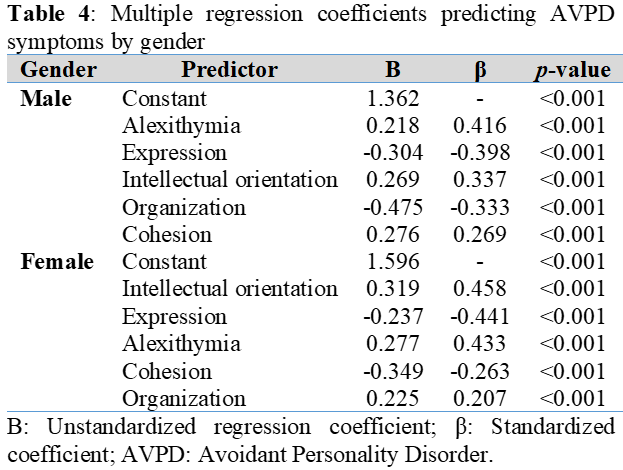
Background: While personality disorders had less research interest than other disorders, Avoidant Personality Disorder (AVPD) is one of the prevalent and dysfunctional personality disorders. There is an essential role for family environment-related factors in the development of AVPD and alexithymia. International students face psychosocial challenges that may be associated with AVPD symptoms. Objective: To investigate the contribution of alexithymia and family environment in predicting AVPD symptoms among international university students in Jordan. Methods: To achieve the objectives of this study, three measures were used: the University Students’ AVPD Scale, the Toronto Alexithymia Scale (TAS-20), and the short version of the Family Environment Scale, which were administered to a sample composed of 393 participants, including 188 males and 205 females. Multiple regression analysis was used. Results: The results showed that alexithymia and family environment significantly predicted AVPD among international students, accounting for 67.4% of the variance. Specifically, alexithymia was the strongest predictor, followed by family. Intellectual orientation, expression, organization, and cohesion, whereas family conflict and orientation to recreational activities did not predict AVPD symptoms. Gender-specific analysis indicated that the model explained 72.2% of variance in males and 62.6% in females. Conclusions: These findings clarify that the difficulties that international students have in understanding and expressing their emotions, together with their family environment, play a pivotal role in their lives. Considering these factors may help identify students who are more susceptible to AVPD symptoms and facilitate efforts to develop effective psychosocial interventions.
التنزيلات
المراجع
Ghaderi D, Mostafaei A, Bayazidi S, Shahnazari M. Investigating the prevalence of personality disorders and its relationship with personality traits among students. Int J Med Res Health Sci. 2016;5(4):119-126.
Kabir R, Isha SN, Chowdhury MTH, Siddika N, Jahan SS, Saha AK, et al. Depression among the non-native international undergraduate students studying dentistry in Bangladesh. Int J Environ Res Public Health. 2021;18(11):5802. doi: 10.3390/ijerph18115802.
Yeh CJ, Inose M. International students' reported English fluency, social support satisfaction, and social connectedness as predictors of acculturative stress. Couns Psychol Q. 2003;16(1):15-28. doi: 10.1080/0951507031000114058.
Minutillo S, Cleary M, Hills AP, Visentin D. Mental health considerations for international students. Issues Ment Health Nurs. 2020;41(6):494-499. doi: 10.1080/01612840.2020.1716123.
Baljé A, Karch J, Greeven A, Giezen A, Muste E, Arntz A, et al. Avoidant personality disorder severity index: dimensional structure and psychometric properties. Pers Individ Dif. 2023;213:112268. doi: 10.1016/j.paid.2023.112268.
Marian Ș, Sava FA, Dindelegan C. A network analysis of DSM-5 avoidant personality disorder diagnostic criteria. Pers Individ Dif. 2022;188:111454. doi: 10.1016/j.paid.2021.111454.
Kantor M. Distancing: avoidant personality disorder. Westport (CT): Praeger Publishers; 2003.
Gunderson JG, Zanarini MC. Borderline personality disorder. N Engl J Med. 2013;368(2):156-165. doi: 10.1038/nrdp.2018.29.
Berthoz S, Luminet O. Alexithymia and the automatic processing of affective information: evidence from the affective priming paradigm. Cogn Emot. 2005;19(2):27-48. doi: 10.1080/02699930500304654.
Martínez-Sánchez F, Ato-García M, Ortiz-Soria B. Alexithymia: state or trait? Span J Psychol. 2003;6(1):51-59. doi: 10.1017/S1138741600005205.
Taylor GJ. Alexithymia: concept, measurement, and implications for treatment. Am J Psychiatry. 1984;141(6):725-732. doi: 10.1176/ajp.141.6.725.
Simonsen S, Eikenaes IUM, Bach B, Kvarstein E, Gondan M, Møller SB, et al. Level of alexithymia as a measure of personality dysfunction in avoidant personality disorder. Nord J Psychiatry. 2021;75(4):266-274. doi: 10.1080/08039488.2020.1841290.
Kench S, Irwin H. Alexithymia and childhood family environment. J Clin Psychol. 2000;56:737-745. doi: 10.1002/(SICI)1097-4679(200006)56:6<737::AID-JCLP4>3.0.CO;2-U.
Widiger TA. The Oxford handbook of the five factor model. Oxford: Oxford University Press; 2017.
Kapoor T, Sethi SR. The impact of family environment on self-esteem and resilience among college day scholars and hostellers. Int J Indian Psychol. 2024;12(2). doi: 10.25215/1202.122.
Roca M, Vilaregut A, Pretel-Luque T, Calvo N, Frías Á, Ferrer M. Assessing family relations in borderline personality disorder: a relational approach. J Marital Fam Ther. 2024;50(2):495-507. doi: 10.1111/jmft.12693.
Pongpitpitak N, Wongpakaran N, Wongpakaran T, Nuansri W. Buffering effect of perseverance and meditation on depression among medical students experiencing negative family climate. Healthcare (Basel). 2022;10(10):1895. doi: 10.3390/healthcare10101895.
Huang C, Yuan Q, Shi S, Ge M, Sheng X, Yang M, et al. Associations between alexithymia, parental rearing styles, and frequency of drug use in male methamphetamine dependence patients. BMC Psychiatry. 2022;22:276. doi: 10.1186/s12888-022-03897-0.
Janik McErlean AB, Lim LXC. Relationship between parenting style, alexithymia and aggression in emerging adults. J Fam Issues. 2019;41. doi: 10.1177/0192513X19886647.
Forbes-Mewett H, Sawyer AM. International students and mental health. J Int Stud. 2016;6(3):661-677. doi: 10.32674/jis.v6i3.348.
Lai AYK, Lee L, Wang MP, Feng Y, Lai TTK, Ho LM, et al. Mental health impacts of the COVID-19 pandemic on international university students, related stressors, and coping strategies. Front Psychiatry. 2020;11:584240. doi: 10.3389/fpsyt.2020.584240.
Momani FA, Almomani KMA. The relative contribution of perceived parenting styles and emotional sensitivity to avoidant personality disorder symptoms among Yarmouk University students. Dirasat Educ Sci. 2023;50(2):187-204. doi: 10.35516/edu.v50i2.441.
Reich J, Schatzberg A. Prevalence, factor structure, and heritability of avoidant personality disorder. J Nerv Ment Dis. 2021;209(10):764-772. doi: 10.1097/NMD.0000000000001378.
Deary IJ, Scott S, Wilson JA. Neuroticism, alexithymia and medically unexplained symptoms. Pers Individ Dif. 1997;22(4):551-564. doi: 10.1016/S0191-8869(96)00229-2.
Wichstrøm L, Wilberg T, Hartveit Kvarstein E, Steinsbekk S. Childhood predictors of avoidant personality disorder traits in adolescence: a seven-wave birth cohort study. J Child Psychol Psychiatry. 2024. doi: 10.1111/jcpp.14064.
Carr SN, Francis AJ. Do early maladaptive schemas mediate the relationship between childhood experiences and avoidant personality disorder features? A preliminary investigation in a non-clinical sample. Cogn Ther Res. 2010;34:343-358. doi: 10.1007/s10608-009-9250-1.
Chaim CH, Almeida TM, de Vries Albertin P, Santana GL, Siu ER, Andrade LH. The implication of alexithymia in personality disorders: a systematic review. BMC Psychiatry. 2024;24(1):647. doi: 10.1186/s12888-024-06083-6.
Torunsky NT, Knauz S, Vilares I, Marcoulides KM, Koutstaal W. What is the relationship between alexithymia and experiential avoidance? A latent analysis using three alexithymia questionnaires. Pers Individ Dif. 2023;214:112308. doi: 10.1016/j.paid.2023.112308.
Davey GC. Psychopathology: research, assessment and treatment in clinical psychology. Hoboken (NJ): John Wiley & Sons; 2021.
Sadeghi T, Wiers-Jenssen J, Thørrisen MM. International student mobility and labour market outcomes: the role of personality dimensions. Res Comp Int Educ. 2023;18(1):8-31. doi: 10.1177/17454999221126065.
Nicolò G, Semerari A, Lysaker PH, Dimaggio G, Conti L, D'Angerio S, et al. Dependent personality disorders unlike avoidant personality disorders are not related to alexithymia after controlling for depression: a reply to Loas. Psychiatry Res. 2012;196(2-3):327-328.
Zhang X. Rejection and childhood abuse during early-stage family communication under cross-cultural background to avoidant personality disorder. Proc Int Conf Glob Politics Soc Humanit. 2024. doi: 10.54254/2753-7048/44/20230092.
Lampe L, Malhi GS. Avoidant personality disorder: current insights. Psychol Res Behav Manag. 2018;11:55-66. doi: 10.2147/PRBM.S121073.
Preece DA, Becerra R, Allan A, Robinson K, Chen W, Hasking P, et al. Assessing alexithymia: psychometric properties of the Perth Alexithymia Questionnaire and 20-item Toronto Alexithymia Scale in United States adults. Pers Individ Dif. 2020;166:110138. doi: 10.1016/j.paid.2020.110138.
Stivaleti Colombarolli M, Carolina Zuanazzi A, Koich Miguel F, Giromini L. Psychometric properties of the Toronto Alexithymia Scale (TAS-20) in Brazil. Transcult Psychiatry. 2019;56(5):992-1010. doi: 10.1177/1363461519847312
Moos RH, Moos BS. Family environment scale. In: Gurman AS, Jacobson NS, editors. Handbook of measurements for marriage and family therapy. New York: Routledge; 2013. p. 82-86.
Dwairi W, Jaradat A. Family environment: an investigation of the effect of family environment on bullying of Irbid Governorate students as a model. J Soc Aff. 2015;32(126):151-174.
Ibraheem H. The psychometric properties of the avoidant personality disorder scale among university students. J Edu Sci. 2021;4(2):80-111. Available from: https://search.shamaa.org/FullRecord?ID=313306
Alshammari MK, Othman MH, Mydin YO, Mohammed BA. The effect of social isolation on the mental health of international students. Interdiscip Soc Stud. 2023. doi: 10.18576/isl/120438.
Eikenaes I, Egeland J, Hummelen B, Wilberg T. Avoidant personality disorder versus social phobia: the significance of childhood neglect. PLoS One. 2015;10(3):e0122846. doi: 10.1371/journal.pone.0122846.
Bach M, de Zwaan M, Ackard D, Nutzinger DO, Mitchell JE. Alexithymia: relationship to personality disorders. Compr Psychiatry. 1994;35(3):239-243. doi: 10.1016/0010-440X(94)90197-X.
Nicolò G, Semerari A, Lysaker PH, Dimaggio G, Conti L, D'Angerio S, et al. Alexithymia in personality disorders: correlations with symptoms and interpersonal functioning. Psychiatry Res. 2011;190(1):37-42. doi 10.1016/j.psychres.2010.07.046.
Abd Ellatif H. Causal model of relationships between alexithymia, dependent personality disorder, avoidant personality disorder, and depression among university students. Fac Educ J Alex Univ. 2020;30(3):285-321. Available at: https://l1nq.com/kj3ez8t
Smith BM, Smith GS, Dymond S. Relapse of anxiety-related fear and avoidance: conceptual analysis of treatment with acceptance and commitment therapy. J Exp Anal Behav. 2020;113(1):87-104. doi: 10.1002/jeab.573.
Dawoud N. The relationship between alexithymia and parental styles, socioeconomic status, family size, and gender. Jordan J Educ Sci. 2016;12(4):415-434. Available from: https://journals.yu.edu.jo/jjes/Issues/2016/Vol12No4/1.pdf
Bani-Hamad AO, Jaradat AKM. The role of family environment in social networking sites addiction among university students. Dirasat Educ Sci. 2022;49(4):17-36. doi: 10.35516/edu.v49i4.3317.
Malagón-Amor Á, Martín-López LM, Córcoles D, González A, Bellsolà M, Teo AR, et al. Family features of social withdrawal syndrome (hikikomori). Front Psychiatry. 2020;11:138. doi: 10.3389/fpsyt.2020.00138.
Krauss S, Orth U, Robins RW. Family environment and self-esteem development: a longitudinal study from age 10 to 16. J Pers Soc Psychol. 2020;119(2):457-478. doi: 10.1037/pspp0000263.
Trusty WT, Chun-Kennedy C. International students are more socially isolated than domestic students, and the gap is growing after COVID-19. Center for Collegiate Mental Health Blog. 2023. Available at: https://sl1nk.com/1gc5vnp
Diab A, Wafi S, Taha M. Avoidant personality disorder and its relationship to emotional dysregulation among high school students. Sci J Fac Educ New Valley Univ. 2024;51(16):183-211. Available from: https://journals.ekb.eg/article_383312.html
التنزيلات
منشور
كيفية الاقتباس
إصدار
القسم
الرخصة
الحقوق الفكرية (c) 2026 Al-Rafidain Journal of Medical Sciences

هذا العمل مرخص بموجب Creative Commons Attribution-NonCommercial-ShareAlike 4.0 International License.
Published by Al-Rafidain University College. This is an open access journal issued under the CC BY-NC-SA 4.0 license (https://creativecommons.org/licenses/by-nc-sa/4.0/).