Functional Outcomes Following Reverse Total Shoulder Arthroplasty with versus Without Subscapularis Tendon Repair
Keywords:
Rotator cuff, Shoulder replacement arthroplasty, Subscapularis, Tendon injuryAbstract
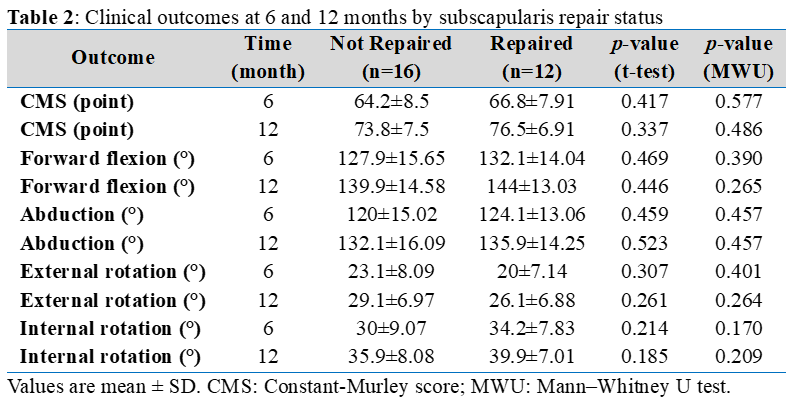
Background: Reverse total shoulder arthroplasty (RTSA) is one of the most important procedures in the management of several shoulder pathologies. Following advances in these procedures, the question was raised whether repairing the subscapularis tendon provides superior functional results compared to leaving it unrepaired following RTSA, with contemporary clinical studies providing conflicting findings. Objective: To compare the clinical and functional outcomes of reversed total shoulder arthroplasty (RTSA) performed with versus without subscapularis tendon repair in Iraqi patients. Methods: Twenty-eight patients scheduled for RTSA, in whom the decision to repair the subscapularis tendon was made intraoperatively according to the operating surgeon’s judgment, were evaluated at baseline preoperatively and at 6-month and 12-month intervals postoperatively using the Constant-Murley score and shoulder range of motion. The final analysis included 12 patients in the tendon repair group and 16 patients in the non-repair group. Results: Both groups demonstrated significant improvements in Constant-Murley Score (CMS) and shoulder range of motion throughout follow-up (all p<0.001). No significant between-group differences were observed at baseline, 6 months, or 12 months for any functional or range-of-motion outcome (p>0.05). However, repeated-measures analysis showed significantly faster recovery trajectories in the repair group for CMS, forward flexion, abduction, and internal rotation (time/group interaction, all p<0.001), whereas external rotation improved similarly regardless of repair status (p=0.595). Conclusions: Subscapularis repair in RTSA, when technically feasible, may facilitate earlier functional recovery without significantly altering 12-month clinical outcomes.
Downloads
References
Kozak T, Bauer S, Walch G, Al-Karawi S, Blakeney W. An update on reverse total shoulder arthroplasty: current indications, new designs, same old problems. EFORT Open Rev. 2021;6:189-201. doi: 10.1302/2058-5241.6.200085.
Dragonas CG, Mamarelis G, Dott C, Waseem S, Bajracharya A, Leivadiotou D. Anatomic total shoulder arthroplasty versus reverse total shoulder arthroplasty in patients aged over 70 without a full-thickness rotator cuff tear: A systematic review and meta-analysis. J Shoulder Elb Arthroplast. 2023;7:24715492231206685. doi: 10.1177/24715492231206685.
Tobin JG, Thomas SK, Elwell JA, Roche CP, Rogalski BL, Eichinger JF, et al. Anatomic total shoulder arthroplasty revised to reverse total shoulder arthroplasty: clinical and radiographic outcomes compared to primary reverse total shoulder arthroplasty. J Shoulder Elbow Surg. 2025;34:1525-31. doi: 10.1016/j.jse.2024.09.019.
Berton A, Gulotta LV, Longo UG, De Salvatore S, Piergentili I, Bandini B, et al. Medialized versus lateralized center of rotation in reverse total shoulder arthroplasty: A systematic review and meta-analysis. J Clin Med. 2021;10. doi: 10.3390/jcm10245868.
Kim SC, Kim IS, Jang MC, Yoo JC. Complications of reverse shoulder arthroplasty: a concise review. Clin Shoulder Elb. 2021;24:42-52. doi: 10.5397/cise.2021.00066.
Moussa MK, Bruchmann MG, Tedah D, Prabhakar A, Suarez-Jimenez LJM, Nassar A, et al. Clinical and radiological outcomes of a highly lateralized reverse shoulder arthroplasty in patients with a height of 160 cm or less versus a height of 170 cm or more. Semin Arthroplasty JSES. 2025;35:62-70. doi: 10.1053/j.sart.2024.09.002.
Cogan CJ, Ho JC, Entezari V, Iannotti JP, Ricchetti ET. The influence of reverse total shoulder arthroplasty implant design on biomechanics. Curr Rev Musculoskelet Med. 2023;16:95-102. doi: 10.1007/s12178-023-09820-8.
Preuss FR, Fossum BW, Peebles AM, Eble SK, Provencher MT. Subscapularis repair in reverse total shoulder arthroplasty: a systematic review and descriptive synthesis of cadaveric biomechanical strength outcomes. JSES Rev Rep Tech. 2022;2:437-441. doi: 10.1016/j.xrrt.2022.05.006.
Chang LR, Anand P, Varacallo MA. Anatomy, Shoulder and Upper Limb, Glenohumeral Joint. StatPearls. Treasure Island (FL): StatPearls Publishing LLC., 2026.
Bethell MA, Hurley ET, Welch J, Cabell G, Levin J, Lassiter TE, et al. Subscapularis repair for reverse shoulder arthroplasty: a systematic review and meta-analysis. J Shoulder Elbow Surg. 2023;32:2631-240. doi: 10.1016/j.jse.2023.06.011.
Ulery D, Mancuso AJ, Edgerton T, Butler J, Singleton A, Miller RM. Does shoulder stability differ with or without subscapularis repair after primary reversing total shoulder arthroplasty? A systematic review. JSES Rev Rep Tech. 2022;2:135-39. Doi: : 10.1016/j.xrrt.2022.01.003.
Corona K, Cerciello S, Ciolli G, Proietti L, Ambrosi R, et al. Clinical outcomes and joint stability after lateralized reverse total shoulder arthroplasty with and without subscapularis repair: A meta-analysis. J Clin Med. 2021;10:3014. doi: 10.3390/jcm10143014.
Miralles-Muñoz FA, Sebastiá-Forcada E. Constant-Murley score categorization to assess outcomes after reverse shoulder arthroplasty following complex proximal humeral fracture. J Orthop Sci. 2025;30:1047-1052. doi: 10.1016/j.jos.2025.03.011.
Werthel JD, Schoch BS, Hooke A, Sperling JW, An KN, Valenti P, et al. Biomechanical effectiveness of tendon transfers to restore active internal rotation in shoulder with deficient subscapularis with and without reverse shoulder arthroplasty. J Shoulder Elbow Surg. 2021;30:1196-1206. doi: 10.1016/j.jse.2020.08.026.
Edwards TB, Williams MD, Labriola JE, Elkousy HA, Gartsman GM, O'Connor DP. Subscapularis insufficiency and the risk of shoulder dislocation after reverse shoulder arthroplasty. J Shoulder Elbow Surg. 2009;18:892-896. doi: 10.1016/j.jse.2008.12.013.
Roberson TA, Shanley E, Griscom JT, Granade M, Hunt Q, Adams KJ, et al. Subscapularis repair is unnecessary after lateralized reverse shoulder arthroplasty. JBJS Open Access. 2018;3:e0056. doi: 10.2106/jbjs.Oa.17.00056.
Matthewson G, Kooner S, Kwapisz A, Leiter J, Old J, MacDonald P. The effect of subscapularis repair on dislocation rates in reverse shoulder arthroplasty: a meta-analysis and systematic review. J Shoulder Elbow Surg. 2019;28:989-997. doi: 10.1016/j.jse.2018.11.069.
Engel NM, Holschen M, Schorn D, Witt KA. Steinbeck J. Results after primary reverse shoulder arthroplasty with and without subscapularis repair: a prospective-randomized trial. Arch Orthop Trauma Surg. 2023;143:255-264. doi: 10.1007/s00402-021-04024-6.
Vourazeris JD, Wright TW, Struk AM, King JJ, Farmer KW. Primary reverse total shoulder arthroplasty outcomes in patients with subscapularis repair versus tenotomy. J Shoulder Elbow Surg. 2017;26:450-457. doi: 10.1016/j.jse.2016.09.017.
Corona K, Cerciello S, Ciolli G, Proietti L, D'Ambrosi R, Braile A, et al. Clinical outcomes and joint stability after lateralized reverse total shoulder arthroplasty with and without subscapularis repair: A meta-analysis. J Clin Med. 2021;10. doi: 10.3390/jcm10143014.
Clark JC, Ritchie J, Song FS, Kissenberth MJ, Tolan SJ, Hart ND, et al. Complication rates, dislocation, pain, and postoperative range of motion after reverse shoulder arthroplasty in patients with and without repair of the subscapularis. J Shoulder Elbow Surg. 2012;21:36-41. doi: 10.1016/j.jse.2011.04.009.
Boulahia A, Edwards TB, Walch G, Baratta RV. Early results of a reverse design prosthesis in the treatment of arthritis of the shoulder in elderly patients with a large rotator cuff tear. Orthopedics. 2002;25:129-33. doi: 10.3928/0147-7447-20020201-16.
Elbeshbeshy M, Rashid R, Hashim Z, Munir A, Kadhmawi I, Magee C, et al. Does subscapularis tendon repair during primary reverse total shoulder replacement improve shoulder stability or functional outcomes: a systematic review and meta-analysis. Semin Arthroplasty JSES. 2025;36(1):151520.
Werner BC, Wong AC, Mahony GT, Craig EV, Dines DM, Warren RF, et al. Clinical outcomes after reverse shoulder arthroplasty with and without subscapularis repair: The importance of considering glenosphere lateralization. J Am Acad Orthop Surg. 2018;26:e114-e19. doi: 10.5435/jaaos-d-16-00781.
Downloads
Published
How to Cite
Issue
Section
License
Copyright (c) 2026 Al-Rafidain Journal of Medical Sciences ( ISSN 2789-3219 )

This work is licensed under a Creative Commons Attribution-NonCommercial-ShareAlike 4.0 International License.
Published by Al-Rafidain University College. This is an open access journal issued under the CC BY-NC-SA 4.0 license (https://creativecommons.org/licenses/by-nc-sa/4.0/).