Incidence and Associated Risk Factors of Axillary Bromhidrosis Following Laser Hair Removal: A Prospective Cohort Study
Keywords:
Axillary, Bromhidrosis, Hair removal, IncidenceAbstract
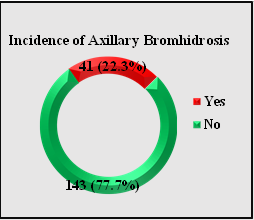
Background: Axillary bromhidrosis causes a considerable negative effect on social, psychological, and emotional well-being. Laser hair removal has recently been reported as the most used cosmetic procedure. Objective: To investigate the incidence, severity, and determinants of axillary bromhidrosis in healthy individuals undergoing laser hair removal. Methods: A prospective longitudinal cohort study was carried out in a private dermatology clinic in Baghdad during February 2024 to February 2026. It included 184 individuals who underwent axillary hair removal laser by one of two Alexandrite laser systems (Candela or DEKA). A total of six sessions (1.5 to 2.5 months apart depending on hair growth cycle) is recommended, followed by maintenance sessions as needed. The severity of axillary bromhidrosis was assessed clinically based on the distance from which the odor can be detected. Results: In this study, axillary bromhidrosis was noticed in 41 participants (22.3%); 58.5% experienced a moderate level of severity, and 95.1% of them were resolved after finishing all sessions. Multivariable logistic regression identified obesity and Fitzpatrick skin type II as independent predictors of axillary bromhidrosis following laser hair removal. These factors were obesity (OR=2.55 with 95% CI:1.61-4.44) and Fitzpatrick skin type II (OR=3.27 with 95% CI:1.89-6.41). Conclusions: Although laser hair removal is generally safe and successful, certain individuals, especially those at higher risk, may develop transient axillary bromhidrosis during treatment, a condition that can be treated. Important patient-related characteristics that contribute to vulnerability include obesity and Fitzpatrick skin type II.
Downloads
References
Yang JJ, Bai JL, Qiang S, Ma Y. Micropore drainage to prevent hematoma in axillary bromhidrosis: A comparative study. Medicine. 2025;104(26):e43068. doi: 10.1097/MD.0000000000043068.
Zhang J, Han P, Yang F, Jiang B. Advances in the treatment of axillary bromhidrosis. Skin Res Technol. 2024;30(8):e13895. doi: 10.1111/srt.13895.
Lan S, Zhao Z, Wu D, Zheng C, Dong X, Zhang K. Impact of apocrine gland residue on bromhidrosis clinical efficacy: A self-controlled case series study. Plast Reconstr Surg Glob Open. 2022;10(5):e4320. doi: 10.1097/GOX.0000000000004320.
Gregoriou S, Markantoni V, Campanati A, Martina E, Offidani A, Kouris A, et al. Treatment of axillary bromhidrosis with topical 2% glycopyrronium bromide cream: A prospective, non-randomized, open-label study. J Clin Aesthet Dermatol. 2021;14(11):E61-e63. PMID: 34980961.
Di Cicco F, Evans RL, James AG, Weddell I, Chopra A, Smeets MA. Intrinsic and extrinsic factors affecting axillary odor variation. A comprehensive review. Physiol Behav. 2023;270:114307. doi: 10.1016/j.physbeh.2023.114307.
Malik AS, Porter CL, Feldman SR. Bromhidrosis treatment modalities: a literature review. J Am Acad Dermatol. 2023;89(1):81-89. doi: 10.1016/j.jaad.2021.01.030.
Bacchini S, Mariani B, Tomassini GM, Oddo A, Cuomo R, Seth I, et al. Medical laser hair removal: a new rotational approach. Lasers Med Sci. 2025;40(1):339. doi: 10.1007/s10103-025-04592-8.
Fazel Z, Majidpour A, Behrangi E, Fathizadeh S, Nokandeh M, Atefi N, et al. Using the hair removal laser in the axillary region and its effect on normal microbial flora. J Lasers Med Sci. 2020;11(3):255-261. doi: 10.34172/jlms.2020.43.
Eldeeb ME, El Mulla K, Alshaer A, Ashraf HM, Omran EA. The effect of long-pulsed 1064 nm Nd: YAG laser-assisted hair removal on some skin flora and pathogens: An in vivo study. Indian J Dermatol Venereol Leprol. 2024;90(5):581-589. doi: 10.25259/IJDVL_854_2022.
Na S, Lee HJ, Park TH, Kim J, Jung YH, Cha M, et al. Sweat glands in action: the role of biological and environmental factors, exercise, and dermatologic conditions in sudomotor function. Korean J Physiol Pharmacol. 2026;30(4):271-287. doi: 10.4196/kjpp.25.192.
Wohlrab J, Bechara FG, Schick C, Naumann M. Hyperhidrosis: A central nervous dysfunction of sweat secretion. Dermatol Ther (Heidelb). 2023;13(2):453-463. doi: 10.1007/s13555-022-00885-w.
Chernychko V. Specifics of using diode lasers on different skin and hair types. Glob Prosperity. 2025;5(4). doi: 10.5281/zenodo.17980578.
Tofiq KA, Suliman KR. Patients’ satisfaction and safety of laser hair removal. J Sulaimani Med Coll. 2021;11(1):13-19. doi: 10.17656/Jsmc.10283.
Altaee M, Nooruldeen M. Advances in laser-based dermatology in Iraq from hair removal to skin rejuvenation. J Healthcare Life-Sci Res. 2025;4(11):2181-4368.
Helou J, Haber R, Kechichian E, Tomb R. A case of generalized bromhidrosis following whole-body depilatory laser. J Cosmet Laser Ther. 2015;17(6):318-320. doi: 10.3109/14764172.2015.1027232.
Mohammed RSH, Helmi RR, Al-Samarraee MF, Al-Sabak H. Effectiveness of 577-nm pro-yellow laser in managing inflammatory acne: Results from a quasi-randomized clinical trial. Al-Rafidain J Med Sci. 2026;10(2):152-158. doi: 10.54133/ajms.v10i2.2880.
Alaqdawi AH, Al-Samarraee MF, Ahmed SA, Abdulla JK. Culturally Adapted Gluten-Free High-Fiber Diet Improves Glycemic Control in Newly Diagnosed Type 2 Diabetes: A Randomized Controlled Trial. Clinical Nutrition Open Science. 2026 Apr 4:100657. doi: 10.1016/j.nutos.2026.100657
Zhang L, Cheng J, Wang C, Zhao J, Zhang C, Li H. Epidemiological analysis of axillary apocrine bromhidrosis in China: a survey from Chinese higher education students. Front Med (Lausanne). 2023;10:1232744. doi: 10.3389/fmed.2023.1232744.
Sakisaka M, Takushima A. Effectiveness of sofpironium bromide in patients with primary axillary hyperhidrosis who experienced residual or recurrence of axillary odor after surgery for axillary osmidrosis. J Plast Reconstr Surg. 2025;4(1):13-19. doi: 10.53045/jprs.2023-0067.
Hasan EF, Ahmed MH, Hraiga NM. Evaluating the clinical outcomes of using pro-yellow laser for steroid-induced rosacea: A prospective clinical study. Al-Rafidain J Med Sci. 2025;9(2):327-332. doi: 10.54133/ajms.v9i2.2445.
Fuseda K, Saito S, Kobayashi T. Perceived odor intensity ratings based on absolute scales of evaluators: Application of a 6-point odor intensity scale approximating the visual analogue scale (VAS). Jpn Psychol Res. 2026. doi: 10.1111/jpr.12611.
Hélou J, Soutou B, Jamous R, Tomb R. Novel adverse effects of laser-assisted axillary hair removal. Ann Dermatol Venereol. 2009;136(6-7):495-500. doi: 10.1016/j.annder.2009.04.005.
Schaller M, Plewig G, (Editors), Structure and function of eccrine, apocrine, and sebaceous glands. In: Dermatology, (3rd ed.), Elsevier. 2018:539-44. doi: 10.1016/B978-0-7020-6275-9.00035-0
Son HT, Choi HS, Cho SS, Park DH. Human body malodor and deodorants: The present and the future. Int J Mol Sci. 2025;26(21):10415. doi: 10.3390/ijms262110415.
Piccolo D, Mutlag MH, Pieri L, Fusco I, Conforti C, Crisman G, et al. Minimally invasive 1,444-nm Nd:YAG laser treatment for axillary bromhidrosis. Front Med. 2023;10:2023. doi: 10.3389/fmed.2023.1034122.
Haykal D, Rocha M. Navigating the intersection of lasers and the skin microbiome: A new frontier in esthetic dermatology. J Cosmet Dermatol. 2025;24(4):e70150. doi: 10.1111/jocd.70150.
Baker LB. Physiology of sweat gland function: The roles of sweating and sweat composition in human health. Temperature (Austin). 2019;6(3):211-259. doi: 10.1080/23328940.2019.1632145.
Aydin F, Pancar GS, Senturk N, Bek Y, Yuksel EP, Canturk T, et al. Axillary hair removal with 1064-nm Nd:YAG laser increases sweat production. Clin Exp Dermatol. 2010;35(6):588-592. doi: 10.1111/j.1365-2230.2009.03638.x.
Setchfield K, Gorman A, Simpson A, Somekh MG, Wright AJ. Effect of skin color on optical properties and the implications for medical optical technologies: a review. J Biomed Opt. 2024;29(1):010901. doi: 10.1117/1.JBO.29.1.010901.
Sharma AN, Patel BC. Laser Fitzpatrick skin type recommendations. 2023 Mar 6. In: StatPearls [Internet]. Treasure Island (FL): StatPearls Publishing; 2026 Jan–. PMID: 32491558.
Downloads
Published
How to Cite
Issue
Section
License
Copyright (c) 2026 Al-Rafidain Journal of Medical Sciences ( ISSN 2789-3219 )

This work is licensed under a Creative Commons Attribution-NonCommercial-ShareAlike 4.0 International License.
Published by Al-Rafidain University College. This is an open access journal issued under the CC BY-NC-SA 4.0 license (https://creativecommons.org/licenses/by-nc-sa/4.0/).