Anti-inflammatory and Gastroprotective Effects of Saroglitazar in a Rat Model of Ethanol-Induced Gastric Ulcer
DOI:
https://doi.org/10.54133/ajms.v11i1.3123Keywords:
Anti-inflammatory, Gastric ulcer, Gastroprotective effects, Saroglitazar , TNF-α , VonoprazanAbstract
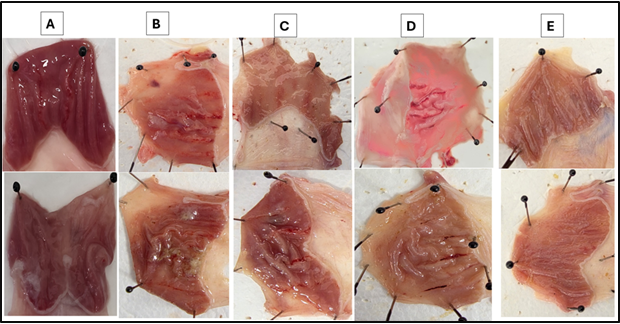
Background: Gastric ulcer is a prevalent gastrointestinal disorder characterized by several recurrences; each year, a million patients are diagnosed with gastric ulcers. Different groups of medications, using various strategies, participate in the prevention and treatment of gastric ulcers and in preventing ulcer relapses after treatment, but their negative effects limit their utility. Objective: To evaluate the possible anti-inflammatory and gastroprotective effects of saroglitazar in ethanol-induced gastric ulcers. Methods: Thirty-five male Wistar albino rats were randomly distributed into five groups, each group with 7 rats, as follows: negative control, positive control, Vonoprazan group, Saroglitazar 4 mg/kg group, and Saroglitazar 2 mg/kg group. All the medications were administered orally daily, and a single dose of ethanol (1 ml) was administered on day 15 for all except the negative control. After scarification, blood samples were gathered, and the stomachs were excised for gross evaluation. Results: TNF-α serum level reduced and gastric pH significantly Increased with Saroglitazar pretreatment groups; mucosal and vascular structure preservation, collagen restoration, and inflammation control were markedly recorded with the saroglitazar 4 mg/kg group and to some extent with the vonoprazan and saroglitazar 2 mg/kg groups. Gross examination of stomach images indicated marked protection in the pretreatment groups in different ranges. Conclusions: Saroglitazar shows gastroprotective effects on gastric ulcers induced with ethanol through anti-inflammatory properties, stomach content regulation, mucosal and vascular change protection, collagen restoration, and fibroblast activity stimulation.
Downloads
References
Islam H, Siddiqui A, Islam R, Islam T, Ahmed S, Fahim M, et al. NSAID-induced Gastric Ulcer Disease: A Deleterious Connection. Discov Med. 2024;36(188):1789. doi: 10.24976/Discov.Med.202436188.165. DOI: https://doi.org/10.24976/Discov.Med.202436188.165
Aziz RS. Gastroprotective effect of bezafibrate and Ginkgo biloba in ethanol-induced gastric ulcer in rats. Al-Rafidain J Med Sci. 2025;8(2):144–149. doi: 10.54133/ajms.v8i2.1816. DOI: https://doi.org/10.54133/ajms.v8i2.1816
Gong H, Zhao N, Zhu C, Luo L, Liu S. Treatment of gastric ulcer, traditional Chinese medicine may be a better choice. J Ethnopharmacol. 2024;324:117793. doi: 10.1016/j.jep.2024.117793. DOI: https://doi.org/10.1016/j.jep.2024.117793
Sen S, Asokkumar K, Umamaheswari M, Sivashanmugam AT, Subhadradevi V. Antiulcerogenic effect of gallic Acid in rats and its effect on oxidant and antioxidant parameters in stomach tissue. Indian J Pharm Sci. 2013;75(2):149–155. PMID: 24019562.
Caputo F, Guarino M, Casabianca A, Lungaro L, Costanzini A, Caio G, et al. Effects of ethanol on the digestive system: A narrative review. J Transl Gastroenterol. 2024. doi: 10.14218/JTG.2024.00028. DOI: https://doi.org/10.14218/JTG.2024.00028
Hama Amin RR, Aziz TA. Gastroprotective effect of azilsartan through ameliorating oxidative stress, inflammation, and restoring hydroxyproline, and gastrin levels in ethanol-induced gastric ulcer. J Inflamm Res. 2022;15:2911–2923. doi:v10.2147/JIR.S365090. DOI: https://doi.org/10.2147/JIR.S365090
Rahman Z, Dwivedi D, Jena G. Ethanol-induced gastric ulcer in rats and intervention of tert-butylhydroquinone: Involvement of Nrf2/HO-1 signalling pathway. Hum Exp Toxicol. 2020;39(4):547–562. doi: 10.1177/0960327119895559. DOI: https://doi.org/10.1177/0960327119895559
Kamada T, Satoh K, Itoh T, Ito M, Iwamoto J, Okimoto T, et al. Evidence-based clinical practice guidelines for peptic ulcer disease 2020. J Gastroenterol. 2021;56(4):303–322. doi: 10.1007/s00535-021-01769-0. DOI: https://doi.org/10.1007/s00535-021-01769-0
Kavitt RT, Lipowska AM, Anyane-Yeboa A, Gralnek IM. Diagnosis and treatment of peptic ulcer disease. Am J Med. 2019;132(4):447–456. doi: 10.1016/j.amjmed.2018.12.009. DOI: https://doi.org/10.1016/j.amjmed.2018.12.009
Andrawes M, Andrawes W, Das A, Siau K. Proton pump inhibitors (PPIs)—An evidence-based review of indications, efficacy, harms, and deprescribing. Medicina (Mex). 2025;61(9):1569. doi: 10.3390/medicina61091569. DOI: https://doi.org/10.3390/medicina61091569
Kuna L, Jakab J, Smolic R, Raguz-Lucic N, Vcev A, Smolic M. Peptic ulcer disease: A brief review of conventional therapy and herbal treatment options. J Clin Med. 2019;8(2):179. doi: 10.3390/jcm8020179. DOI: https://doi.org/10.3390/jcm8020179
Roy A, Tewari B, Giri S, Goenka M. Saroglitazar in non-alcoholic fatty liver disease from bench to bedside: A comprehensive review and sub-group meta-analysis. Cureus. 2023. doi: 10.7759/cureus.47493. DOI: https://doi.org/10.7759/cureus.47493
FDA. Saroglitazar magnesium; Orphan Designation for Treatment of Primary Biliary Cholangitis (PBC). Date designated: January 26, 2021.
Alanazi BH, Nour OA, Serrya MS. Saroglitazar mitigated cyclophosphamide-induced testicular injury: Crosstalk between oxidative stress, inflammation and apoptosis. Pharmaceuticals. 2026;19(2):266. doi: 10.3390/ph19020266. DOI: https://doi.org/10.3390/ph19020266
Krishnappa M, Patil K, Parmar K, Trivedi P, Mody N, Shah C, et al. Effect of saroglitazar 2 mg and 4 mg on glycemic control, lipid profile and cardiovascular disease risk in patients with type 2 diabetes mellitus: a 56-week, randomized, double blind, phase 3 study (PRESS XII study). Cardiovasc Diabetol. 2020;19(1):93. doi: 10.1186/s12933-020-01073-w. DOI: https://doi.org/10.1186/s12933-020-01073-w
Ibrahim A, Baiz H, Ahmed Z, Othman H, Aziz T. Healing effects of saroglitazar gel in thermally induced burn in rats. Al-Anbar Med J. 2024. doi: 10.33091/amj.2024.152658.1866. DOI: https://doi.org/10.33091/amj.2024.152658.1866
Makled MN, El-Kashef DH. Saroglitazar attenuates renal fibrosis induced by unilateral ureteral obstruction via inhibiting TGF-β/Smad signaling pathway. Life Sci. 2020;253:117729. doi: 10.1016/j.lfs.2020.117729. DOI: https://doi.org/10.1016/j.lfs.2020.117729
Rasheed RH, Aziz TA. Cardioprotective effects of SAR through attenuating cardiac-specific markers, inflammatory markers, oxidative stress, and anxiety in rats challenged with 5-fluorouracil. J Xenobiotics. 2025;15(4):130. doi: 10.3390/jox15040130. DOI: https://doi.org/10.3390/jox15040130
Montaigne D, Butruille L, Staels B. PPAR control of metabolism and cardiovascular functions. Nat Rev Cardiol. 2021 Dec;18(12):809–823. doi: 10.1038/s41569-021-00569-6. DOI: https://doi.org/10.1038/s41569-021-00569-6
Saha L, Bhatia A, Chakrabarti A. Gastroprotective effect of bezafibrate, a peroxisome proliferator activated receptor α agonist and its mechanism in a rat model of aspirin‐induced gastric ulcer. Adv Dig Med. 2016;3(3):101–110. doi: 10.1016/j.aidm.2016.04.001. DOI: https://doi.org/10.1016/j.aidm.2016.04.001
Mahmoud SA, Elkhoely A, El-Sayed EK, Ahmed AAE. Enhanced upregulation of SIRT1 via pioglitazone and ligustrazine confers protection against ethanol-induced gastric ulcer in rats. Naunyn Schmiedebergs Arch Pharmacol. 2024;397(8):6177–6195. doi: 10.1007/s00210-024-03026-6. DOI: https://doi.org/10.1007/s00210-024-03026-6
El-Shitany NA, EL-saidy EA, EL-Naggar ME, Sokar SS. Cilostazol protects against gastric ulcers by regulating PPAR-γ, HO-1, PECAM-1, pErk-1, NF-κB, Bcl-2, and cleaved caspase-3 protein expression. Naunyn Schmiedebergs Arch Pharmacol. 2024;397(11):9033–9050. doi: 10.1007/s00210-024-03176-7. DOI: https://doi.org/10.1007/s00210-024-03176-7
Naito Y, Takagi T, Matsuyama K, Yoshida N, Yoshikawa T. Pioglitazone, a specific PPAR‐γ ligand, inhibits aspirin‐induced gastric mucosal injury in rats. Aliment Pharmacol Ther. 2001;15(6):865–873. doi: 10.1046/j.1365-2036.2001.00983.x. DOI: https://doi.org/10.1046/j.1365-2036.2001.00983.x
Slomiany BL, Slomiany A. Suppression of gastric mucosal inflammatory responses to Helicobacter pylori lipopolysaccharide by peroxisome proliferator‐activated receptor γ activation. IUBMB Life. 2002;53(6):303–308. doi: 10.1080/15216540213459. DOI: https://doi.org/10.1080/15216540213459
Saha L. Role of peroxisome proliferator-activated receptors alpha and gamma in gastric ulcer: An overview of experimental evidences. WJGPT. 2015;6(4):120. doi: 10.4292/wjgpt.v6.i4.120. DOI: https://doi.org/10.4292/wjgpt.v6.i4.120
Elsisy RA, Qahl SH, Badawy AA, El-Magd MA, Eldeeb AE, Farage AE. The effect of cinnamic acid-isatin hybrid and/or vonoprazan on indomethacin-induced gastric ulcer in rats. J Radiat Res Appl Sci. 2025;18(4):102031. doi: 10.1016/j.jrras.2025.102031. DOI: https://doi.org/10.1016/j.jrras.2025.102031
Ahamad R, Bhandari U, Nabi S, Sharma S. Saroglitazar suppresses KIM-1 and type IV collagen in high fat diet and low-dose streptozotocin-induced diabetic nephropathy in Wistar rats. Iran J Basic Med Sci. 2024;27(11). doi: 10.22038/ijbms.2024.78221.16908.
Li W, Huang H, Niu X, Fan T, Mu Q, Li H. Protective effect of tetrahydrocoptisine against ethanol-induced gastric ulcer in mice. Toxicol Appl Pharmacol. 2013;272(1):21–29. doi: 10.1016/j.taap.2013.05.035. DOI: https://doi.org/10.1016/j.taap.2013.05.035
Hui S, Fangyu W. Protective effects of bilobalide against ethanol-induced gastric ulcer in vivo/vitro. Biomed Pharmacother. 2017;85:592–600. doi: 10.1016/j.biopha.2016.11.068. DOI: https://doi.org/10.1016/j.biopha.2016.11.068
Mousa AM, El-Sammad NM, Hassan SK, Madboli AENA, Hashim AN, Moustafa ES, et al. Antiulcerogenic effect of Cuphea ignea extract against ethanol-induced gastric ulcer in rats. BMC Complement Altern Med. 2019;19(1):345. doi: 10.1186/s12906-019-2760-9. DOI: https://doi.org/10.1186/s12906-019-2760-9
Shen Q, Sun ZH, Xu YM, Hu QB, Zhang WH, Huang SA. Associations between complete-blood-count-derived inflammatory markers and gastric ulcer: A cross-sectional study. World J Gastroenterol. 2025;31(38). doi: 10.3748/wjg.v31.i38.111298. DOI: https://doi.org/10.3748/wjg.v31.i38.111298
Ke J, Qiu F, Fan W, Wei S. Associations of complete blood cell count-derived inflammatory biomarkers with asthma and mortality in adults: a population-based study. Front Immunol. 2023;14:1205687. doi: 10.3389/fimmu.2023.1205687. DOI: https://doi.org/10.3389/fimmu.2023.1205687
Zhang JW. Systemic inflammatory markers in gastric ulcer: Leveraging routine blood tests. World J Gastroenterol. 2026;32(1). doi: 10.3748/wjg.v32.i1.114172. DOI: https://doi.org/10.3748/wjg.v32.i1.114172
Akbari R, Behdarvand T, Afarin R, Yaghooti H, Jalali MT, Mohammadtaghvaei N. Saroglitazar improved hepatic steatosis and fibrosis by modulating inflammatory cytokines and adiponectin in an animal model of non-alcoholic steatohepatitis. BMC Pharmacol Toxicol. 2021;22(1):53. doi: 10.1186/s40360-021-00524-8. DOI: https://doi.org/10.1186/s40360-021-00524-8
Li Y, Jin Y, Shu W, Li H, Zhang C, Wang X, et al. Isoliquiritigenin alleviates ethanol-induced gastric ulcers by modulating the TNF signaling pathway and targeting IL-6. J Funct Foods. 2026;140:107255. doi: 10.1016/j.jff.2026.107255. DOI: https://doi.org/10.1016/j.jff.2026.107255
Shahin M, Konturek JW, Pohle T, Schuppan D, Herbst H, Domschke W. Remodeling of extracellular matrix in gastric ulceration. Microsc Res Tech. 2001;53(6):396–408. doi: 10.1002/jemt.1108. DOI: https://doi.org/10.1002/jemt.1108
Tuorkey M, Karolin K. Anti-ulcer activity of curcumin on experimental gastric ulcer in rats and its effect on oxidative stress/antioxidant, IL-6 and enzyme activities. Biomed Environ Sci. 2009;22(6):488–495. doi: 10.1016/S0895-3988(10)60006-2. DOI: https://doi.org/10.1016/S0895-3988(10)60006-2
Liu J, Wang F, Luo H, Liu A, Li K, Li C, et al. Protective effect of butyrate against ethanol-induced gastric ulcers in mice by promoting the anti-inflammatory, anti-oxidant and mucosal defense mechanisms. Int Immunopharmacol. 2016;30:179–187. doi: 10.1016/j.intimp.2015.11.018. DOI: https://doi.org/10.1016/j.intimp.2015.11.018
Zhou D, Yang Q, Tian T, Chang Y, Li Y, Duan LR, et al. Gastroprotective effect of gallic acid against ethanol-induced gastric ulcer in rats: Involvement of the Nrf2/HO-1 signaling and anti-apoptosis role. Biomed Pharmacother. 2020;126:110075. doi: 10.1016/j.biopha.2020.110075. DOI: https://doi.org/10.1016/j.biopha.2020.110075
Downloads
Published
How to Cite
Issue
Section
License
Copyright (c) 2026 Al-Rafidain Journal of Medical Sciences ( ISSN 2789-3219 )

This work is licensed under a Creative Commons Attribution-NonCommercial-ShareAlike 4.0 International License.
Published by Al-Rafidain University College. This is an open access journal issued under the CC BY-NC-SA 4.0 license (https://creativecommons.org/licenses/by-nc-sa/4.0/).