Implementation Status, Operational Workflow, and Challenges of Iraq’s National Pharmaceutical Track-and-Trace System (Gudea): From Health Officials’ Perspectives
Keywords:
Gudea, Iraq, Medicine authentication , Pharmaceutical regulation , Serialization , Track-and-trace systemAbstract
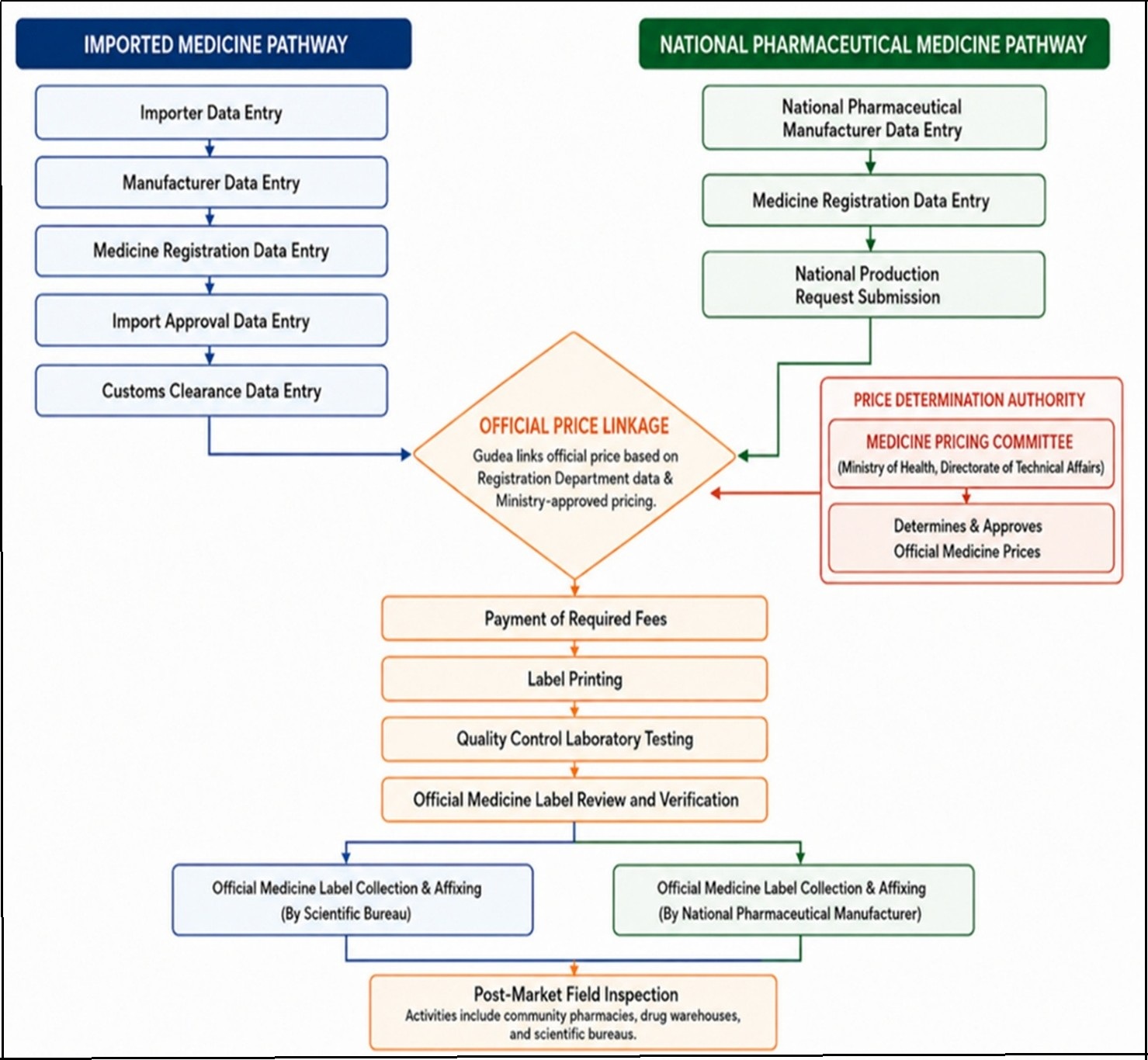
Background: The private pharmaceutical sector in Iraq has problems with medicine authenticity, price differences, smuggling, and limited post-market control. The Iraqi Ministry of Health introduced the National Pharmaceutical Track-and-Trace System, known as Gudea, to strengthen medicine authentication, price regulation, and supply-chain oversight. Objectives: To describe the implementation status, operational workflow, key administrative indicators, and challenges of the Gudea system in Iraq’s private pharmaceutical sector from the Ministry of Health’s perspective. Methods: A qualitative-dominant descriptive mixed-methods design was used between 22 October 2025 and 15 February 2026. Qualitative data were collected through two semi-structured key-informant interviews with Ministry of Health pharmacists involved in Gudea implementation and regulatory use and analyzed thematically. Administrative quantitative data were extracted from official system records and summarized descriptively. Results: The Gudea system functions as an integrated digital regulatory platform linking serialization, official price control, laboratory testing, customs-related information, field inspection, and public verification. Administrative indicators showed substantial activity, including more than 1.8 billion official medicine labels, 22,120 medicine items, 78,817 tested batches, and 3,263 inspection visits. Qualitative findings indicated a transition from paper-based procedures to electronic regulatory verification, particularly in field inspection. Key challenges were partial coverage, low stakeholder cooperation, customs-release gaps, laboratory delays, and the need for wider system integration. Conclusions: The Gudea represents an important national step toward strengthening pharmaceutical governance, medicine authentication, price transparency, and regulatory oversight in Iraq. Future efforts should focus on expanding system coverage, improving institutional coordination, completing technical integration, and evaluating its impact on medicine safety and market regulation.
Downloads
References
A study on the public health and socioeconomic impact of substandard and falsified medical products n.d. https://www.who.int/publications/i/item/9789241513432 (accessed April 28, 2026).
Iraq n.d. https://data.who.int/countries/368 (accessed May 18, 2026).
Iraqi Ministry of Health. Iraq pharmaceutical country profile 2020. Baghdad: 2020. Available at: https://moh.gov.iq/upload/1375.pdf
Al-Sudani: Iraq spends $3 billion dollars on imported medications - Shafaq News n.d. https://shafaq.com/en/Iraq/Al-Sudani-Iraq-spends-3-billion-dollars-on-imported-medications (accessed March 25, 2026).
Ahmed KK, Al-Jumaili AA, Aladul MI, Farhan MS, Al-Ghuraibawi FH, Al-Sayegh HF. Pharmacy education and practice in Iraq: expanding roles and fostering research. Int J Pharmacy Pract. 2026. doi: 10.1093/ijpp/riag072.
Kulkarni SR. Implementation of track and trace systems at pharmaceuticals industry Ltd. J Inform Syst Engineer Manag. 2025;10:834–841. doi: 10.52783/jisem.v10i19s.3120.
Rached S. Barriers to the implementation of a unique identifier and a track and trace system in the Lebanese pharmaceutical sector Lebanese American University. Thesis, 2022. doi: 10.26756/th.2022.427.
Al-Jumaili AA, Sameer HN. View of the insights of experienced pharmacists regarding the Iraqi health insurance program: A qualitative study. Iraqi J Pharm Sci. 2022;31(Suppl.):131-140. doi: 10.31351/vol31issSuppl.pp131-140.
Anonymous. Pharmaceutical Drug Regulatory Affairs Journal Challenges of Iraq Pharmaceutical Market Post-2003. n.d. Available at: https://www.researchgate.net/publication/338013459_Pharmaceutical_Drug_Regulatory_Affairs_Journal_Challenges_of_Iraq_Pharmaceutical_Market_Post-2003 (accessed May 24, 2026).
Al-Jumaili AA, Younus MM, Kannan YJA, Nooruldeen ZE, Al-Nuseirat A. Pharmaceutical regulations in Iraq: from medicine approval to postmarketing. East Mediterr Health J. 2021;27(10):1007-1015. doi: 10.26719/emhj.21.025.
Al-Jumaili AA, Younus MM, Saleh MZ. The epidemic of substandard and falsified medications in Iraq: Evaluating the effectiveness of national pharmacovigilance alerts to community pharmacies. Pharm Med. 2021;35:169–186. doi: 10.1007/s40290-021-00386-9.
Gudea. Gudea National Pharmaceutical Verification System: Official Website. Available at: https://gudea.gov.iq/ (accessed March 26, 2026).
Braun V, Clarke V. Using thematic analysis in psychology. Qual Res Psychol. 2006;3:77–101. doi: 10.1191/1478088706qp063oa.
Parmaksiz K, Pisani E, Kok MO. What makes a national pharmaceutical track and trace system succeed? lessons from turkey. Glob Health Sci Pract. 2020;8:431–441. doi: 10.9745/GHSP-D-20-00084.
Drug Track and Trace System (RSD). The official website of the Saudi Food and Drug Authority. Available at: https://www.sfda.gov.sa/en/eservices/65904 (accessed May 17, 2026).
Almutairi M, Alyousef A, Alduraywish W, Hafiz R, Almutairi K, Alturki M. The impact of implementing the drug-tracking system on operational efficiency in the Saudi healthcare supply chain. Saudi J Health Syst Res. 2026:1–13. doi: 10.1159/000551453.
Anonymous. Policy paper on traceability of medical products. Available at: https://www.who.int/publications/i/item/policy-paper-on-traceability-of-medical-products (accessed May 17, 2026).
Anonymous. Healthcare traceability and GS1 standards. Available at: https://www.gs1.org/industries/healthcare/traceability (accessed May 17, 2026).
Zhang H, Hua D, Huang C, Samal SK, Xiong R, Sauvage F, et al. Materials and technologies to combat counterfeiting of pharmaceuticals: Current and future Problem tackling. Adv Mater. 2020;32. doi: 10.1002/adma.201905486.
Bolla AS, Patel AR, Priefer R. The silent development of counterfeit medications in developing countries – A systematic review of detection technologies. Int J Pharm. 2020;587. doi: 10.1016/j.ijpharm.2020.119702.
FDA. Drug Supply Chain Security Act (DSCSA). Available at: https://www.fda.gov/drugs/drug-supply-chain-integrity/drug-supply-chain-security-act-dscsa (accessed May 17, 2026).
European Commission. Falsified medicines - Public Health - European Commission. Available at: https://health.ec.europa.eu/medicinal-products/falsified-medicines_en (accessed May 17, 2026).
Kootstra J, Kleinhout-Vliek T. Implementing pharmaceutical track-and-trace systems: a realist review. BMJ Glob Health. 2021;6:3755. doi: 10.1136/bmjgh-2020-003755.
Da Silva RB, de Mattos CA. Critical success factors of a drug traceability system for creating value in a pharmaceutical supply chain (PSC). Int J Environ Res Public Health. 2019;16:1972. doi: 10.3390/ijerph16111972.
Downloads
Published
How to Cite
Issue
Section
License
Copyright (c) 2026 Al-Rafidain Journal of Medical Sciences ( ISSN 2789-3219 )

This work is licensed under a Creative Commons Attribution-NonCommercial-ShareAlike 4.0 International License.
Published by Al-Rafidain University College. This is an open access journal issued under the CC BY-NC-SA 4.0 license (https://creativecommons.org/licenses/by-nc-sa/4.0/).