Ravitch versus Nuss for Adolescent Pectus Carinatum: Multicenter Evidence to Guide Deformity-Specific Surgical Decision-Making
DOI:
https://doi.org/10.54133/ajms.v10i2.2909Keywords:
Deformity-specific surgery, Nuss procedure, Pectus carinatum , Ravitch procedure , Surgical outcomesAbstract
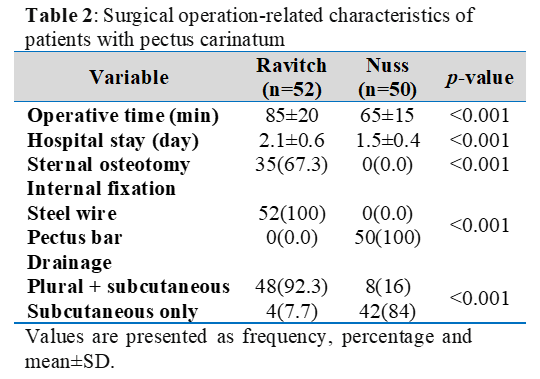
Background: Pectus carinatum (PC) is a congenital malformation of the chest wall, affecting adolescent males predominantly and associated with psychosocial effects. In the Middle East, many studies address the same topic. Objective: To evaluate outcomes of modified Ravitch and Nuss procedures in Iraqi adolescents. Methods: A multicenter retrospective cohort study (2020–2025) involved 102 adolescents (12–18 years) who underwent PC correction using Ravitch (n=52) or Nuss (n=50) techniques. Procedure selection was based on the severity of deformity, rigidity of the chest wall, and expertise of the surgeon. Outcomes included operative time, hospital stay, complications, aesthetic results, and patient satisfaction (5-point Likert scale). A severity-stratified subgroup analysis was performed. Results: Baseline characteristics were comparable, although severe deformities were more frequent in the Ravitch group (65.4% vs. 16.0%, p<0.001). The Nuss procedure had a shorter operation time (65±15 vs. 85±20 minutes, p<0.001) and less hospitalization (1.5±0.4 vs. 2.1±0.6 days, p<0.001). The rates of complications were identical (13.5% vs. 14%; p=0.93). Severity-stratified analysis showed higher Nuss operation efficiency in moderate levels of deformities with comparable rates of complication and satisfaction at severity levels. Favorable aesthetic outcomes were obtained in 82.7% of Ravitch and 88% of Nuss, and more than 90% of patients were satisfied after two years of follow-up. Conclusions: The two techniques are safe and effective in PC correction, supporting the Nuss procedure for moderate deformities, and the Ravitch technique is preferred for severe or rigid cases.
Downloads
References
Janssen N, Coorens NA, Franssen AJPM, Daemen JHT, Michels IL, Hulsewé KWE, et al. Pectus excavatum and carinatum: a narrative review of epidemiology, etiopathogenesis, clinical features, and classification. J Thorac Dis. 2024;16(2):1687-1701. doi: 10.21037/jtd-23-957. DOI: https://doi.org/10.21037/jtd-23-957
Martinez-Ferro M, Bellia-Munzon G, Schewitz IA, Toselli L. Pectus carinatum: When less is more. Afr J Thorac Crit Care Med. 2019;25(3). doi: 10.7196/AJTCCM.2019. DOI: https://doi.org/10.7196/SARJ.2019.v25i3.019
de Beer S, Volcklandt S, de Jong J, Oomen M, Zwaveling S, van Heurn E. Dynamic compression therapy for Pectus Carinatum in children and adolescents: Factors for success. J Pediatr Surg. 2023;58(8):1440-1445. doi: 10.1016/j.jpedsurg.2022.09.008. DOI: https://doi.org/10.1016/j.jpedsurg.2022.09.008
Altınok V, Altınok Eİ, Kasar T. Non-operative treatment of Pectus Excavatum and Carinatum: A retrospective analysis. Cam Sakura Med J. 2025;5(2):62-66. doi: 10.4274/csmedj.galenos.2025.2025-5-3. DOI: https://doi.org/10.4274/csmedj.galenos.2025.2025-5-3
Omanik P, Sesia SB, Kozlikova K, Schmidtova V, Funakova M, Haecker FM. Bracing of Pectus Carinatum in children: Current practices. Children. 2024;11(4):470. doi: 10.3390/children11040470. DOI: https://doi.org/10.3390/children11040470
Kaspiris A, Spyrou I, Panagopoulos F, Marougklianis V, Pelantis P, Vavourakis M, et al. Surgical strategies and challenges in scheuermann’s kyphosis: A comprehensive review. J Clin Med. 2025;14(12):4276. doi: 10.3390/jcm14124276. DOI: https://doi.org/10.3390/jcm14124276
Park JB, Lee GW. Choosing the right treatment for degenerative cervical myelopathy. J Clin Orthopaed Trauma. 2025;66:103014. doi: 10.1016/j.jcot.2025.103014. DOI: https://doi.org/10.1016/j.jcot.2025.103014
Eldredge RS, Sabati A, Ochoa B, Viswanath V, Khoury E, Rassam K, et al. Cardiopulmonary impact of the minimally invasive repair of Pectus Excavatum in pediatric patients. J Pediatr Surg. 2025;60(4):162177. doi: 10.1016/j.jpedsurg.2025.162177. DOI: https://doi.org/10.1016/j.jpedsurg.2025.162177
Liu YH, Htut N, Hsu CY, Cheng YL. Modified Nuss procedure in patients with recurrent pectus excavatum following the Ravitch procedure with a retained strut: report of two cases. J Cardiothorac Surg. 2025;20(1):423. doi: 10.1186/s13019-025-03595-4. DOI: https://doi.org/10.1186/s13019-025-03595-4
Wang L, Liu J, Li Y, Feng T, Cao B, Xiao H, et al. Modified Nuss operation using introducer-bar complex for pectus excavatum in adults. J Cardiothorac Surg. 2021;16(1):267. doi: 10.1186/s13019-021-01624-6. DOI: https://doi.org/10.1186/s13019-021-01624-6
Viggiano D, Bongiolatti S, Borgianni S, Lo Piccolo R, Voltolini L, Gonfiotti A. Nuss technique for Pectus Excavatum in adult patients. Front Surg. 2022;9:903791. doi: 10.3389/fsurg.2022.903791. DOI: https://doi.org/10.3389/fsurg.2022.903791
Media AS, Christensen TD, Katballe N, Juhl-Olsen P, Vad H, Petersen RH, et al. Complication rates rise with age and Haller index in minimally invasive correction of pectus excavatum. J Thorac Cardiovasc Surg. 2024;168(3):699-711. doi: 10.1016/j.jtcvs.2024.01.047. DOI: https://doi.org/10.1016/j.jtcvs.2024.01.047
Farronato A, Ghionzoli M, Messineo A, Politi L, Divisi D, Gonfiotti A, et al. Pectus excavatum in adolescents and children: the Nuss technique. Pediatric Med. 2019;2. doi: 10.21037/pm.2019.07.02. DOI: https://doi.org/10.21037/pm.2019.07.02
Davari H, Asbagh RA, Hosseini S, Ahmadi Tafti SH, Foruzannia SK, Ghavidel AA, et al. Modified Nuss procedure versus Ravitch in concurrent repair of pectus deformity and open-heart surgery. Asian Cardiovasc Thoracic Ann. 2026;34(1):33-42. doi: 10.1177/02184923251404220. DOI: https://doi.org/10.1177/02184923251404220
Huerta CT, Alligood DM, Davis JK, Ramsey WA, Cobler-Lichter MD, Shagabayeva L, et al. Outcomes after Pectus excavatum repair: A nationwide comparison of Nuss versus Ravitch operations. J Surg Res. 2024;303:381-389. doi: 10.1016/j.jss.2024.09.025. DOI: https://doi.org/10.1016/j.jss.2024.09.025
Sollie ZW, Gleason F, Donahue JM, Wei B. Evolution of technique and results after permanent open repair for pectus deformities. JTCVS Tech. 2022;12:212-219. doi: 10.1016/j.xjtc.2021.12.008. DOI: https://doi.org/10.1016/j.xjtc.2021.12.008
Jawitz OK, Raman V, Thibault D, Yerokun B, Zwischenberger BA, Kosinski AS, et al. Complications after Ravitch versus Nuss repair of pectus excavatum: A Society of Thoracic Surgeons (STS) General Thoracic Surgery Database analysis. Surgery. 2021;169(6):1493-1499. doi: 10.1016/j.surg.2020.12.023. DOI: https://doi.org/10.1016/j.surg.2020.12.023
Orrick BA, Pierce AL, McElroy SF. Changes in self-image after pectus carinatum brace treatment. J Pediatr Surg. 2022;57(8):1579-1583. doi: 10.1016/j.jpedsurg.2021.12.002. DOI: https://doi.org/10.1016/j.jpedsurg.2021.12.002
Elsayed HH, Hassaballa AS, Abdel Hady SM, Elbastawisy SE, Ahmed TA. Choosing between the modified Ravitch and Nuss procedures for pectus excavatum: Considering the patient’s perspective. Ann R Coll Surg Engl. 2016;98(8):581-585. doi: 10.1308/rcsann.2016.0254. DOI: https://doi.org/10.1308/rcsann.2016.0254
Di Salvo N, Ruggeri G, Thomas E, Parente G, Di Mitri M, Lima M. Long-term evaluation of patient satisfaction and quality of life in pectus excavatum repair. Ann Pediatr Surg. 2022;18(1):84. doi: 10.1186/s43159-022-00226-8. DOI: https://doi.org/10.1186/s43159-022-00226-8
Ravanbakhsh S, Farina JM, Bostoros P, Abdelrazek A, Mi L, Lim E, et al. Sex differences in objective measures of adult patients presenting for Pectus Excavatum repair. Ann Thorac Surg. 2022;114(4):1159-1167. doi: 10.1016/j.athoracsur.2021.08.060. DOI: https://doi.org/10.1016/j.athoracsur.2021.08.060
Albahadili M, Ismael SM, Al-Samarraee MF. Is it possible to manage appendicular mass without surgery? Al-Rafidain J Med Sci. 2025;9(2):46-50. doi: 10.54133/ajms.v9i2.2322. DOI: https://doi.org/10.54133/ajms.v9i2.2322
Kadhim S, Al-Atta D, Samarraee M. Superiority of the body roundness index over BMI in linking central adiposity with vitamin D3: A cross-sectional study in Iraqi adults. Funct Food Health Dis. 2025;15(11):783-795. doi: 10.31989/ffhd.v15i11.1798. DOI: https://doi.org/10.31989/ffhd.v15i11.1798
Janssen N, Daemen JHT, Michels IL, Franssen AJPM, Maessen JG, Hulsewé KWE, et al. Preoperative imaging of clinically relevant intrathoracic abnormalities in pectus excavatum patients. Quant Imaging Med Surg. 2023;13(6):3489-3495. doi: 10.21037/qims-22-1366. DOI: https://doi.org/10.21037/qims-22-1366
Shakhsheer BA, Bachier-Rodriguez M, Shew SB, Loeff DS. Ethics and multiculturalism in pediatric surgery. Semin Pediatr Surg. 2021;30(5):151103. doi: 10.1016/j.sempedsurg.2021.151103. DOI: https://doi.org/10.1016/j.sempedsurg.2021.151103
Toselli L, Bellia-Munzon G, Sanjurjo D, Martinez-Ferro M. Novel techniques and future developments in minimally invasive pectus repair. J Thorac Dis. 2024;16(7):4807-4815. doi: 10.21037/jtd-23-1676. DOI: https://doi.org/10.21037/jtd-23-1676
Downloads
Published
How to Cite
Issue
Section
License
Copyright (c) 2026 Al-Rafidain Journal of Medical Sciences ( ISSN 2789-3219 )

This work is licensed under a Creative Commons Attribution-NonCommercial-ShareAlike 4.0 International License.
Published by Al-Rafidain University College. This is an open access journal issued under the CC BY-NC-SA 4.0 license (https://creativecommons.org/licenses/by-nc-sa/4.0/).