Metabolic, Electrolyte, and Hepatobiliary Complications of Parenteral Nutrition in Neonates: A Prospective Case-Series Study
Keywords:
Cholestasis, Electrolyte imbalance, Metabolic complications, Neonates, Parenteral nutritionAbstract
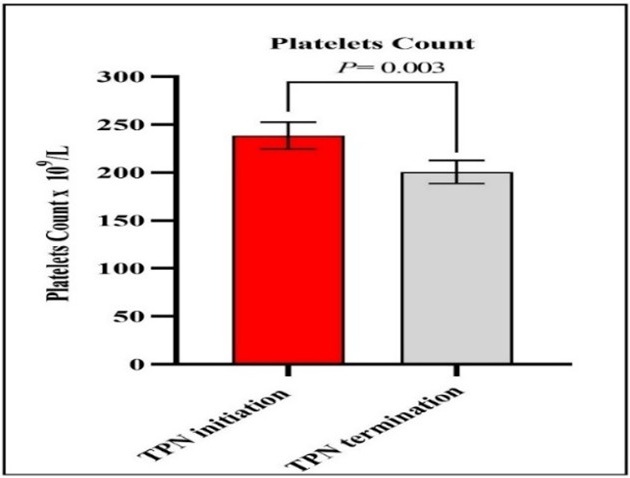
Background: Parenteral nutrition (PN) is a life‑saving intervention for neonates who are unable to meet their nutritional requirements through enteral feeding. Despite its essential role, PN is frequently associated with metabolic, electrolyte, and hepatobiliary complications. Objective: To evaluate the frequency and pattern of metabolic, electrolyte, and hepatobiliary complications associated with PN administration in neonates. Methods: A prospective case-series study was conducted in two tertiary neonatal intensive care units (NICUs) in Baghdad, Iraq. Term and preterm neonates who received PN for at least five days were included. PN‑related metabolic, electrolyte, hepatobiliary, and hematological complications were recorded and analyzed. Results: Of the 94 neonates included in the primary outcome. The incidence of hypoglycemia is 35.1%, and hyperglycemia is 31.9%. Cholestasis 11.7%, hypokalemia 20.2%, hyponatremia 18%, hypocalcemia 27.6%, and thrombocytopenia 28.7%. The mean ± standard deviation of gestational age was 32.1±3.8 weeks; for postnatal age at the start of PN, it was 9.72±17.4 days; for the duration of TPN exposure, it was 12.65±9.27 days; and for the weight of the patients at the start and end of TPN, it was 1.7±0.70 and 1.84±0.74 kg, respectively. Conclusions: PN‑related metabolic, electrolyte, and hepatobiliary complications are common in neonates. Close monitoring and individualized PN management are essential to improve neonatal outcomes.
Downloads
References
Mirtallo J, Canada T, Johnson D, Kumpf V, Petersen C, Sacks G, et al. Task Force for the Revision of Safe Practices for Parenteral Nutrition. Safe practices for parenteral nutrition. J Parenter Enteral Nutr. 2004;28(6):S39-70. doi: 10.1177/0148607104028006s39.
Shulman RJ, Phillips S. Parenteral nutrition in infants and children. J Pediatr Gastroenterol Nutr. 2003;36(5):587-607. doi: 10.1097/00005176-200305000-00002.
Boscarino G, Conti MG, Di Chiara M, Bianchi M, Onestà E, Faccioli F, et al. Early enteral feeding improves tolerance of parenteral nutrition in preterm newborns. Nutrients. 2021;13(11):3886. doi: 10.3390/nu13113886.
Barnett MI, Cosslett AG, Duffield JR, Evans DA, Hall SB, Williams DR. Parenteral nutrition. Pharmaceutical problems of compatibility and stability. Drug Saf. 1990;5(Suppl 1):101-6. doi: 10.2165/00002018-199000051-00016.
Driscoll DF. Stability and compatibility assessment techniques for total parenteral nutrition admixtures: setting the bar according to pharmacopeial standards. Curr Opin Clin Nutr Metab Care. 2005;8(3):297-303. doi: 10.1097/01.mco.0000165009.24202.64.
Katoue MG. Role of pharmacists in providing parenteral nutrition support: current insights and future directions. Integr Pharm Res Pract. 2018;7:125-140. doi: 10.2147/IPRP.S117118.
Ayers P, Adams S, Boullata J, Gervasio J, Holcombe B, Kraft MD, et al; American Society for Parenteral and Enteral Nutrition. A.S.P.E.N. parenteral nutrition safety consensus recommendations. J Parenter Enteral Nutr. 2014;38(3):296-333. doi: 10.1177/0148607113511992.
De Rose DU, Cairoli S, Dionisi M, Santisi A, Massenzi L, Goffredo BM, et al. Therapeutic drug monitoring is a feasible tool to personalize drug administration in neonates using new techniques: An overview on the pharmacokinetics and pharmacodynamics in neonatal age. Int J Mol Sci. 2020;21(16):5898. doi: 10.3390/ijms21165898.
Vega Díaz EN, Miranda Barros AA, Castelo Reyna MA, Tenelanda López D, Tubon I. Negative outcomes associated with medication in neonates on parenteral nutrition therapy. Pediatr Rep. 2023;15(2):360-372. doi: 10.3390/pediatric15020032.
Mutair AA, Alhumaid S, Shamsan A, Zaidi ARZ, Mohaini MA, Al Mutairi A, et al. The effective strategies to avoid medication errors and improving reporting systems. Medicines (Basel). 2021;8(9):46. doi: 10.3390/medicines8090046.
Thomson F, Naysmith M, Lindsay A. Managing drug therapy in patients receiving enteral and parenteral nutrition. Hospital Pharmacist. 2004;7(6):155–164.
Boullata JI. Total Parenteral Nutrition, Multifarious Errors Patient safety network Patient safety network 2023 [Available from: https://psnet.ahrq.gov/web-mm/total-parenteral-nutrition-multifarious-errors
Yang S, Lee BS, Park HW, Choi YS, Chung SH, Kim JH, et al. Effect of high vs standard early parenteral amino acid supplementation on the growth outcomes in very low birth weight infants. J Parenter Enteral Nutr. 2013;37(3):327-334. doi: 10.1177/0148607112456400.
Giancarelli A, Davanos E. Evaluation of nutrition support pharmacist interventions. J Parenter Enteral Nutr. 2015;39(4):476-4781. doi: 10.1177/0148607114551025.
Allegaert K, van den Anker JN. Adverse drug reactions in neonates and infants: a population-tailored approach is needed. Br J Clin Pharmacol. 2015;80(4):788-795. doi: 10.1111/bcp.12430.
Awoke M, Melaku T, Beshir M. Drug-related problems and its determinant among hospitalized neonates with sepsis at Jimma University Medical Center, Ethiopia: a prospective observational study. J Pharm Health Care Sci. 2021;7(1):20. doi: 10.1186/s40780-021-00203-0.
AlAzmi A, Ahmed O, Alhamdan H, AlGarni H, Elzain RM, AlThubaiti RS, et al. Epidemiology of preventable drug-related problems (DRPs) among hospitalized children at KAMC-Jeddah: A single-institution observation study. Drug Healthc Patient Saf. 2019;11:95-103. doi: 10.2147/DHPS.S220081.
van Goudoever JB, Carnielli V, Darmaun D, Sainz de Pipaon M. ESPGHAN/ESPEN/ESPR/CSPEN guidelines on pediatric parenteral nutrition: Amino acids. Clin Nutr. 2018;37(6 Pt B):2315-2323. doi: 10.1016/j.clnu.2018.06.945.
Joosten K, Embleton N, Yan W, Senterre T. ESPGHAN/ESPEN/ESPR/CSPEN guidelines on pediatric parenteral nutrition: Energy. Clin Nutr. 2018;37(6 Pt B):2309-2314. doi: 10.1016/j.clnu.2018.06.944.
Gomella TL, Eyal FG, Bany-Mohammed F, (Eds.), Gomella's Neonatology: Management, Procedures, On-Call Problems, Diseases, and Drugs, (8th edn.), McGrawHill, New York; 2020. Available at: https://accesspediatrics.mhmedical.com/book.aspx?bookid=2762
Johnson MJ, Lapillonne A, Bronsky J, Domellof M, Embleton N, Iacobelli S, et al. Research priorities in pediatric parenteral nutrition: a consensus and perspective from ESPGHAN/ESPEN/ESPR/CSPEN. Pediatr Res. 2022;92(1):61-70. doi: 10.1038/s41390-021-01670-9.
Blackmer AB, Partipilo ML. Three-in-one parenteral nutrition in neonates and pediatric patients: risks and benefits. Nutr Clin Pract. 2015;30(3):337-343. doi: 10.1177/0884533615580596.
Saeedi M, Mohajerani S, Mohsenipour R. The complications of total parenteral nutrition and the contributing factors in children in Tehran, Iran. Int J Nutr Sci. 2022;7(2):94-99. doi: 10.30476/IJNS.2022.94960.1183.
Waffa EMAM, Islahudin F, Shamsuddin AF. Complications of parenteral nutrition in neonates. Res J Pharm Technol. 2014;7(7):779–782.
Iacobelli S, Bonsante F, Vintéjoux A, Gouyon JB. Standardized parenteral nutrition in preterm infants: early impact on fluid and electrolyte balance. Neonatology. 2010;98(1):84-90. doi: 10.1159/000276979.
Suganuma H, Bonney D, Andersen CC, McPhee AJ, Sullivan TR, Gibson RA, et al. The efficacy and safety of peripheral intravenous parenteral nutrition vs 10% glucose in preterm infants born 30 to 33 weeks' gestation: a randomised controlled trial. BMC Pediatr. 2020;20(1):384. doi: 10.1186/s12887-020-02280-w.
Zhou W, Yu J, Wu Y, Zhang H. Hypoglycemia incidence and risk factors assessment in hospitalized neonates. J Matern Fetal Neonatal Med. 2015;28(4):422-425. doi: 10.3109/14767058.2014.918599.
Mohammed DAK, Abdulridha YI, Alabbassi MG, Hussain SA. Parenteral nutrition-associated sepsis and extravasation in Iraqi neonates: Case-series prospective study. Al-Rafidain J Med Sci. 2024;6(1):91–96. doi: 10.54133/ajms.v6i1.458.
Mantegazza C, Landy N, Zuccotti GV, Köglmeier J. Indications and complications of inpatient parenteral nutrition prescribed to children in a large tertiary referral hospital. Ital J Pediatr. 2018;44(1):66. doi: 10.1186/s13052-018-0505-x.
Alaedeen DI, Walsh MC, Chwals WJ. Total parenteral nutrition-associated hyperglycemia correlates with prolonged mechanical ventilation and hospital stay in septic infants. J Pediatr Surg. 2006;41(1):239-244; discussion 239-44. doi: 10.1016/j.jpedsurg.2005.10.045.
Lapillonne A, Fidler Mis N, Goulet O, van den Akker CHP, Wu J, Koletzko B, et al. ESPGHAN/ESPEN/ESPR/CSPEN guidelines on pediatric parenteral nutrition: Lipids. Clin Nutr. 2018;37(6 Pt B):2324-2336. doi: 10.1016/j.clnu.2018.06.946.
Hammerman C, Aramburo MJ. Decreased lipid intake reduces morbidity in sick premature neonates. J Pediatr. 1988;113(6):1083-1088. doi: 10.1016/s0022-3476(88)80587-0.
Salama GS, Kaabneh MA, Almasaeed MN, Alquran MIa. Intravenous lipids for preterm infants: a review. Clin Med Insights Pediatr. 2015;9:25-36. doi: 10.4137/CMPed.S21161.
Jolin-Dahel K, Ferretti E, Montiveros C, Grenon R, Barrowman N, Jimenez-Rivera C. Parenteral nutrition-induced cholestasis in neonates: where does the problem lie? Gastroenterol Res Pract. 2013;2013:163632. doi: 10.1155/2013/163632.
Yang Q, Kong J, Bai RM, Yu WT, Zhang J, Shen W, et al. Effects of mixed oil emulsion on short-term clinical outcomes in premature infants: A prospective, multicenter, randomized controlled trial. Eur J Clin Nutr. 2023;77(8):823-832. doi: 10.1038/s41430-023-01288-6.
Soussi MA, Besbes H, Mellouli F, Drira C, Lazreg O, Belghith A, et al. Parenteral nutrition complications in children undergoing bone marrow transplantation. J Pediatr Hematol Oncol. 2019;41(7):e473-e477. doi: 10.1097/MPH.0000000000001560.
Giretti I, Correani A, Antognoli L, Monachesi C, Marchionni P, Biagetti C, et al. Blood urea in preterm infants on routine parenteral nutrition: A multiple linear regression analysis. Clin Nutr. 2021;40(1):153-156. doi: 10.1016/j.clnu.2020.04.039.
Al-Lawama M, Abu Alrous H, Alkhatib H, Alrafaeh A, Wakileh Z, Alawaisheh B, et al. Nutritional support of very low birth weight infants in a tertiary center in a developing country. J Clin Med Res. 2019;11(4):283-288. doi: 10.14740/jocmr3797.
Correani A, Giretti I, Antognoli L, Monachesi C, Cogo P, D'Ascenzo R, et al. Hypertriglyceridemia and intravenous lipid titration during routine parenteral nutrition in small preterm infants. J Pediatr Gastroenterol Nutr. 2019;69(5):619-625. doi: 10.1097/MPG.0000000000002459.
Downloads
Published
How to Cite
Issue
Section
License
Copyright (c) 2026 Al-Rafidain Journal of Medical Sciences ( ISSN 2789-3219 )

This work is licensed under a Creative Commons Attribution-NonCommercial-ShareAlike 4.0 International License.
Published by Al-Rafidain University College. This is an open access journal issued under the CC BY-NC-SA 4.0 license (https://creativecommons.org/licenses/by-nc-sa/4.0/).